

AUSTIN & MIDLAND, Texas — Deep in the sun-baked expanses of the Permian Basin, the engine of American energy production is hurtling toward an unprecedented bottleneck. Every single day, oil and gas operations in the region generate nearly 1 billion gallons of liquid waste. Known as "produced water," this toxic fluid—a toxic cocktail of injected fracking chemicals, heavy metals, radioactive isotopes, and ancient, hyper-saline brines trapped underground for millennia—has long been disposed of through deep underground injection wells.
However, that traditional disposal method has reached its limits. The sheer volume of fluid pumped underground has triggered a rise in seismic activity and well blowouts across West Texas, forcing state regulators to restrict injection volumes in designated "seismic response areas."
Now, elected officials, energy executives, and environmental watchdogs warn that Texas is standing at the "precipice" of running out of underground space entirely. With disposal avenues rapidly closing, the state is under intense political pressure to fast-track programs that would treat this wastewater and repurpose it for agriculture, rangeland restoration, and industrial cooling. Yet, as regulators scramble to draft rules, a fierce debate is unfolding over whether Texas is rushing to loosen environmental safeguards before science can guarantee the safety of the water being released into rivers and onto soils.
The Chronology of a Crisis: From Disposal to Desalination
The current scramble to overhaul Texas wastewater policy is the culmination of years of mounting geological and regulatory pressure.
- 2021: The Texas Commission on Environmental Quality (TCEQ) secures primacy from the U.S. Environmental Protection Agency (EPA) to oversee discharges of treated produced water into surface waters.
- 2024: TCEQ officially opens a permitting pathway for companies seeking to discharge treated produced water into state waterways, though no permits have been issued to date. Simultaneously, companies like Texas Pacific Water Resources submit initial applications to discharge treated water into local waterways like Salt Creek, a tributary of the Pecos River.
- April 2025: The Texas Produced Water Consortium—a state-funded research body based at Texas Tech University—publishes a landmark report compiling water quality data from five active pilot projects.
- During the 2025 Legislative Session: Texas lawmakers formally transfer the authority to permit land application of treated produced water from the Railroad Commission of Texas (which regulates oil and gas) to the TCEQ, recognizing the latter’s deeper expertise in water quality standards.
- Early 2026: TCEQ releases a proposed rule framework to allow treated produced water to be applied across lands for irrigation and rangeland restoration, drawing hundreds of contentious public comments.
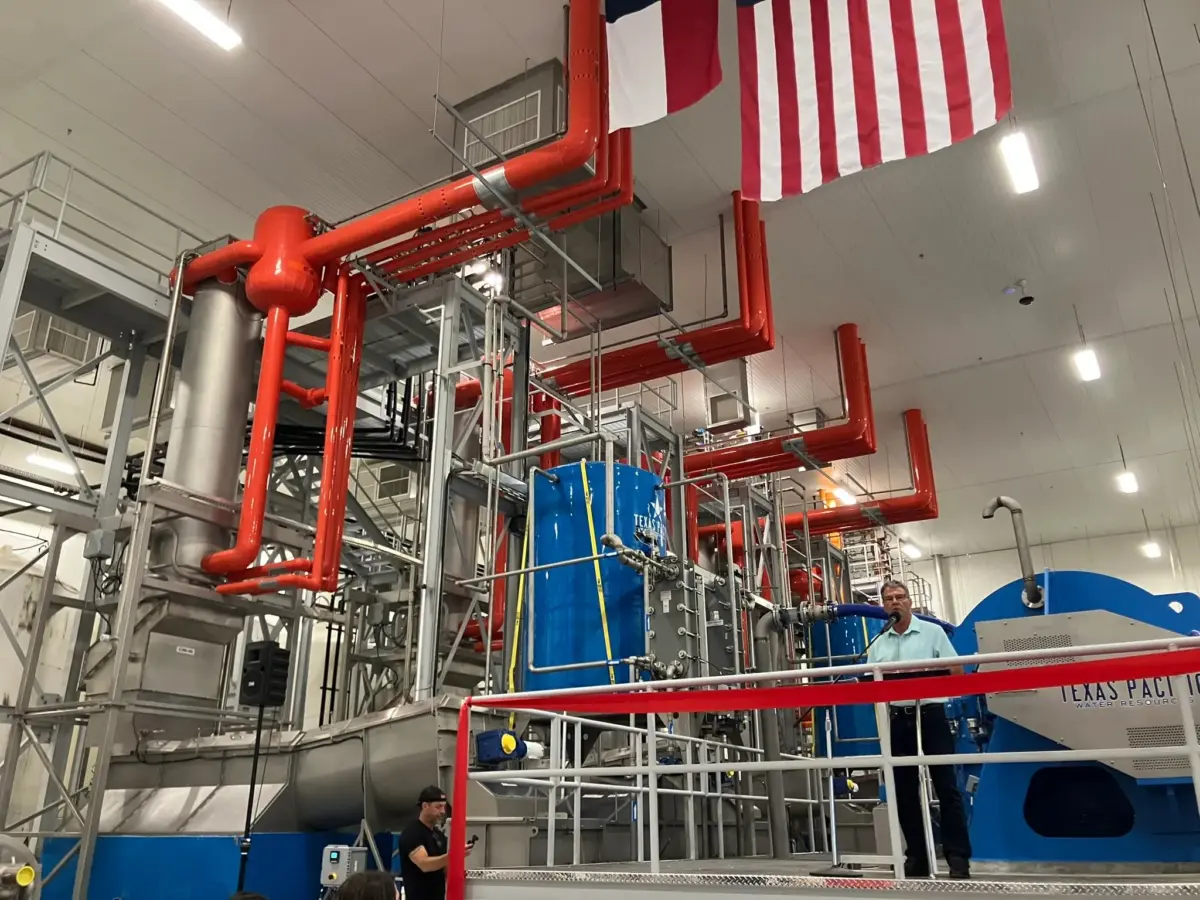
- August 2026: Texas Pacific Water Resources hosts a ribbon-cutting ceremony for its state-of-the-art freeze desalination plant in Orla, Texas, just as the Texas Senate Natural Resources Committee convenes in Austin and the Produced Water Society holds its annual conference in Midland.
Supporting Data: The Scale of the Permian Waste Stream
The numbers defining the Permian Basin’s water dilemma highlight an infrastructure crisis of monumental proportions:
- 1 Billion Gallons: The approximate volume of produced water generated daily by oil and gas operations in the Permian Basin.
- 10,000 Barrels (420,000 Gallons): The daily treatment capacity of Texas Pacific Water Resources’ newly opened freeze desalination facility in Reeves County.
- 5.5 Megawatts: The massive electrical load required to power the Orla desalination plant—enough energy to power several thousand homes, underscoring the immense energy-intensity of treating hyper-saline water.
- 50% Recovery Rate: The efficiency of the freeze desalination process, which yields half of the processed volume as reusable clean water and the other half as concentrated, highly toxic brine requiring continued underground disposal.
- 450 Public Comments: The volume of feedback received by the TCEQ regarding its proposed land-application rule, with an independent analysis revealing that over two-thirds of respondents opposed the measure.
Official Responses and Regulatory Friction
The tension between economic necessity and environmental caution took center stage during legislative hearings in Austin and industry panels in Midland.
Michael Lozano of the Permian Basin Petroleum Association painted a stark picture during testimony before the Texas Senate Natural Resources Committee. "We’re at this precipice," Lozano told lawmakers. "This is a large volume of water that we don’t have avenues for that we’re trying to rapidly create."
State Sen. Kevin Sparks (R-Midland), who chairs the committee and serves as an oil company director, emphasized the urgent need for regulatory speed. While acknowledging that the end product must be safe, Sparks stressed, "Timing is a critical issue at this point."
Railroad Commission (RRC) Commissioner Jim Wright echoed that urgency during a Senate hearing, publicly urging the TCEQ to finalize and issue workable permits immediately. "Continued delay could restrict oil and gas development across the Permian Basin," Wright warned.
However, the TCEQ has proceeded with caution, citing the unique and complex nature of the waste stream. Victoria Cann, a spokesperson for the agency, noted via statement that TCEQ crafts permits reflecting site-specific conditions. "Permits are drafted to ensure compliance with the Texas Surface Water Quality Standards and protective of drinking water, aquatic life, and other existing uses of the receiving waterway," Cann wrote.
During the Produced Water Society conference, TCEQ Commissioner Catarina Gonzales acknowledged that a few discharge permits were nearing the final stages of review, though she declined to name the applicants or provide a firm timeline for issuance.
Environmental advocates and policy groups, meanwhile, argue that regulators are bowing to industry pressure at the expense of public health. Julie Range, policy manager for the nonprofit Commission Shift, sharply criticized the rushed timeline during public commentary. "Let’s not trade one problem for another by hastily allowing unsafe waste fluids into our soils and into our rivers," Range warned, pointing out that TCEQ has yet to publish clear water quality thresholds for many of the hazardous compounds found in produced water.
Technological Innovation Meets Real-World Hurdles
While regulators debate policy in Austin, energy companies in the Permian Basin are deploying high-tech engineering solutions on the ground.
At the edge of the Chihuahuan Desert in Orla, Texas Pacific Water Resources has launched a freeze desalination facility utilizing technology described by research lead Adrianne Lopez Billings as a "massive ice maker." By freezing the water molecules, the system forces salts out into a separate brine stream.
Yet, innovation comes with steep costs. Desalination is exceptionally energy-intensive. To process a modest 10,000 barrels a day—a fraction of the billion gallons generated daily—the Orla plant requires 5.5 megawatts of electricity. As data centers and other heavy industries flock to the Permian Basin, water treatment facilities must compete for scarce electrical grid capacity and micro-turbine generators, making treatment significantly more expensive than traditional underground injection.
Furthermore, scientists caution that long-term data remains scarce. Recent peer-reviewed studies published in journals such as Irrigation Science and Separation and Purification Technology emphasize that while pilot projects show promise for agricultural reuse (such as irrigating alfalfa), the studies are limited to single growing seasons. Researchers argue that short-term laboratory experiments fail to capture the operational variability and cumulative environmental impacts of continuous wastewater application over years or decades.
Broader Implications for Texas
The outcome of the produced water debate will reverberate far beyond the oilfields of West Texas.
If the TCEQ successfully establishes a defensible, efficient permitting framework, Texas could pioneer a circular water economy, turning a troublesome industrial liability into a vital resource for drought-stricken regions, agricultural producers, and burgeoning industrial tech hubs like data centers. State Sen. Charles Perry (R-Lubbock) even joked at the Orla ribbon-cutting that he would be willing to drink the treated water himself once certified.
Conversely, if regulators rush the process without adequate scientific backing, Texas risks contaminating vital river watersheds, agricultural soils, and groundwater aquifers with benzene, heavy metals, and radioactive isotopes. Environmental groups like the Sierra Club Lone Star Chapter maintain that writing regulations before robust, multi-year research can inform them is fundamentally unreasonable.
As disposal caverns fill up and political drums beat louder in Austin, Texas sits at a definitive crossroads. The choices made by state regulators in the coming months will determine whether the Permian Basin’s water crisis is safely resolved or traded for an entirely new generation of environmental challenges.
