

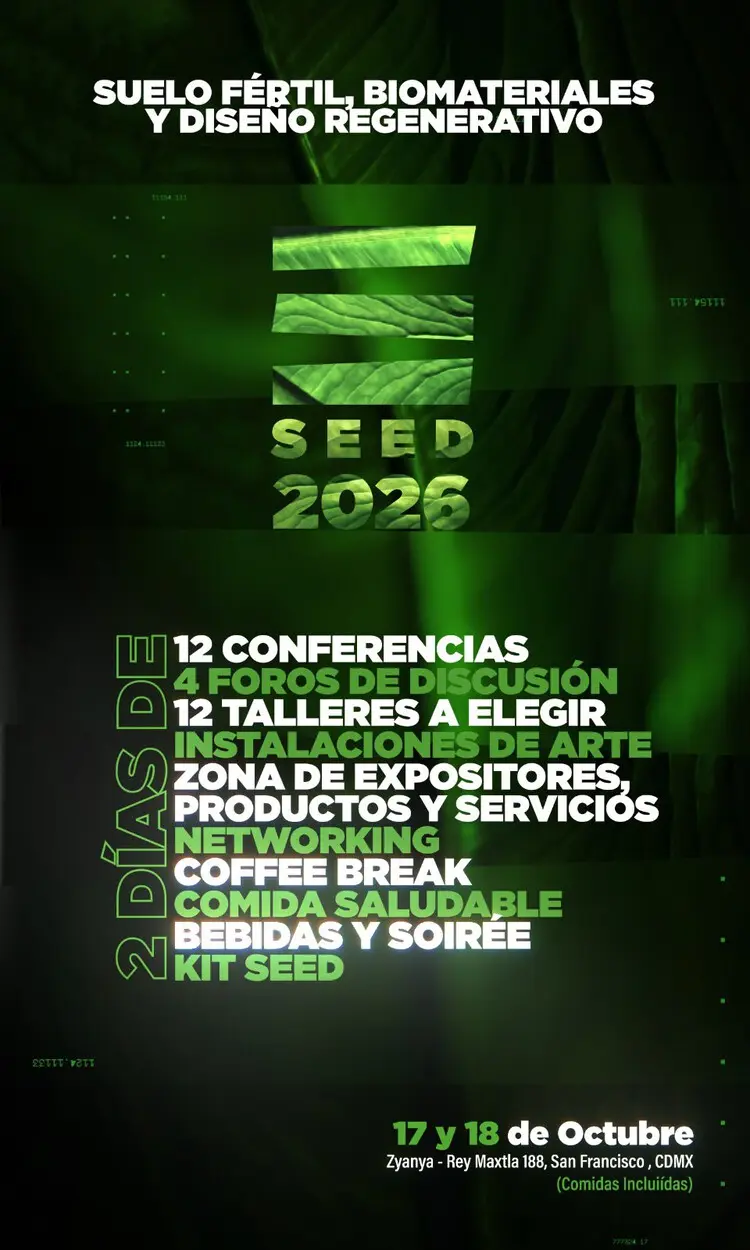
MEXICO CITY — As the global architectural landscape faces an urgent reckoning with climate change, resource depletion, and the carbon-heavy footprint of conventional construction, pioneering voices are looking backward to traditional wisdom and forward to cutting-edge technology. Enter SEED 2026, a premier international gathering dedicated to forging dynamic new relationships between territory, architecture, biomaterials, and regenerative systems.
Set to take place in the vibrant cultural and architectural hub of Mexico City, the second edition of this landmark event positions itself at the intersection of ecological survival and spatial design. Organized by the SEED Collective (Soil, Earth Regenerative Design)—a celebrated Mexican applied research laboratory renowned for its trailblazing work in earth construction, structural 3D printing, and earth-based concrete—the two-day symposium is designed to be more than a conference. It is a crucible for a growing international community, a living educational space, and a collaborative blueprint for a more sustainable built environment.
Main Facts: At the Core of SEED 2026
- Event Focus: Exploring the evolving paradigms connecting territory, architecture, biomaterials, and regenerative systems.
- Organizers: SEED Collective (Soil, Earth Regenerative Design), a Mexican applied research laboratory specializing in earth architecture, structural 3D printing, and earth-based concretes.
- Location: Mexico City, Mexico.
- Edition: The second annual gathering, scaling up its international reach and academic depth.
- Key Speakers: A multidisciplinary lineup featuring international luminaries such as Brazilian architects Marcelo Rosenbaum and Gabriela de Matos, Canadian regenerative agriculture educator Jean-Martin Fortier, visionary Mexican architect Javier Senosiain, and Andreea Dani, director of the Sustainable Architecture program at the Universidad del Medio Ambiente.
- Core Mission: To bridge ancestral building techniques with contemporary technological innovations, fostering a global network of practitioners committed to regenerative design.
Chronology: The Evolution of Regenerative Dialogue
The path to SEED 2026 reflects a broader, accelerating shift within the global architectural community—a transition away from sustainable mitigation toward active ecological regeneration.
Phase I: The Rise of Earth-Centric Research
Years before the inception of the SEED symposium, the founders of the SEED Collective recognized a profound disconnect between modern urban development and the local landscapes from which it extracted resources. Operating out of Mexico, the collective established an applied research laboratory. Their early work focused heavily on demystifying traditional earth construction systems—adobe, rammed earth, and cob—while simultaneously probing their compatibility with the 21st century.
Rather than viewing earth architecture as a relic of the past, the collective treated it as a high-tech material of the future. By experimenting with structural 3D printing and advanced earth-based concretes, they bridged the chasm between ancestral craft and computational design.
Phase II: Inception of the SEED Event Series
Recognizing that material innovation must be accompanied by community education and interdisciplinary dialogue, the collective launched the inaugural edition of the SEED gathering. Designed as a localized forum, the first event proved that there was a ravenous appetite among students, professionals, and specialists for radical alternatives to steel-and-glass hegemony. The symposium sparked crucial conversations about land stewardship, material sourcing, and socio-environmental responsibility.
Phase III: The Global Scale-Up (SEED 2026)
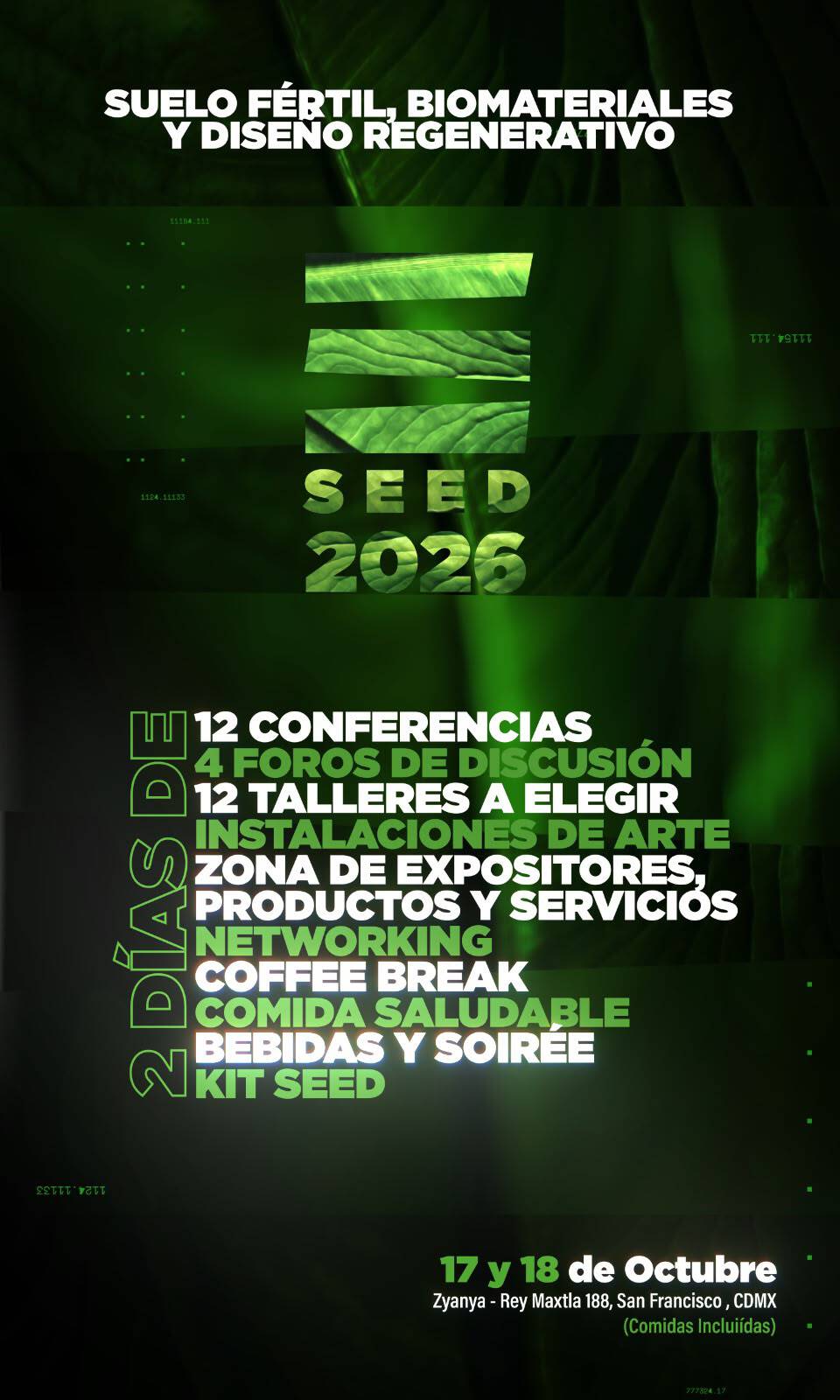
Building on the momentum of its predecessor, SEED 2026 marks a decisive leap forward. Scheduled for Mexico City, this second edition expands its programmatic scope, curating an elite international roster of speakers. By drawing experts from diverse fields—ranging from market gardening and social architecture to structural engineering and academia—the event transitions from a regional workshop into a major global milestone on the architectural calendar. It sets the stage for how the Global South can lead the conversation on planetary habitability.
Supporting Data: The Urgent Need for Regenerative Systems
The urgency underpinning SEED 2026 is anchored in stark environmental realities. According to data from the United Nations Environment Programme (UNEP), the building and construction sector accounts for roughly 37% of global energy-related carbon dioxide emissions and over 34% of global energy demand. Traditional materials like Portland cement and structural steel are among the leading industrial drivers of global warming, responsible for a staggering share of greenhouse gas emissions.
| Sector Impact Area | Conventional Material Standard | The SEED Alternative / Regenerative Approach |
|---|---|---|
| Primary Binder | Portland Cement (high carbon footprint, intensive thermal processing) | Earth-based concretes, stabilized soils, local clays |
| Construction Method | Linear extraction, heavy machinery, high waste output | Circular economies, structural 3D printing, biodegradable biomaterials |
| Land Relationship | Domination, fragmentation, and ecological displacement | Biophilic integration, regenerative agriculture, territorial stewardship |
| Socio-Cultural Value | Homogenized global aesthetics, outsourced labor | Celebration of vernacular heritage, localized community empowerment |
By replacing carbon-intensive binders with earth-based solutions and leveraging additive manufacturing (such as 3D printing with local soil), practitioners can dramatically slash embodied carbon. Furthermore, integrating principles from regenerative agriculture—championed by figures like Jean-Martin Fortier—ensures that architecture is no longer seen as a foreign object dropped onto a site, but rather as an active participant in healing local ecosystems, water tables, and biodiversity networks.
Official Perspectives and Key Speaker Lineup
The strength of SEED 2026 lies in its radical interdisciplinarity. The event rejects the siloed nature of traditional design conferences, instead bringing together architects, agronomists, educators, and social activists.
International Luminaries
- Marcelo Rosenbaum (Brazil): Renowned for his deeply human-centric design philosophy, Rosenbaum’s work consistently explores how architecture can honor local cultures, ancestral knowledge, and socio-environmental identity. His presence underscores the deep connection between cultural preservation and spatial design.
- Gabriela de Matos (Brazil): An influential voice in contemporary Brazilian architecture, de Matos brings a critical perspective on spatial justice, Afro-Brazilian heritage, and the social dimensions of urban territory. Her research challenges architects to consider who benefits from spatial development and how design can rectify historical inequities.
- Jean-Martin Fortier (Canada): A globally recognized authority on organic, human-scale agriculture and a leading figure in the Market Gardening movement. Fortier’s inclusion signals a vital conceptual bridge between the food we grow and the spaces we inhabit, emphasizing that regenerative design must encompass the entire living landscape.
Local Vanguard
- Javier Senosiain (Mexico): A legendary figure in Mexican architecture, Senosiain is the pioneer of Bioarchitecture (Arquitectura Orgánica). Famous for his awe-inspiring, fluid structures that mimic natural forms—such as the iconic Nautilus House—Senosiain’s lifetime of work proves that human habitats can grow organically out of the earth without disrupting natural ecosystems.
- Andreea Dani (Mexico): As the director of the Sustainable Architecture program at the Universidad del Medio Ambiente (University of the Environment), Dani bridges academic theory with practical application. Her work focuses on educating the next generation of designers to view architecture not as a finished product, but as an ongoing metabolic relationship with the environment.
Organizers from the SEED Collective note that the collective expertise of these speakers creates an indispensable framework: "Architecture cannot be solved by architecture alone. To build regeneratively, we must look to the soil beneath our feet, the food we cultivate, and the social fabrics that bind our communities together. SEED 2026 is our shared platform to rewrite the rules of how we inhabit the earth."
Implications: What SEED 2026 Means for the Future of Architecture
The convening of SEED 2026 in Mexico City carries profound implications for the global architectural discourse. For decades, the epicenter of architectural innovation was heavily concentrated in Western metropolitan hubs, often exporting energy-intensive glass-and-steel typologies wholly unsuited to local climates.
By anchoring this international dialogue in Mexico City—a metropolis grappling with acute water scarcity, urban density, and rich vernacular traditions—the narrative shifts. The Global South is firmly asserting its role as a leader in ecological innovation.
1. Redefining Materiality in Professional Practice
The insights shared by the SEED Collective and its international guests will challenge architectural firms worldwide to rethink their specification sheets. As building codes gradually evolve to accommodate alternative materials, the techniques showcased at SEED—ranging from robotic earth-printing to clay-stabilized structures—will move from the fringes of experimental labs into mainstream commercial and residential projects.
2. Educational Transformation
Institutions like the Universidad del Medio Ambiente are proving that environmental education must fundamentally overhaul traditional studio pedagogy. By prioritizing ecological literacy, territorial awareness, and hands-on material science, events like SEED help reshape university curriculums globally, ensuring that graduating architects are equipped to face the climate realities of the 21st century.
3. Fostering a Global Solidarity Network
Ultimately, SEED 2026 is about community. Climate change respects no borders, and neither should the solutions to it. By bringing together Canadian agriculturalists, Brazilian social architects, and Mexican earth-builders, the symposium establishes a transnational network of mutual aid, research sharing, and collaborative action.
As the architectural world watches Mexico City this year, the message is clear: the future of design is not about conquering nature through technological might, but about listening to the earth, respecting our territories, and building a regenerative future from the ground up.
