


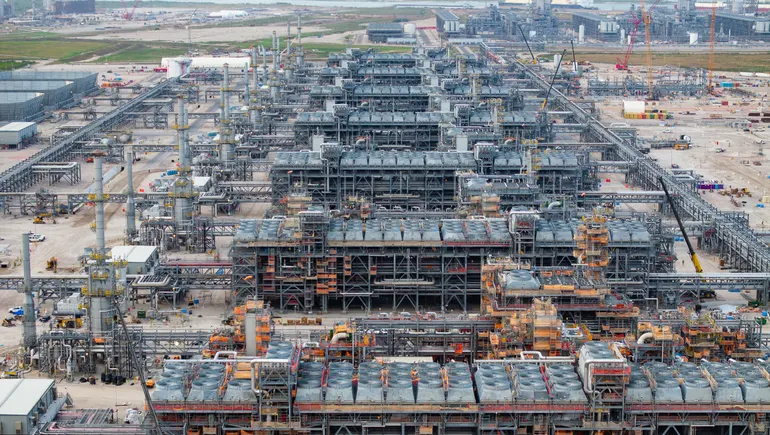
GREGORY, Texas — In a landmark achievement for both American heavy industrial construction and the global energy market, engineering and construction giant Bechtel has officially reached substantial completion on Stage 3 of the Corpus Christi Liquefaction Project. Announced on September 8, 2026, the milestone marks the formal handover of the final liquefaction train from the Reston, Virginia-based contractor to plant owner Cheniere Energy, underscoring the growing strategic dominance of U.S. liquefied natural gas (LNG) on the world stage.
The successful delivery of the massive infrastructure project in Gregory, Texas, highlights Bechtel’s increasing focus on LNG facilities as a primary driver of work, revenue, and technological innovation. As geopolitical tensions strain traditional energy corridors across the globe, mega-projects like Corpus Christi Stage 3 are transforming the United States into an indispensable anchor for international energy security.
Main Facts: The Corpus Christi Stage 3 Completion
The core of this milestone centers on the transition of care, custody, and control of the seventh and final liquefaction train from Bechtel to Cheniere Energy on August 28, 2026. With all seven trains now operational or ready for commercial integration, the Stage 3 expansion dramatically increases the facility’s production footprint.
- Capacity Expansion: The completion of Stage 3 expands Cheniere’s overall LNG production capacity at the Corpus Christi site by more than 20%.
- Total Output: The plant’s total nominal production capacity now reaches approximately 56 million tonnes per annum (MTPA).
- Timeline: Bechtel originally broke ground and commenced construction on the third stage in 2022, executing a complex engineering, procurement, and construction (EPC) mandate through shifting macroeconomic and supply chain environments.
Cheniere Energy, the leading producer of LNG in the United States, noted that the integration of the final train fortifies its operational network along the Gulf Coast. The facility utilizes cutting-edge cryogenic liquefaction technology to supercool natural gas into a liquid state, reducing its volume by 600 times for safe, efficient maritime transport to international markets.
Chronology: From 2022 Groundbreaking to Final Handover
The journey to substantial completion at Corpus Christi Stage 3 is the result of years of meticulous planning, heavy logistical coordination, and precise execution.
2022: Project Launch
Following earlier successes with Cheniere’s initial phases at Corpus Christi, Bechtel was awarded the EPC contract for Stage 3. Construction officially commenced in 2022, bringing thousands of skilled tradespeople, engineers, and project managers to San Patricio County, Texas.
2024–2025: Progressive Commissioning
As modular components were fabricated and shipped to the site, Bechtel began the phased commissioning of the facility’s extensive infrastructure, which includes massive refrigerant compressors, gas-turbine generators, cryogenic heat exchangers, and extensive storage and marine loading docks.
August 28, 2026: Substantial Completion
Bechtel formally transferred operational control of the seventh and final liquefaction train to Cheniere Energy. This milestone concluded years of continuous site work, safety milestones, and environmental compliance monitoring, cementing the project’s status as one of the most successful large-scale industrial deliveries of the decade.
Supporting Data: Bechtel’s Dominance in U.S. LNG Infrastructure
Bechtel’s recent triumph in Gregory is part of a broader, multi-billion-dollar portfolio of LNG projects that has positioned the firm at the apex of the global energy construction sector. Consistently ranked among the nation’s largest contractors by revenue, Bechtel has doubled down on hydrocarbon infrastructure designed to export cleaner-burning natural gas overseas.
The Cheniere Partnership
The relationship between Bechtel and Cheniere extends far beyond the Texas coast. In May 2026, Bechtel secured a massive $4.69 billion contract to execute the expansion of Cheniere’s Sabine Pass LNG plant located in Cameron Parish, Louisiana. This project will further enlarge U.S. export capacities and demonstrates Cheniere’s institutional trust in Bechtel’s execution model.
The Texas Gulf Coast Hub: Rio Grande LNG
Texas continues to serve as the epicenter of Bechtel’s industrial construction activities.
- June 2025: Owner NextDecade awarded Bechtel an additional $9 billion worth of work at the sprawling Rio Grande LNG project, building upon the initial $12 billion contract secured for the project’s first phase.
- September 2025: NextDecade officially reached financial close on Train 4 of the Rio Grande project—a critical segment of construction valued at $4.77 billion for the contractor.
These concurrent mega-projects require unprecedented amounts of steel, specialized electrical wiring, heavy-lift crane mobilization, and a workforce numbering in the tens of thousands.

Official Responses: Industry Leaders Weigh In
Executives from both Cheniere Energy and Bechtel emphasized the broader significance of the Corpus Christi milestone, framing it not merely as a corporate victory, but as a vital contribution to global stability.
"This achievement enables us to increase our supply of much-needed secure, reliable and affordable energy to the world at a critical time, while delivering on our commitments to our customers and creating long-term value for our stakeholders," said Jack Fusco, Cheniere’s Chairman, President, and CEO, in the official press release.
Industry analysts have noted that Cheniere’s ability to bring major trains online ahead of or on schedule reinforces its reputation for disciplined project execution—a rarity in an era marked by inflationary pressures and labor shortages across the construction sector.
Bechtel leadership echoed these sentiments, pointing to the collaborative partnership with Cheniere as a blueprint for executing complex, multi-billion-dollar energy infrastructure safely and efficiently.
Implications: Geopolitical Shifts and Global Energy Security
The timing of the Corpus Christi Stage 3 completion is deeply intertwined with a volatile geopolitical landscape that has upended traditional energy trade routes across the globe.
Mitigating Global Supply Disruptions
In recent months, escalating conflicts have threatened critical energy bottlenecks. Notably, ongoing hostilities involving Iran have severely constrained the ability of oil and gas tankers to navigate the Strait of Hormuz—a vital chokepoint through which a significant percentage of Middle Eastern petroleum and LNG transit. According to reports from CNBC, disruptions in the region have left millions of barrels of oil and vast quantities of energy supplies vulnerable, causing sudden spot-market volatility.

Against this backdrop, the influx of reliable U.S. LNG volumes from facilities like Corpus Christi Stage 3 acts as a vital stabilizing force. European and Asian allies, eager to diversify their energy portfolios and reduce exposure to volatile Middle Eastern shipping lanes, view American export terminals as essential lifelines.
Economic and Environmental Impact Domestically
From an economic standpoint, the completion of Stage 3 ensures sustained high-wage employment in South Texas, bolstering local economies through property taxes, supply chain spending, and service industry growth.
While natural gas remains a fossil fuel, proponents argue that U.S. LNG exports play a transitional role in global decarbonization efforts. By supplying natural gas to nations seeking to phase out coal-fired power generation, American exporters help lower aggregate greenhouse gas emissions on a global scale while bridging the gap toward renewable energy integration.
The Road Ahead
As Bechtel turns its full attention toward executing its expanding backlog—including the Sabine Pass expansion in Louisiana and ongoing phases at the Rio Grande LNG project—the engineering firm remains at the forefront of the global energy transition. The successful delivery of Corpus Christi Stage 3 proves that American engineering, combined with world-class project management, can successfully meet the immense demands of an uncertain and rapidly evolving world.
