

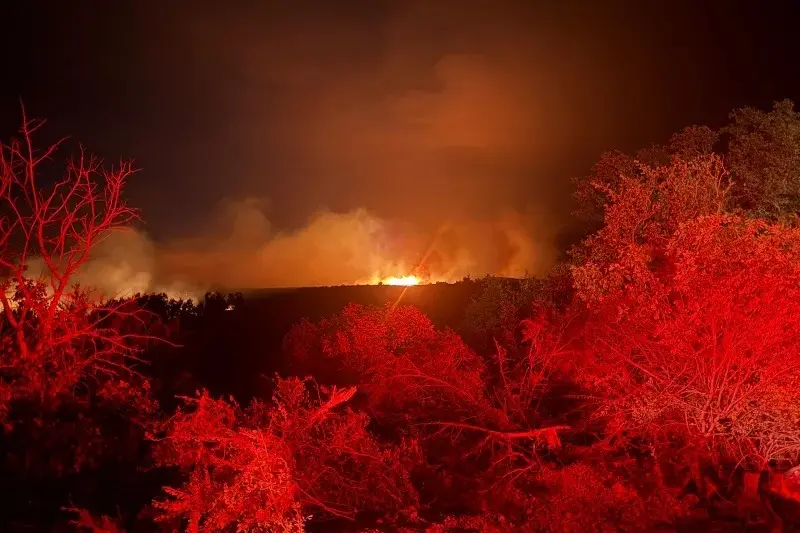
NORTH TEXAS — After two agonizing weeks of battling an unrelenting blaze across parched ranchlands, firefighters received a long-awaited and desperately needed respite on Thursday. Rain fell over and around the massive Ross Fire, providing a brief yet critical window for exhausted crews working tirelessly to contain the flames.
While the downpour was fleeting, meteorologists and emergency officials hope the precipitation will dampen active firelines, subdue lingering embers, and accelerate containment efforts on what has quickly become one of the most destructive and expansive wildfires in North Texas history.
Yet, as crews catch their breath, the shadow of a historic drought and extreme weather conditions continues to loom large over Palo Pinto and Jack counties. With thousands of acres scorched, dozens of structures lost, and historical landmarks impacted, the Ross Fire serves as a stark reminder of the escalating vulnerability of the Lone Star State to extreme weather events.
Main Facts: The Scope and Impact of the Ross Fire
As of mid-September, the Texas A&M Forest Service reported that the Ross Fire had consumed an astonishing 90,400 acres across Palo Pinto and Jack counties. Thanks to a combination of strategic tactical deployments and recent weather shifts, the fire has reached approximately 76% containment.
However, the sheer scale of the fire—spanning nearly 141 square miles—presents monumental challenges for suppression efforts.
- Historical Context: The Ross Fire now stands as the second-largest wildfire in North Texas history. It is eclipsed only by the infamous Possum Kingdom Complex Fire, which charred 126,734 acres in April 2011.
- Property and Infrastructure Damage: Initial assessments by firefighting teams indicate that at least 157 structures have been destroyed, including 18 occupied residences. Among the damaged properties is Worth Ranch, an 800-acre historic Scouting America camp situated along the Brazos River, though the full extent of the damage to the property remains under evaluation.
- Casualties: Despite the extreme behavior of the fire—including mass tree torching driven by erratic winds—only two minor injuries have been reported among firefighting personnel. One involved a minor hand injury sustained during a traffic collision, while the other was a minor eye injury treated immediately on-site.
- Wider Threat: The Ross Fire is not burning in isolation. Statewide, the Texas A&M Forest Service has tracked nearly 85 active fires scorching a combined total of more than 99,400 acres, underscoring a severe statewide wildfire crisis driven by unrelenting heat and bone-dry terrain.
Chronology: From a Spark Along the Road to a 90,000-Acre Inferno
The timeline of the Ross Fire is a testament to how quickly a spark in dry brush can evolve into a catastrophic regional emergency.
August 24–26: Explosive Initial Growth
The fire originated on August 24 near Palo Pinto, sparked by equipment or a vehicle along a roadway, according to investigators from the Forest Service and local law enforcement. Fueled by dry grasses, steep rocky terrain, and fierce winds, the blaze exploded in size almost overnight.
By August 25, the fire had doubled in size within a matter of hours, surging to approximately 50,000 acres. Just 24 hours later, on August 26, the estimated footprint climbed past 80,000 acres. The rapid acceleration prompted urgent evacuation orders in parts of Jack County and voluntary advisories in Palo Pinto County.
Late August to Early September: Tropical Relief and Stalemate
As the fire raged into late August, the region anticipated relief from Tropical Storm Edouard. While the storm did not make direct landfall, it successfully injected humidity into the atmosphere and dropped temperatures into the 90s. This weather shift proved vital, allowing firefighters to boost containment from a meager 38% up to 57%.
Entering September, however, progress slowed. Firefighters faced intense hotspots where radiant heat made ground attacks nearly impossible. Helicopters were deployed to drop thousands of gallons of water on burning timber and logs, but the threat of reburn from scorched debris remained a constant danger amid strong southeasterly winds.
Mid-September: The Breakthrough Rain
On Thursday, September 10, localized showers and thunderstorms finally moved over the fire zone. According to the National Weather Service (NWS) office in Fort Worth, these storms brought gusty winds, lightning, and slightly cooler temperatures—a welcome, if temporary, break for crews who have spent a fortnight on the front lines.
Supporting Data: A Bone-Dry August and Environmental Fallout
The severity of the Ross Fire cannot be decoupled from the extreme meteorological conditions plaguing North Texas.
A Historic Drought
The Dallas-Fort Worth region endured a punishing, bone-dry August, cementing the month as the driest August on record for the area. By the time the rains arrived on Thursday, it had been more than 55 consecutive days since the region experienced measurable precipitation—marking the seventh-longest dry spell in local recorded history.
Compounding the lack of moisture, relentless triple-digit heatwaves have baked the soil and vegetation, turning local ranchlands into a literal tinderbox. NWS forecasters warn that high temperatures hovering near the 100-degree mark will persist over the coming days, keeping baseline wildfire risks elevated.
Air Quality and Public Health
The massive plume of smoke generated by the Ross Fire has drifted steadily eastward and southeastward across North Texas, casting an eerie, orange haze over urban and rural communities alike.
State environmental regulators issued advisories warning that the heavy particulate matter has severely degraded local air quality. Vulnerable populations—including children, the elderly, and individuals with chronic respiratory conditions such as asthma—were strongly advised to remain indoors to avoid health complications.
Official Responses: Government Action, Evacuations, and Recovery
State and local leaders have mounted a multi-layered response to manage the crisis, protect human life, and prepare for the long road to recovery.
State Leadership and Federal Aid
Governor Greg Abbott took proactive steps early in the crisis, announcing on August 25 that the Federal Emergency Management Agency (FEMA) had approved a Fire Management Assistance Grant (FMAG) for the Ross Fire. This critical federal authorization provides financial assistance to local and state agencies, reimbursing eligible firefighting and emergency response costs.
Speaking on the disaster response, Governor Abbott urged residents to prioritize personal safety above all else:
"To all families out there affected or maybe not yet affected, our core message remains: protect your life. Don’t drive into [the fire]. Don’t drive near it. I know you may be wanting to get back to your home right now, but that could be very dangerous."
Abbott also promised that the state government would stand ready to assist communities with rebuilding efforts once the area is officially declared safe.
Emergency Management and Ground Operations
Texas Division of Emergency Management (TDEM) Chief Nim Kidd noted during a September 3 press conference that due to the complexity of the terrain and deep-seated hotspots, it could take up to two weeks of sustained effort to fully extinguish the blaze.
The multi-agency response has brought together an expansive coalition, including small rural volunteer fire departments closest to the ignition zone, municipal departments from the Dallas-Fort Worth metroplex, and specialized assets from the Texas A&M Forest Service.
Laura Stevens, a public information officer with the Forest Service, highlighted the dynamic nature of the firefighting operations:
"The fire is estimated at 90,000 acres, so there are going to be portions that may see rain, portions that may not see rain. It is an ongoing operation, very dynamic, very changing as the weather comes in."
Community Support and Evacuation Logistics
While mandatory evacuation orders in Jack County and voluntary advisories in Palo Pinto County have since been lifted as conditions improved, local officials continue to urge residents to remain vigilant and prepared to evacuate on short notice.
To support displaced residents and agricultural operators, emergency infrastructure was quickly mobilized:
- Evacuation Centers: Set up at locations such as the Jacksboro Twin Lakes Recreation Center.
- Livestock Relocation Centers: Established across the region to provide safe shelter for cattle, horses, and other farm animals displaced by the advancing flames.
- Infrastructure Closures: Portions of Texas Highway 254 remain closed to civilian traffic as heavy equipment and emergency response vehicles continue to utilize the corridor for containment operations.
Implications: Lessons Learned and Future Preparedness
As North Texas slowly works to put out the final embers of the Ross Fire, the disaster carries profound implications for the region’s future disaster preparedness and environmental outlook.
- Heightened Wildfire Vulnerability: The combination of historic dry spells, rising global temperatures, and rapid suburban and rural development in brush-heavy zones means North Texas can no longer view major wildfires as anomalies. Mitigation strategies, such as controlled burns, clearing defensible space around rural homes, and strict enforcement of burn bans, will need to be aggressively scaled up.
- Resource Strain: The simultaneous occurrence of nearly 85 active fires across Texas places immense strain on mutual-aid networks, volunteer fire departments, and state-level air assets. Expanding funding and recruitment for rural firefighting corps will be a critical legislative priority moving forward.
- Climate Resilience: With long-term meteorological models predicting continued volatility in precipitation patterns—characterized by prolonged droughts punctuated by sporadic, intense storms—water resource management and ecosystem resilience will take center stage in regional planning.
For now, the immediate focus remains on finishing the job. As showers taper off and the weekend approaches, firefighters on the ground and in the air continue to reinforce containment lines, ensuring that the Ross Fire is permanently relegated to the history books rather than threatening the future of North Texas communities.
