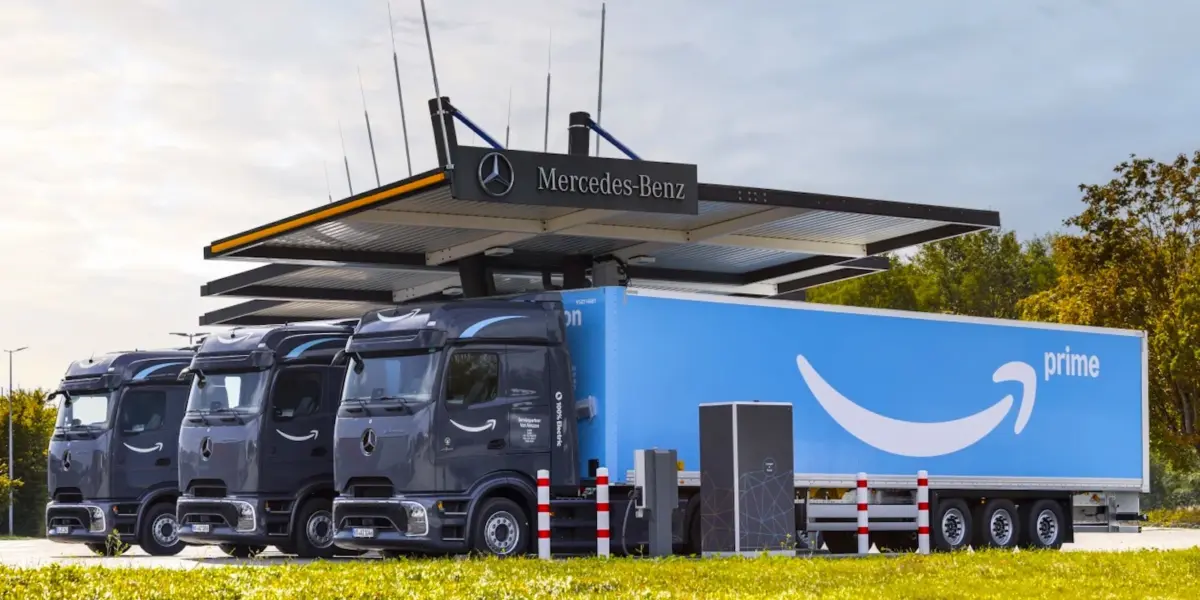
BERLIN — In a significant leap forward for corporate sustainability and heavy-duty freight electrification, retail giant Amazon has announced a monumental rollout of heavy-duty electric trucks in Europe. The company is actively integrating more than 50 Mercedes-Benz eActros 600 battery-electric semi-trucks onto German roads, with a targeted completion date before the close of 2026.
This ambitious deployment forms the vanguard of Amazon’s largest-ever heavy electric vehicle (EV) procurement initiative, which encompasses an order of more than 200 eActros 600 units. With the initial deployment of 26 trucks already navigating regional logistics corridors, Amazon is signaling that the era of zero-emission long-haul and middle-mile freight is no longer a distant theoretical goal, but a logistical reality.
Main Facts
The transition of heavy-duty commercial transport from fossil fuels to electricity has historically faced skepticism due to battery weight, payload constraints, and limited charging infrastructure. However, Amazon’s latest deployment aims to shatter these barriers by pairing state-of-the-art commercial EV engineering with robust corporate infrastructure investment.
The Fleet: Amazon is deploying over 50 Mercedes-Benz eActros 600 battery-electric semi-trucks in Germany by the end of 2026, kicking off a broader procurement pipeline exceeding 200 units.
The Vehicle Specs: Each eActros 600 is equipped with a massive 621 kWh battery pack, feeding proprietary Mercedes-Benz electric drive axles.
Operational Performance: The trucks boast an impressive real-world range of approximately 500 kilometers (310 miles) on a single charge, operating at an average combined vehicle weight of 36 metric tons (roughly 79,400 lbs).
Efficiency: The vehicles achieve an efficiency rating of approximately 1.61 kWh per mile under heavy loads, matching or exceeding theoretical benchmarks set by rival heavy-duty platforms—even when operating through punishing European winters.
Financial Commitment: The deployment is part of a broader corporate investment exceeding €1 billion aimed at decarbonizing Amazon’s European transportation network, with over €400 million specifically dedicated to German operations.
Chronology of the Transition: From Last-Mile Vans to Heavy Semis
To understand the significance of Amazon’s current heavy-duty rollout, it is necessary to examine the step-by-step evolution of the company’s fleet electrification strategy over recent years.
The Last-Mile Foundation (2020–2024)
Amazon’s initial foray into sustainable transport focused overwhelmingly on the "last mile"—the final delivery phase from urban distribution hubs to customer doorsteps. Through massive investments in custom electric delivery vans (most notably a multi-year partnership with Rivian), Amazon populated cities across North America and Europe with tens of thousands of light electric commercial vehicles. By mid-2026, the company’s global electric van fleet surpassed the 50,000 milestone.
Expanding the Middle Mile (2025–Early 2026)
While last-mile delivery successfully proved that light commercial routes could be electrified, the movement of bulk freight between fulfillment centers and regional hubs—the "middle mile"—remained heavily reliant on diesel-powered Class 8 semi-trucks.
Recognizing this bottleneck, Amazon began aggressively scaling its heavy-duty capacity. In early 2025, the company significantly expanded its Rivian van fleet while simultaneously scouting industrial heavy-truck manufacturers. By April 2026, Amazon partnered with autonomous and electric freight provider Einride to scale its electric semi-truck capacity. This momentum culminated in June 2026, when Mercedes-Benz published performance data showcasing the eActros 600 maintaining high efficiency while hauling 36-ton loads through adverse winter conditions in Germany.
The 2026 Milestone
Today, the rollout of the first 26 Mercedes-Benz eActros 600 trucks represents the culmination of years of pilot programs and infrastructure development. With the initial tranche now on the road and the remaining units scheduled for deployment by the end of the year, Amazon is effectively bridging the gap between urban last-mile delivery and heavy regional logistics.
Supporting Data: Infrastructure, Economics, and Scale
Electrifying heavy-duty freight requires much more than simply purchasing trucks; it demands a wholesale reimagining of logistics corridors, energy supply chains, and capital allocation.
Charging Architecture
To support the energy demands of the eActros 600 fleet, Amazon is installing hundreds of high-powered Direct Current (DC) fast chargers strategically across its operational footprint in Germany and wider Europe. These ultra-fast charging stations are engineered to replenish the trucks’ 621 kWh battery banks from 20% to 80% capacity in just over an hour. This rapid turnaround time ensures that vehicle downtime is minimized, allowing fleet operators to maintain tight delivery schedules comparable to traditional diesel operations.
Macroeconomic Impact
Amazon’s green transition is deeply intertwined with regional economic development. According to an independent analysis commissioned from Frontier Economics, Amazon’s investments in Europe’s low-carbon economy—including the €400 million earmarked for Germany—have generated profound fiscal benefits. The study estimates that these targeted sustainability investments have directly and indirectly supported over 35,000 jobs across Germany while contributing up to €3 billion to the national economy.
Official Responses and Corporate Perspectives
Leadership from both Amazon and Mercedes-Benz Trucks have emphasized that heavy transport decarbonization cannot be achieved in isolation; it requires deep cross-industry collaboration.
Andreas Marschner, Vice President of Sustainable Operations at Amazon, highlighted the strategic importance of the rollout:
"The handover of these vehicles is a milestone for the electrification of our transportation network. Electric solutions have already been widely used for some time in last-mile package delivery to customers. With the high-performance electric trucks from Mercedes-Benz Trucks, we can now make even longer transport routes between fulfillment centers and urban areas more sustainable. This is a true solution for the future."
Stina Fagerman, President of Mercedes-Benz Trucks Customer Region Europe, echoed these sentiments, pointing to the validation of heavy-duty EV technology:
"The fact that Amazon relies on our vehicles underscores the confidence in our technology and also shows that the electrification of heavy-duty transport is increasingly becoming reality. Such partnerships are crucial to further accelerate the transformation of the transport industry."
Implications for the Global Logistics and Freight Industry
The deployment of over 50 Mercedes-Benz eActros 600 trucks by a logistics titan like Amazon carries profound implications for the commercial vehicle market, regulatory compliance, and competing manufacturers.
1. Proof of Concept for Heavy Electrification
For years, critics argued that battery-electric powertrains were too heavy, expensive, and limited in range to handle the demanding duty cycles of 40-ton articulated lorries. By successfully deploying trucks capable of a 500-kilometer range while hauling heavy payloads through varying European weather conditions, Amazon and Mercedes-Benz are dismantling these lingering doubts. The real-world performance data generated by this fleet will serve as a baseline for other major industrial players looking to phase out internal combustion engines.
2. Intensifying Competition in the Electric Semi Market
The success of the eActros 600 in European operations adds intense competitive pressure to the global electric semi-truck market. As Mercedes-Benz proves its mettle against American and Asian alternatives—including the Tesla Semi and various Asian EV platforms—traditional truck manufacturers will be forced to accelerate their own zero-emission development pipelines to avoid losing market share to early movers.
3. Accelerating Infrastructure Mandates
Amazon’s deployment underscores the urgent necessity for public-private cooperation regarding grid capacity and charging infrastructure. As major corporations install hundreds of high-powered DC fast chargers for private use, pressure will mount on European governments to expand public mega-charging networks along major European transport corridors (such as the TEN-T network), ensuring that smaller fleet operators can also transition to electric freight.
4. Setting a Precedent for Global Fleets
As Amazon successfully scales its middle-mile electrification in Europe, industry analysts anticipate similar large-scale rollouts in North America and other key global markets. By proving that heavy transport decarbonization can be executed at scale without sacrificing operational efficiency, Amazon is establishing a new corporate benchmark for environmental responsibility in global supply chain management.