

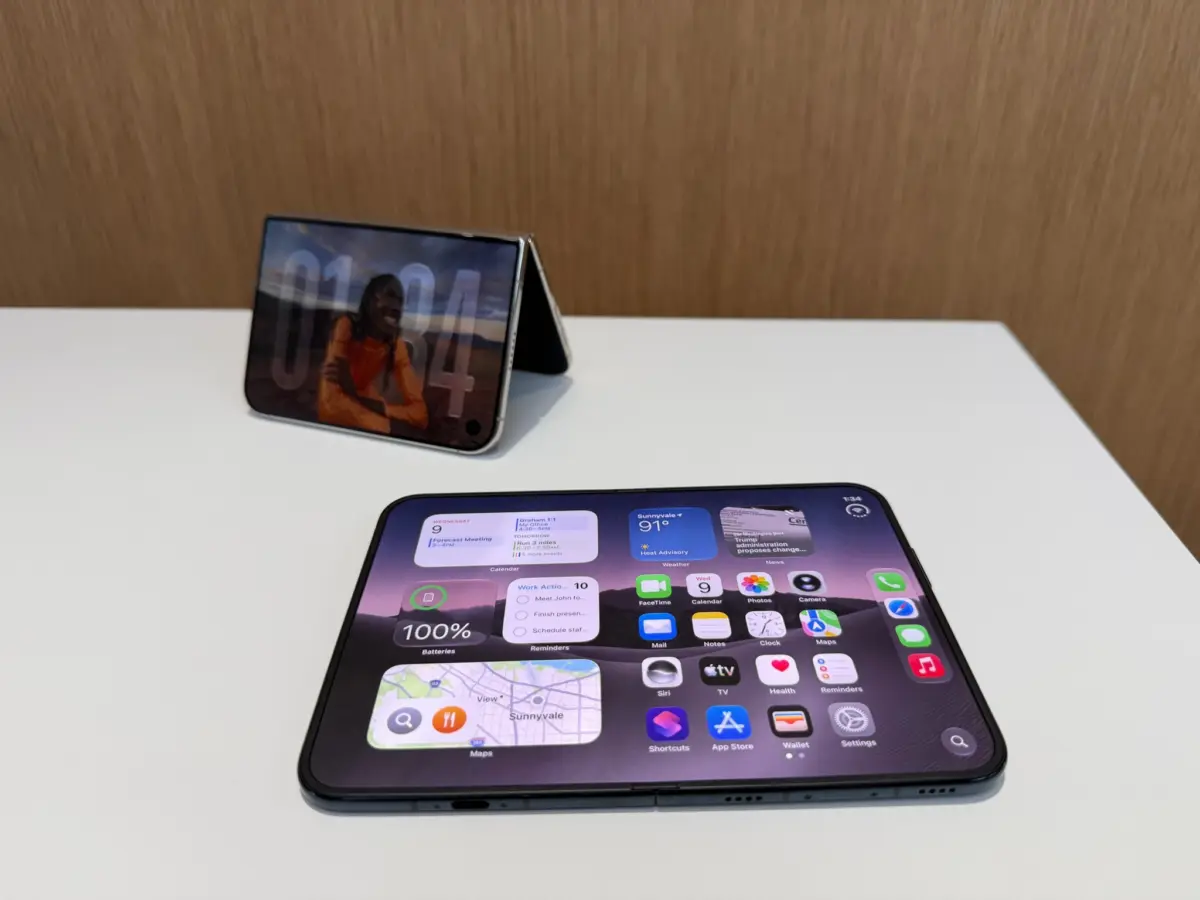
After months of swirling rumors, industry speculation, and sky-high expectations, Apple has officially entered the foldable smartphone market. Eschewing the heavily predicted "iPhone Ultra" moniker, the tech giant debuted its inaugural foldable handset under a new name: the iPhone Duo.
Priced starting at $1,999 for the 256GB base model, the iPhone Duo enters a mature, highly competitive landscape. To understand how Apple’s debut foldable stacks up against the reigning heavyweight, we must pit it against Samsung’s ultra-premium offering, the Galaxy Z Fold 8 Ultra.

Main Facts: The Tale of Two Foldables
The introduction of the iPhone Duo marks a watershed moment for Apple, yet the device itself makes distinct design and hardware compromises. Skipping the "Ultra" tier feels deliberate; while the Duo is undeniably a luxury device, it lacks a dedicated telephoto camera and features a more modest battery footprint than Apple’s traditional flagship, the iPhone 18 Pro Max.
Instead, the iPhone Duo leans into a compact, palm-friendly form factor. It features a squat 5.4-inch OLED cover display and a sprawling 7.6-inch inner screen. Its closest conceptual rival in Samsung’s ecosystem is the standard Galaxy Z Fold 8, but it is the Samsung Galaxy Z Fold 8 Ultra—priced at $2,100—that serves as the true technological battleground for high-end foldable supremacy.

Key Comparative Specs at a Glance:
- Starting Price: iPhone Duo ($1,999) vs. Galaxy Z Fold 8 Ultra ($2,100).
- Form Factor: Duo utilizes a squat, pocketable build; Z Fold 8 Ultra mirrors the tall, narrow dimensions of a standard "slab" phone when closed.
- Durability: iPhone Duo boasts an impressive IP68 water and dust resistance rating; Z Fold 8 Ultra settles for an IP48 rating (water-resistant, but lacking dust/sand protection).
- Ecosystem/Charging: Duo features native MagSafe and Qi2 wireless charging up to 25W; Z Fold 8 Ultra requires a specialized magnetic case to achieve similar magnetic accessory compatibility.
Chronology: From Rumor Mill to Retail Release
The journey to the iPhone Duo has been a long time coming, characterized by years of industry delays and cautious engineering from Apple.
- Late 2023 – Early 2025: Persistent leaks suggested Apple was prototyping inward-folding devices, with analysts universally predicting the branding would follow the company’s established nomenclature: "iPhone Ultra."
- Mid-2025: Supply chain reports indicated that Apple had finalized its panel sourcing, choosing specialized matte, nano-texture displays to combat the perennial foldable bane: the screen crease.
- Wednesday (Launch Day): Apple officially unveiled the iPhone Duo, surprising analysts with the nomenclature shift and outlining its specifications.
- October 16: Official preorders for the iPhone Duo kick off globally.
- October 23: The official retail release date for the iPhone Duo, putting the device directly into consumer hands.
- Current Status: Meanwhile, the Samsung Galaxy Z Fold 8 Ultra is already available on store shelves, having launched earlier in the product cycle.
Supporting Data: Design, Display, and Performance Breakdown
When comparing the hardware of these two heavyweights, the philosophy of each manufacturer becomes immediately apparent.

Design and Displays
The iPhone Duo measures a compact 5.4 inches on its outer OLED cover display, opening up to a 7.6-inch inner canvas. The Galaxy Z Fold 8 Ultra adopts a more conventional book-style silhouette, featuring a taller 6.5-inch cover screen and an expansive 8.0-inch inner AMOLED display.
Apple’s standout engineering achievement here is its matte, nano-texture inner display. While Samsung relies on an anti-reflective coating, Apple’s physical matte finish does a superior job of mitigating harsh overhead glares and softening the visibility of the central screen crease.

However, Samsung claws back ground in physical dimensions and multitasking capability. The Z Fold 8 Ultra is exceptionally thin—measuring a razor-thin 4.1mm when open and 8.9mm closed—and weighs a mere 215 grams. The Duo is slightly thicker (5.2mm open, 11.3mm closed) and heavier at 254 grams. Furthermore, the Z Fold 8 Ultra’s wider canvas supports seamless three-app multitasking, whereas the Duo caps multitasking performance at two concurrent apps.
Durability Showdown
In a massive win for Apple, the iPhone Duo secures an IP68 rating, granting it full dust resistance and survival in up to 6 meters of water for 30 minutes. True dust resistance remains an extreme rarity in the foldable market (shared only by Google’s Pixel 11 Pro Fold). The Galaxy Z Fold 8 Ultra, by contrast, relies on a more fragile IP48 rating, leaving its hinges and internal mechanisms vulnerable to fine dust and sand particles.

Cameras and Optics
Because of its compact stature, the iPhone Duo makes noticeable compromises on the photography front. It features a dual rear camera system:
- 48-megapixel main camera
- 48-megapixel ultrawide camera
- Notable Omission: No telephoto lens.
- Front-facing: A 12-megapixel selfie camera on the cover and an under-display FaceTime camera inside.
The Galaxy Z Fold 8 Ultra flexes its photographic muscle with a triple-lens rear array borrowed directly from the elite Galaxy S26 Ultra:

- 200-megapixel wide-angle sensor
- 50-megapixel ultrawide sensor
- 10-megapixel telephoto sensor
- Dual 10-megapixel selfie cameras (one on each display)
Processor and Battery Life
Under the hood, the iPhone Duo runs on Apple’s proprietary A20 Pro chip, matching the horsepower found in the iPhone 18 Pro lineup. Samsung answers with Qualcomm’s formidable Snapdragon 8 Elite Gen 5 chip for Galaxy.
Battery performance metrics tell different stories. Apple rates the Duo for up to 24 hours of mixed dual-screen usage (or up to 31 hours of inner-screen video playback), supporting fast-charging up to 50% in roughly 20 minutes using a 60W adapter. Samsung counters with a physical 5,000 mAh battery capacity on the Z Fold 8 Ultra, ensuring all-day stamina.

Crucially, the Duo takes the crown in wireless convenience: it features built-in MagSafe and Qi2 wireless charging up to 25 watts. The Z Fold 8 Ultra lacks internal magnets, requiring a compatible third-party case to achieve similar magnetic accessory integration.
Official Responses and Market Positioning
Both Cupertino and Seoul are positioning their devices for distinct consumer segments, acknowledging that foldables are no longer a monolith.

Apple representatives emphasize the Duo’s unique ergonomic balance, designed deliberately to optimize both horizontal and vertical content consumption without forcing the user to constantly rotate the device. By choosing the name "Duo," Apple is signaling that this device bridges two distinct use cases—acting as a compact everyday phone when closed and a media-rich tablet when unfolded—while keeping the door open for a future, higher-end "Ultra" foldable down the road.
Samsung executives, meanwhile, lean into the "Ultra" pedigree. By carrying over the top-tier camera technology and processing power from the Galaxy S26 Ultra, Samsung is marketing its foldable not as a compromise device, but as an absolute powerhouse that sacrifices nothing in exchange for a flexible screen.

Implications for the Mobile Industry
The launch of the iPhone Duo alters the trajectory of the mobile industry in profound ways:
- Validation of the Foldable Form Factor: Apple’s entrance validates foldables as a permanent, mainstream tier of consumer electronics rather than a passing technological gimmick.
- The Durability Benchmark: By introducing an IP68 dust-resistant rating on its first foldable attempt, Apple has immediately raised the bar. Competitors like Samsung will face intense consumer pressure to match dust-proofing in their next-generation hardware.
- Ecosystem Lock-in: For millions of consumers deeply entrenched in Apple’s ecosystem—utilizing Apple Intelligence, Visual Intelligence, and MagSafe accessories—the iPhone Duo provides an immediate off-ramp from traditional slab phones without requiring them to abandon iOS.
Ultimately, choosing between the iPhone Duo and the Galaxy Z Fold 8 Ultra comes down to personal philosophy. If you value pocket-friendly compactness, rugged dust resistance, integrated MagSafe, and the seamless embrace of the Apple ecosystem, the iPhone Duo is a landmark achievement. If your priorities lie in expansive multitasking screen real estate, industry-leading camera zooms, and a slim slab-like profile when closed, Samsung’s Galaxy Z Fold 8 Ultra remains the productivity king.
