

By Pavel Polityuk
Additional reporting and editing by Mark Potter
KYIV — Facing an existential threat to its agrarian economy, the Ukrainian government is actively evaluating enhanced maritime insurance mechanisms to restore vital seaborne food exports. The initiative comes in the wake of an escalating campaign of Russian military strikes targeting commercial vessels and critical port infrastructure along the Black Sea coast.
According to statements released on Wednesday by leading agricultural organizations—including the Ukrainian Agribusiness Club (UCAB) and the Ukrainian Agrarian Council (UAC)—high-level discussions are underway between farming sector representatives, President Volodymyr Zelenskyy, and Prime Minister Denys Shmyhal. The primary objective is to find immediate ways to bypass the de facto blockade strangling Ukraine’s maritime trade, safeguard future planting campaigns, and prevent widespread bankruptcies among the nation’s agricultural producers.
Main Facts: The Black Sea Shipping Crisis and Economic Fallout
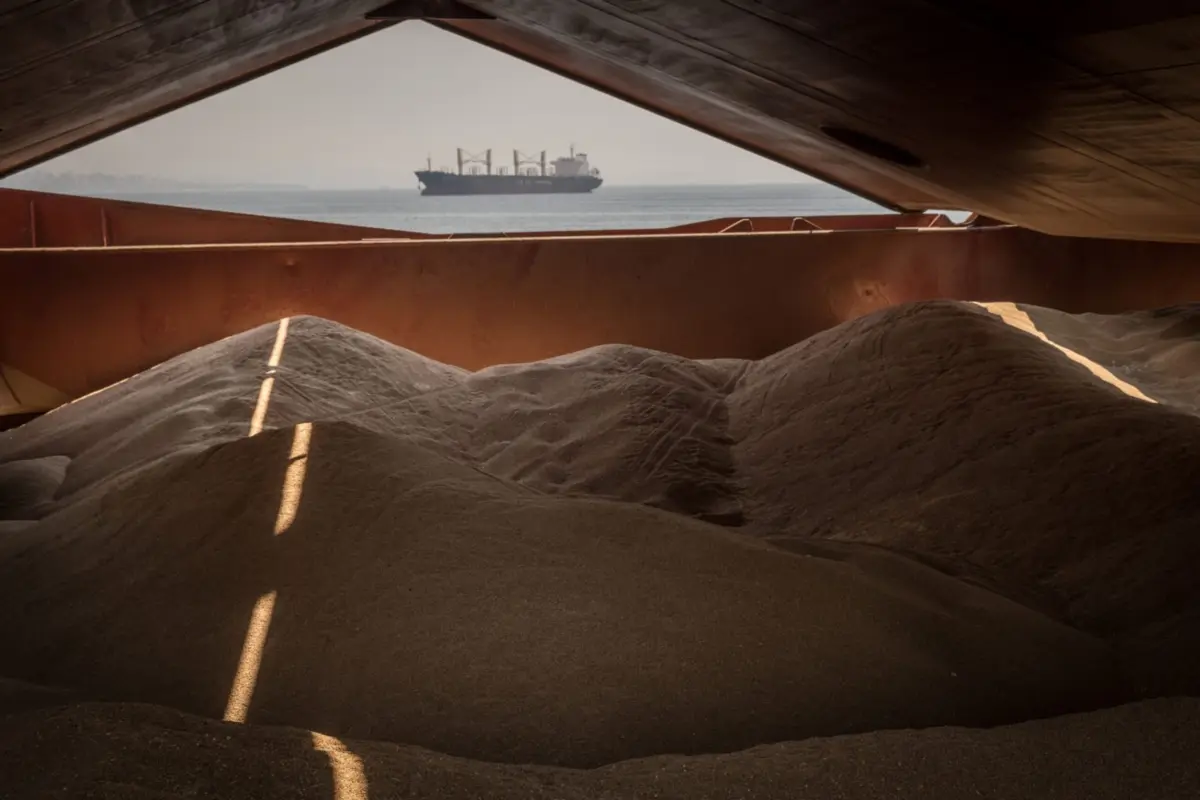
The war in Ukraine has long since transformed into a conflict of economic attrition, with global food security caught in the crossfire. Historically, Ukraine has functioned as one of the world’s premier agricultural breadbaskets, relying on its deep-water Black Sea ports to dispatch approximately 90% of its total export cargo.
However, a sharp escalation in Russian missile and drone attacks targeting Odesa-region ports and commercial shipping since the summer has effectively severed this maritime lifeline. While Kyiv has not officially suspended Black Sea shipping, the reality on the ground is stark: international shipowners, fearful for the safety of their crews and capital assets, are flatly refusing to send vessels into the Odesa transport hub.
The disruption has been catastrophic for Ukraine’s export-driven agricultural sector:
- Export Collapse: Outbound agricultural shipments have plummeted by roughly 60%.
- Storage and Price Crises: Ukraine routinely produces approximately three times more grain than it consumes domestically. With export corridors severely restricted, the country faces a looming crisis of exhausted grain-storage capacity, plunging domestic crop prices, and crippling cash-flow shortages for growers.
- Long-Term Threats: The inability to monetize current harvests is already jeopardizing the 2027 planting campaign and subsequent crop yields, threatening long-term agricultural productivity.
To counter these pressures, agricultural leaders and government officials are exploring two parallel tracks: expanding war-risk insurance cover to entice commercial shipping companies back to Black Sea ports, and establishing innovative financial instruments—such as grain-backed loans—to keep farmers solvent amid depressed local market conditions.
Chronology: From the Grain Corridor to the Current Stalemate
Understanding the urgency of Kyiv’s current deliberations requires examining the trajectory of Black Sea logistics since the onset of the full-scale Russian invasion in February 2022.
- Spring–Summer 2022: A Russian naval blockade completely halts Ukrainian maritime trade, trapping tens of millions of tons of grain in silos and triggering global food price shocks.
- July 2022: The Black Sea Grain Initiative, brokered by the United Nations and Turkey, is established. It creates a humanitarian maritime corridor, allowing millions of tons of Ukrainian agricultural products to safely reach international markets.
- July 2023: Russia unilaterally withdraws from the Black Sea Grain Initiative, subsequently intensifying attacks on Ukrainian port facilities in Odesa, Chornomorsk, and Pivdennyi, as well as Danube River ports.
- Late 2023: Demonstrating resilience, Ukraine establishes its own unilateral temporary shipping corridor hugged close to the western coast of the Black Sea. Concurrently, the Ukrainian government launches a state compensation scheme to cover vessel war damage, followed by the rollout of the "Unity Facility"—a specialized war-risk insurance mechanism developed in cooperation with global broker Marsh McLennan and Lloyd’s of London underwriters.
- Summer–Autumn 2024: Russia significantly escalates targeted strikes against civilian merchant vessels and port logistics, undermining confidence in the temporary corridor and driving insurance premiums to prohibitive levels.
- Present: With commercial shipping once again brought to a near-standstill, Kyiv convenes emergency consultations with agrarian lobbies (UCAB and UAC) to design enhanced insurance interventions and emergency liquidity measures.
Supporting Data: The Anatomy of Ukraine’s Agricultural Dependence
The numbers underscoring Ukraine’s agricultural crisis illustrate a macroeconomic vulnerability that extends far beyond national borders, directly impacting food security across the Middle East, Africa, and parts of Europe.
Production vs. Domestic Consumption
Ukraine’s agricultural output dwarfs its domestic requirements. While domestic consumption hovers near 15 to 20 million tons of grain and oilseeds annually, total production in typical years exceeds 60 million tons. This structural surplus means that external export markets are not merely a source of profit for Ukrainian farmers—they are an absolute operational necessity. Without an outlet for the surplus, domestic silos overflow within months.
The Export Deficit
- Pre-War Volume: Ukraine exported upwards of 50 to 60 million tons of agricultural commodities annually.
- Current Reduction: The 60% contraction in outbound shipments means millions of tons of unexported grain remain trapped inside the country, depressing local prices far below international parity indices. Farmers are effectively forced to sell at a loss—when they can find a buyer at all—due to the exorbitant logistics and insurance costs associated with alternative overland routes through Eastern Europe.
Existing Risk-Mitigation Frameworks
The financial architecture supporting Ukrainian maritime trade has evolved through several iterations:
- The State Compensation Fund: Established in 2023 by the Ukrainian government, this fund allocates dedicated capital to indemnify shipowners against physical damage sustained during attacks while operating in Ukrainian territorial waters.
- The Unity Facility: Launched in late 2023, this public-private partnership brings together the Ukrainian government, insurance giant Marsh McLennan, and Lloyd’s of London syndicates to provide affordable hull and protection-and-indemnity (P&I) war-risk insurance.
Despite these innovations, the sheer frequency and lethality of recent Russian strikes have outpaced existing coverage models, necessitating the new round of evaluations currently underway in Kyiv.
Official Responses and Stakeholder Perspectives
The discussions between government leaders and agricultural associations have brought to light the competing priorities and innovative solutions being weighed in the capital.
The Agribusiness Perspective (UCAB)
Following the high-level meeting with President Zelenskyy and Prime Minister Shmyhal, the Ukrainian Agribusiness Club (UCAB) issued a comprehensive report emphasizing that physical security and financial predictability remain the twin pillars of economic survival.
"The main challenge remains ensuring the safety of maritime transport and the stability of export corridors. The introduction of improved ship-insurance mechanisms was discussed," the UCAB report stated.
The lobby group underscored that without renewed confidence from international maritime insurers and shipowners, the Odesa port cluster will remain isolated, starving the national economy of critical foreign currency earnings.
The Agrarian Council’s Financial Proposal (UAC)
Recognizing that restoring full maritime trade will take time, the Ukrainian Agrarian Council (UAC) has advanced a complementary domestic proposal aimed at insulating primary producers from immediate bankruptcy: lending secured against stored grain.
Under this proposed mechanism, farmers would be permitted to utilize grain inventories held in certified domestic warehouses as tangible collateral for working-capital loans through partner commercial banks and state financial institutions.
- How it works: Rather than dumping their harvest onto a saturated local market at depressed prices just to pay off immediate debts, farmers can secure loans against the physical value of their stored crops.
- The benefit: This injects vital liquidity into the agricultural sector, allowing producers to service loans, pay wages, and purchase diesel and fertilizer for upcoming field operations while waiting for maritime export channels to normalize.
Implications: Global Food Security and Domestic Economic Stability
The outcomes of Kyiv’s current policy evaluations carry profound implications that stretch far beyond the borders of Eastern Europe.
Domestic Economic Survival
For Ukraine, the agricultural sector represents the backbone of the wartime economy. It accounts for a massive share of export revenues, employment, and rural economic activity. If systemic farmer bankruptcies take hold due to unhedged risks and trapped harvests, the ripple effects will debilitate the broader national economy, reducing tax revenues essential for funding state operations and defense.
Furthermore, the failure to secure financing and execute the 2027 planting campaign would create structural supply deficits lasting for years, turning a short-term logistical crisis into a multi-year agricultural depression.
Global Food Markets and Geopolitics
On the international stage, any prolonged disruption of Ukrainian grain and oilseed exports exerts upward pressure on global food prices. Developing nations in the Global South—particularly importers in North Africa and the Middle East—rely heavily on accessible Ukrainian wheat, corn, and sunflower oil. A continued maritime blockade threatens to renew food insecurity and price volatility in vulnerable regions, amplifying geopolitical instability worldwide.
The Future of Maritime War-Risk Underwriting
The discussions in Kyiv are also serving as a testing ground for modern marine insurance and conflict economics. The ability of governments, international brokerages (such as Marsh McLennan), and Lloyd’s syndicates to craft scalable, resilient war-risk frameworks under active fire will set a precedent for how international trade can be maintained in geopolitical conflict zones globally.
As deliberations continue between Ukrainian state authorities, agricultural unions, and international financial partners, the focus remains laser-focused on finding a workable synthesis of enhanced maritime risk-sharing and domestic financial scaffolding. Whether these measures can be implemented swiftly enough to rescue the current harvest and preserve the nation’s farming infrastructure will determine the trajectory of Ukraine’s economy—and millions of meals worldwide—in the months to come.
