

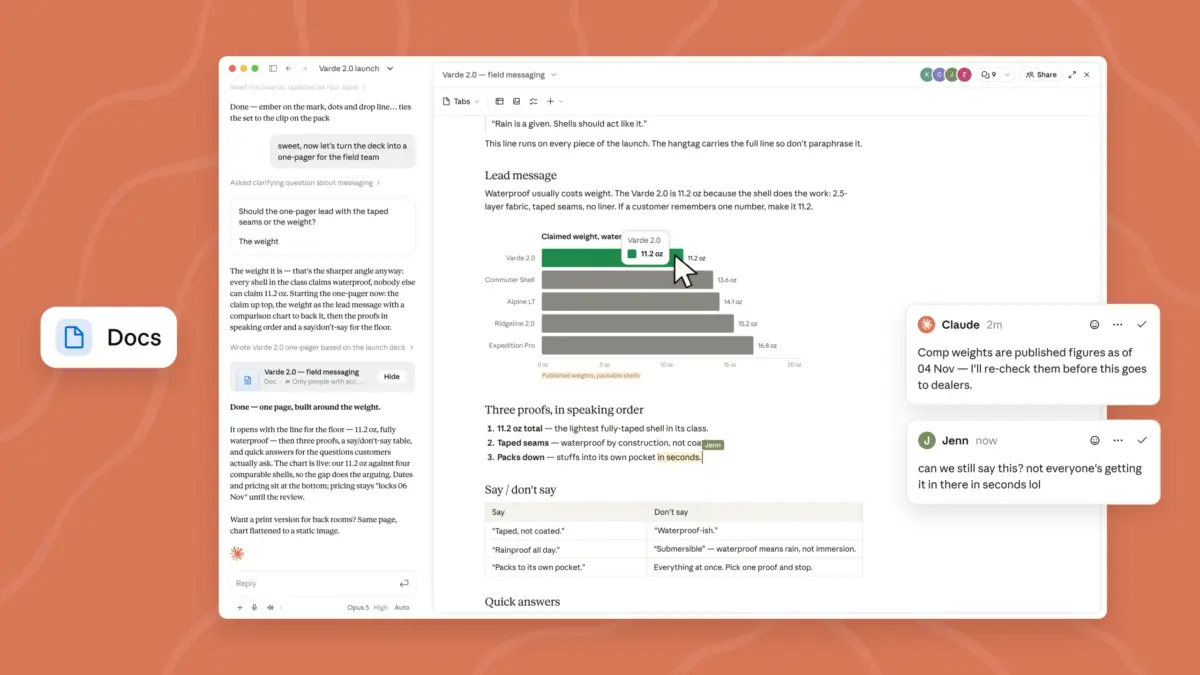
In a major strategic evolution that blurs the line between conversational AI and traditional office productivity software, Anthropic has announced the launch of Claude Docs and Claude Slides. Debuting in beta, these new creation tools allow users to generate structured documents and multi-slide presentations directly inside a Claude chat interface, complete with real-time collaboration features, manual editing capabilities, and seamless cross-platform sharing.
Alongside the introduction of Docs and Slides, Anthropic is fundamentally restructuring how users interact with its flagship AI. The company is phasing out isolated feature modes—merging standard chats, its Cowork functionality, and Claude Design into a unified ecosystem dubbed "One Claude."
This comprehensive update is designed to make Anthropic’s advanced artificial intelligence context-aware across all tasks. Instead of jumping between specialized windows, users can now prompt Claude from any conversation, and the system will intelligently determine whether a task requires a document, a presentation, or a design asset.
Main Facts: What is New in the "One Claude" Ecosystem?
The latest rollout introduces several sweeping changes to the Claude platform, transforming it from a text-based chatbot into a holistic digital workspace.
- Claude Docs (Beta): A native document creation tool that starts as a private workspace and supports real-time, multi-user collaboration. Much like Google Docs or Microsoft Word online, collaborators—including human users and Claude itself—can leave inline comments, edit text simultaneously, and view changes live.
- Claude Slides (Beta): A presentation generator capable of transforming natural language prompts into formatted slide decks. Users can ask Claude to adjust visual layouts, rewrite bullet points, or alter color palettes on the fly.
- "One Claude" Integration: Standard chat, Cowork, Artifacts, and Claude Design are now accessible from a single, unified interface. Anthropic claims the AI can now dynamically identify what a user’s task requires, applying the correct context, skills, and connectors automatically.
- Unified Link Sharing: Everything generated through Claude Design, Slides, or Docs is tied to a single, shareable web link that can be opened instantly across desktop, mobile browsers, and native applications.
- Rollout Timeline: The unified experience is rolling out initially to Pro and Max users across web, desktop, and mobile platforms over the coming weeks. Support for Team and Free tier users is scheduled to follow. Anthropic notes that the update happens automatically with "nothing to turn on."
Chronology: The Evolution of Claude from Chatbot to Productivity Suite
To understand the significance of Docs and Slides, it is helpful to trace how Anthropic has systematically expanded Claude’s capabilities over the past year.
1. The Conversational Era
Claude initially gained industry acclaim for its nuanced natural language understanding, robust coding assistance, and massive context windows. However, interactions were strictly confined to a single, vertical conversational stream where users had to copy-paste outputs into external word processors or presentation software.
2. The Introduction of Artifacts and Design
Anthropic took its first major step toward productivity integration by introducing Artifacts—a dedicated side-panel window that rendered code, scalable vector graphics, and text snippets independently from the main chat. This was soon followed by Claude Design, a creative editor offering layout controls, export options, and integrations that positioned Claude as a nascent competitor to design-centric platforms like Canva and Figma.
3. The Cowork Experiment and Fragmentation
As Anthropic experimented with specialized workflows, it introduced modes like "Cowork" to handle complex, multi-step tasks. While powerful, this created a fragmented user experience where individuals had to select specific modes depending on whether they wanted to chat, code, or build administrative assets.
4. The "One Claude" Convergence (Today)
With today’s announcement of Docs and Slides, Anthropic is officially retiring the era of siloed feature modes. By merging Cowork, Design, Docs, and Slides into a single conversational engine, the company has created an all-in-one platform where document creation and presentation building are treated as native extensions of dialogue.
Supporting Data and Competitive Landscape
The launch of Claude Docs and Slides arrives at a critical juncture in the generative AI wars. While Anthropic’s large language models are frequently rated by industry benchmarks and developer communities as matching—or occasionally surpassing—OpenAI’s GPT series and Google’s Gemini in raw reasoning and coding performance, the company has historically faced a massive distribution hurdle.
The Ecosystem Advantage
For enterprise and casual users alike, productivity software is deeply entrenched in platform ecosystems.
- Google Workspace: Google has aggressively integrated Gemini directly into Google Docs, Sheets, and Slides. Users can summon a Gemini sidebar to draft entire reports, reorganize spreadsheets, or generate slide themes without ever leaving their native cloud documents.
- Microsoft 365 Copilot: Microsoft has woven OpenAI-powered Copilot capabilities into Word, Excel, PowerPoint, and Teams, anchoring its AI directly inside corporate workflows.
By comparison, Anthropic previously relied on an "export-only" model. Users would ask Claude to write an essay or outline a slide deck, copy the text, and paste it into Microsoft Office or Google Docs.

Closing the Gap
Claude Docs and Slides directly target this friction point. By allowing users to generate, edit, and collaborate on office documents natively within the Claude interface, Anthropic is drastically reducing the incentive for users to switch windows.
Furthermore, data security and enterprise readiness remain cornerstones of Anthropic’s pitch. Organizations that rely on Claude for sensitive legal, financial, and coding tasks can now manage entire document lifecycles within a secure environment governed by enterprise-grade privacy controls.
Official Responses and Platform Mechanics
Anthropic’s engineering and product teams have emphasized that the primary goal of the "One Claude" update is to eliminate cognitive load for the user.
In its official release notes, Anthropic stated:
“Claude can now figure out what a task needs, so what Cowork and Design can do is available from any conversation, with the context, skills, and connectors you already have.”
How Collaboration Works in Practice
Under the hood, Claude Docs functions similarly to modern cloud-native text editors.
- Private by Default: Every document or slide deck starts in a private state visible only to the creator and Claude.
- Granular Sharing: Users can generate a secure link to invite co-editors.
- AI as a Collaborative Partner: Unlike traditional word processors where AI is a passive plugin, Claude acts as an active participant in the document. Users can highlight a paragraph and instruct Claude to rewrite it, shorten it, or translate it. Simultaneously, human editors can leave margin comments directed at either their human peers or Claude itself.
- Cross-Device Continuity: Anthropic has heavily optimized the mobile experience. Because every asset lives at a single shareable link, a presentation generated on a desktop workstation can be reviewed, tweaked, and presented directly from a smartphone or tablet.
Implications: What This Means for the Future of Work
The introduction of Claude Docs and Slides has profound implications for software developers, enterprise buyers, and everyday knowledge workers.
1. The Death of the Monolithic Office Suite?
For decades, Microsoft and Google have held a duopoly over office productivity because their applications (Word/Docs, Excel/Sheets, PowerPoint/Slides) were the ultimate destination for work. AI is fundamentally changing this dynamic. If an AI assistant can generate, format, and host documents and presentations natively, the underlying software suite shifts from being a creative canvas to a mere delivery mechanism. Users may increasingly care less about whether a file is saved in Google Drive or Microsoft OneDrive, and more about which AI generated the best content in the first place.
2. A Direct Challenge to Figma and Canva
With Claude Design already carving out space in visual layout creation, the addition of Slides positions Anthropic as a direct challenger to presentation tools like Canva, Gamma, and Pitch. By blending text generation, structured data processing, and visual styling into a single chat prompt, Claude appeals to time-strapped professionals who need clean, polished decks without manually fiddling with templates.
3. Workflow Consolidation for Power Users
For Pro and Max subscribers, the friction of context-switching is vanishing. Instead of opening a terminal to code, a browser tab to design graphics, and a word processor to write reports, users can conduct an unbroken train of thought that seamlessly morphs from conversation into fully realized digital deliverables.
Looking Ahead
As Anthropic rolls out Claude Docs and Slides over the coming weeks, the tech industry will be watching closely to see how enterprise users adopt these tools and how competitors respond. One thing is certain: the era of the standalone chatbot is officially over. The battle for the AI-powered digital workplace has entered its next, most aggressive phase.
