

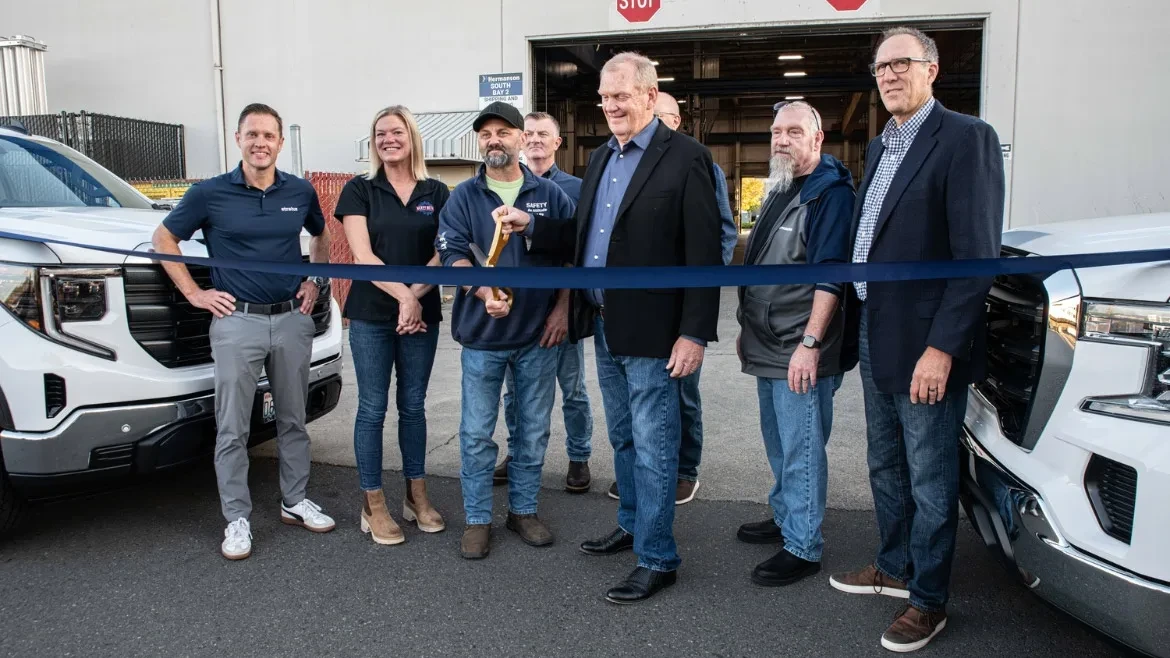
KENT, Washington — For modern mechanical contractors, growth is rarely just a matter of securing more contracts or hiring additional field personnel. As project scopes expand in complexity, geographic footprint, and technical demand, the traditional boundaries of construction are shifting from the job site directly into the controlled environment of the fabrication shop.
For the Hermanson Company, recognizing this paradigm shift meant confronting a fundamental operational bottleneck. The limitation wasn’t simply a matter of running out of physical room; it was about evolving to meet the demands of larger, more complex, and geographically dispersed projects. The company’s existing fabrication infrastructure could no longer keep pace with what needed to be accomplished before materials ever touched a job site.
The answer to this challenge was a massive, strategic scaling of Hermanson’s prefabrication capabilities. By opening a state-of-the-art facility in Kent, Washington—spanning tens of thousands of square feet and equipped with cutting-edge digital management tools—Hermanson has redefined how a mechanical contractor can support both regional and national operations. Yet, company leadership is quick to point out that square footage alone does not guarantee success. True prefabrication excellence requires an ecosystem of early decision-making, meticulous digital coordination, and an unwavering commitment to serving the field.
Main Facts: The Kent Facility and Strategic Expansion
At the core of Hermanson’s recent operational evolution is its new pipe fabrication shop in Kent, Washington. Designed to alleviate the constraints of the company’s previous workspace, the facility boasts an impressive physical footprint tailored for heavy industrial and commercial mechanical work:
- Fabrication Space: 81,800 square feet dedicated entirely to cutting, welding, assembling, and testing piping systems.
- Tradesmen’s Office: A 4,950-square-foot administrative and planning hub designed to bridge the gap between digital detailing and shop-floor execution.
- Pipe Yard: A sprawling 33,000-square-foot outdoor and staging yard allowing for efficient material handling, raw stock storage, and outbound logistics staging.
This expanded capacity fundamentally changes what Hermanson’s pipefitting teams can achieve. The facility empowers the company to take on complex piping scopes for a diverse portfolio of projects—ranging from regional commercial builds to expansive national developments—while shifting high-precision work away from hazardous or weather-dependent job sites and into a controlled shop environment.
Chronology: The Journey from Bottlenecks to Breakthroughs
To understand the necessity of the Kent facility, one must examine the operational trajectory that led Hermanson to this juncture.
Phase 1: The Constraints of Legacy Operations
In Hermanson’s previous, smaller fabrication shop, physical limitations dictated workflow limitations. Moving large, heavy pieces of pipe frequently brought production lines to a grinding halt. Fabricators and shop hands regularly found themselves losing valuable time waiting for overhead cranes to clear paths, or stalling operations until larger assemblies could be physically maneuvered out of the way to allow subsequent work to proceed.
Phase 2: The Shift in Market Demands
Simultaneously, the nature of Hermanson’s project portfolio was undergoing a radical transformation. The contractor’s work began shifting rapidly into hyper-specialized, highly regulated sectors. Modern data centers, complex battery manufacturing plants, isolated laboratory systems, and high-pressure industrial facilities demanded rigorous quality standards that legacy shops struggled to accommodate at scale. The company recognized the urgent need to integrate advanced stainless steel capabilities, specialized welding stations, and enhanced Quality Assurance/Quality Control (QA/QC) protocols directly into its standard operating procedures.
Phase 3: The Kent Facility Launch and Digital Integration
The culmination of these pressures resulted in the launch of the Kent shop. However, physical expansion was only half the battle. To ensure the new facility operated at peak efficiency, Hermanson integrated Stratus—an advanced fabrication management platform built specifically for Mechanical, Electrical, and Plumbing (MEP) contractors. This platform established real-time status tracking and transparent communication channels connecting detailing, project management, shop production, shipping, and the field.
Supporting Data: Measuring Success Beyond the Shop Floor
For many industrial operations, fabrication success is quantified narrowly through sheer output—how many tons of steel or feet of pipe move out the loading dock door. Hermanson, however, evaluates its operational health through a much wider and more rigorous lens.
The company tracks a complex array of key performance indicators (KPIs) to ensure the shop is truly adding value:
- Planned Versus Actual Fabrication Hours: Evaluating estimating accuracy and labor productivity against baseline projections.
- Package Completion and Release Reliability: Measuring whether work packages are finalized and delivered precisely when downstream operations require them.
- Rework and Hard-Ticket Activity: Tracking instances where fabricated pieces require field modification, serving as a critical metric for quality and coordination accuracy.
- On-Time Delivery Rates: Ensuring materials arrive at the job site ahead of installation crews to maintain project momentum.
- Labor Codes and Production Data Accuracy: Utilizing granular data to optimize staffing, station utilization, and workflow sequencing.
- QA/QC Performance: Maintaining strict quality standards, bolstered by an additional layer of QA/QC specifically instituted for national-level projects.
By tying these metrics together, Hermanson ensures that production data directly correlates with real-world execution on the job site.
Official Responses: Perspectives from Leadership
The strategic philosophy guiding Hermanson’s expansion is deeply rooted in collaboration, humility, and a service-oriented mindset. Key leaders within the organization emphasize that the shop exists not as an independent manufacturing silo, but as a direct support mechanism for construction personnel.
Scott Ponsler, Director of Labor at Hermanson, emphasizes that the motivation behind the expansion went far beyond acquiring more floor space.
"The biggest issue was capacity, but not simply physical space," Ponsler explains. "As our projects became larger, more complex, and more geographically dispersed, we needed a fabrication operation that could support multiple major projects without forcing the field to absorb work that could be performed more safely and predictably in a controlled environment."
Ponsler also notes that while the digital tools and scale of modern fabrication have evolved, the foundational values of the craft remain unaltered.
"The fundamentals of the trade remain the same, including quality, craftsmanship, welding, assembly, layout, and safety," Ponsler says. "लेकिन the scale, specialized stations, complex assemblies, and level of digital coordination have changed."
Pat Klein, Pipe Shop Foreman at Hermanson, echoes this sentiment, articulating a clear service ethic that governs the shop’s daily rhythm:
"Our philosophy in the fab shop is that we are here to serve the field," Klein states. "We think through the hardest aspects of field installation and try to simplify them as much as possible as fabrication moves through the shop."
Klein highlights how the physical layout of the new Kent facility has directly translated to safer, more streamlined operations.
"The larger space has shown how much workflow can be affected by the physical environment," Klein notes. "Having more room reduces delays caused by material movement and allows the team to work more efficiently and safely. The new shop gives Hermanson the space, workflow, and custom equipment needed to take on larger opportunities that may have been out of reach before."
Implications: The Upstream Realities of Modern Prefabrication
Perhaps the most profound takeaway from Hermanson’s facility expansion is a sobering reality check for the broader construction industry: a bigger fabrication shop does not automatically create a better prefabrication program.
A common misconception across the construction sector is that prefabrication is simply a mechanical translation—taking work traditionally performed outdoors in the dirt and mud and moving it indoors to a clean, climate-controlled workbench. According to Hermanson’s leadership, this perspective fundamentally misunderstands how modern construction ecosystems function.
Prefabrication is not just a physical relocation of labor; it is a fundamental restructuring of when decisions are made and how an entire project is planned and executed. Because a fabrication shop operates on rigid schedules and high throughput, it relies entirely on upstream information arriving early enough for production teams to act.
When projects suffer from incomplete engineering designs, late procurement cycles, poor logistical sequencing, inaccurate project status reporting, or a lack of early involvement from field leadership, the fabrication shop cannot magically compensate for those deficiencies downstream. Incomplete information breeds rework, and late decisions invalidate the core cost-saving and schedule-accelerating benefits of prefabrication.
Therefore, the expansion at Kent underscores an essential industry truth: increasing fabrication capacity inherently increases the demand for rigorous, early-stage coordination across every stakeholder group.
As Pat Klein summarizes:
"A shop cannot correct incomplete designs, late procurement, poor sequencing, inaccurate status information, or a lack of field involvement by itself. Prefab succeeds when detailing, purchasing, project management, field leadership, fabrication quality, and logistics operate as one coordinated process. It takes the whole team to get the process right."
By pairing an 81,800-square-foot facility with advanced digital tracking platforms and an uncompromising commitment to cross-functional teamwork, Hermanson Company has established a blueprint for the future of mechanical contracting—one where physical space and digital precision unite to serve the ultimate test of construction success: seamless installation in the field.
