

Introduction
As California enters a new regulatory era, a quiet revolution is taking place across commercial jobsites, residential neighborhoods, and industrial supply chains. What began as a highly publicized legislative push to eliminate the emissions of residential lawnmowers and leaf blowers has quietly expanded into a sweeping prohibition affecting critical industrial equipment.
Enacted under Assembly Bill 1346 (AB 1346) in 2021, California’s ban on the sale of new gas-powered Small Off-Road Engines (SORE) rated under 25 gross horsepower officially took effect on January 1, 2024. While early media coverage focused almost exclusively on the landscaping sector, the reality of the law’s implementation has sent shockwaves through the construction, agricultural, and roofing industries. Contractors are now grappling with a rapidly depleting inventory of traditional gas-powered tools, prompting a scramble for compliant technology and raising urgent questions about the operational feasibility of a fully electrified jobsite.
Main Facts: The Scope of the SORE Ban
At its core, AB 1346 directs the California Air Resources Board (CARB) to adopt regulations to prohibit the sale of new engines classified as SORE. These are spark-ignition engines rated at or below 19 kilowatts—approximately 25 gross horsepower.
┌────────────────────────────────────────────────────────────────────────┐
│                        AB 1346 / SORE REGULATION                       │
├────────────────────────────────────┬───────────────────────────────────┤
│            BANNED SORE             │          EXEMPT / ALLOWED         │
│         (Under 25 Gross HP)        │        (Over 25 Gross HP)         │
├────────────────────────────────────┼───────────────────────────────────┤
│ • Leaf Blowers & Lawnmowers        │ • Heavy Excavators & Backhoes     │
│ • Weed Trimmers & Chainsaws        │ • Large Tow-Behind Generators     │
│ • Portable Generators              │ • Diesel Air Compressors (>25 HP) │
│ • Roof Tear-Off Machines & Pumps   │ • Pre-2024 SORE Inventory (Sales) │
│ • Light-Duty Material Handlers     │ • Continued Use of Owned SORE     │
└────────────────────────────────────┴───────────────────────────────────┘
While the public face of the legislation was the ubiquitous residential gardener, the regulatory definition of SORE covers a vast array of commercial and industrial machinery.
What is Prohibited?
Starting in 2024, manufacturers are prohibited from selling new gas-powered engines under 25 horsepower in California. This includes:
- Landscaping equipment: Leaf blowers, lawnmowers, string trimmers, and chainsaws.
- Specialty vehicles: Gas-powered golf carts, utility carts, and small off-road recreational vehicles.
- General construction tools: Pressure washers, concrete saws, and small air compressors.
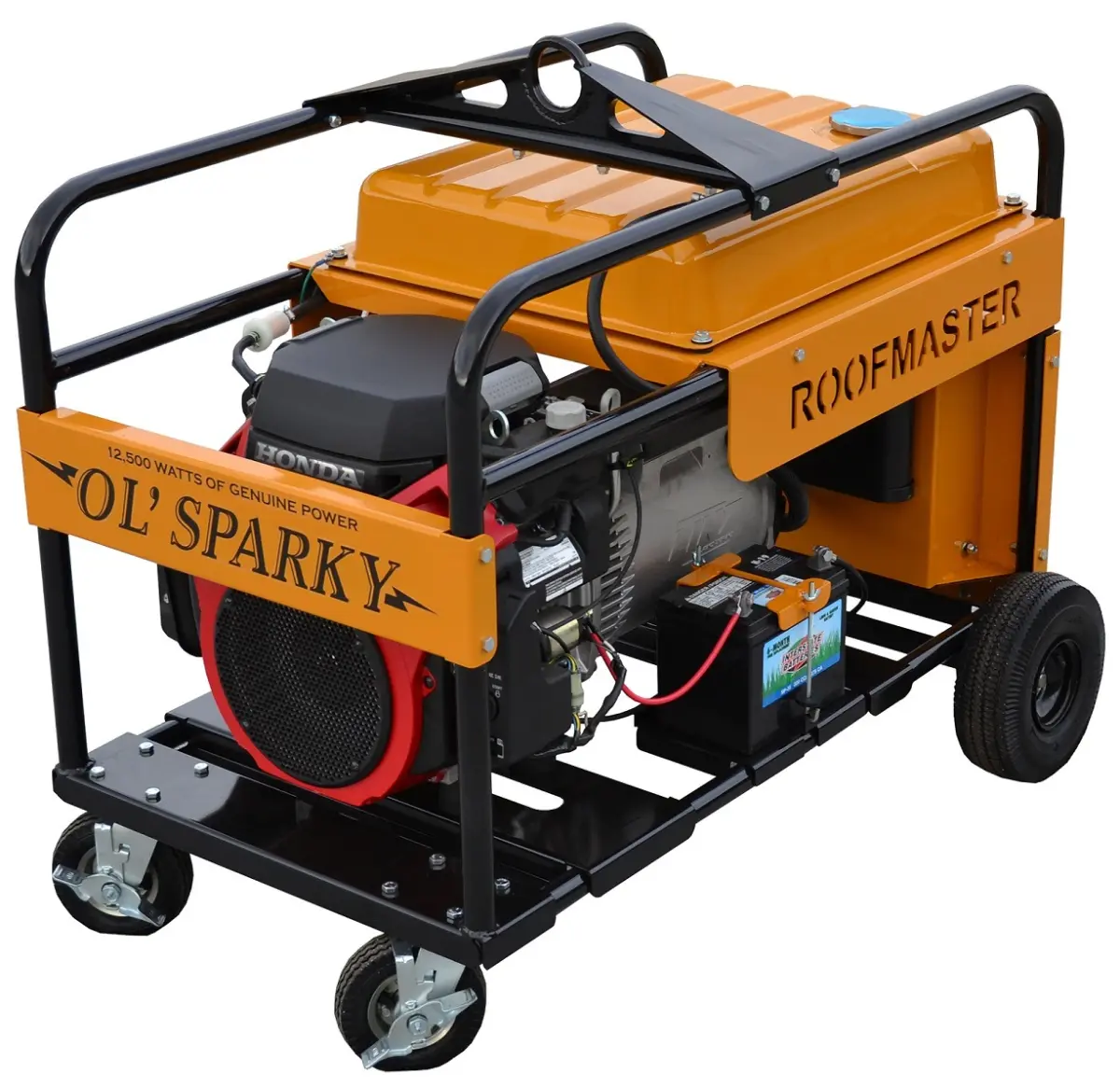
- Roofing-specific machinery: Portable generators, asphalt pumps, material handling lifts, tear-off machines, and hot-air welding application equipment.
The "Use vs. Sale" Distinction
A critical distinction in the regulation is that it does not ban the use of existing gas-powered equipment. Homeowners, landscapers, and commercial roofing contractors may continue to operate the gas-powered SORE tools they currently own. Furthermore, the law allows manufacturers and distributors to sell remaining inventory of pre-2024 manufactured equipment, provided the engines were certified under older emissions standards. However, once these existing retail stocks are exhausted, new gas-powered purchases within the state of California will no longer be legally permitted.
The Myth of the Construction Exemption
During the legislative drafting and public comment phases of AB 1346, industry trade groups were repeatedly assured that critical sectors such as construction and agriculture would be largely shielded from the transition due to the specialized nature of their work.
However, as the regulations are enforced, contractors have discovered that the exemption is highly narrow. While heavy machinery (such as diesel excavators, backhoes, and large tow-behind generators exceeding 25 horsepower) remains exempt, the small-engine tools that support these larger operations are not. Because roofing and light construction rely heavily on small portable generators, walk-behind scrapers, and small hydraulic pumps, these trades find themselves directly in the crosshairs of the ban.
Chronology: From Bill to Enforcement
The path to the 2024 SORE ban was paved over several years of legislative maneuvering, regulatory drafting, and intense lobbying.
  2021                      Oct 2021                 Dec 2021                  Jan 2024
   │                           │                        │                         │
   ▼                           ▼                        ▼                         ▼
Assembly Bill 1346        Signed into Law          CARB Approves              Sales Ban
Introduced by             by Governor              Regulatory                 Officially Takes
Berman & Gonzalez         Gavin Newsom             Framework                  Effect across CA
1. Legislative Origins (Early 2021)
Assembly Bill 1346 was introduced by Assemblymembers Marc Berman (D-Menlo Park) and Lorena Gonzalez (D-San Diego). The bill was designed to accelerate California’s broader mandate to transition to a zero-emission economy. Authors of the bill argued that while passenger vehicle emissions had drastically decreased due to decades of stringent regulations, small off-road engines had remained largely unregulated and highly polluting.
2. Signing and Ratification (October 2021)
Governor Gavin Newsom signed AB 1346 into law on October 9, 2021. The statute mandated that CARB adopt regulations to phase out SORE sales by January 1, 2024, or as soon as CARB determined was technologically and commercially feasible.
3. CARB Rulemaking and Public Hearings (December 2021)
On December 9, 2021, CARB officially approved the regulatory amendments to implement AB 1346. During these hearings, representatives from the outdoor power equipment industry, agricultural groups, and construction coalitions testified about the lack of commercial readiness for certain battery-powered alternatives. Despite these objections, CARB maintained the 2024 deadline for most categories, while offering limited delay pathways only for specific emergency response equipment and highly specialized applications.
4. The Transition and Enforcement Phase (2022–2024)
Throughout 2022 and 2023, manufacturers adjusted their production lines. Some began phasing out California-compliant gas engines entirely, while others maximized production of 2023-certified engines to build up "legacy inventory" that could legally be sold past the 2024 deadline.
On January 1, 2024, the ban on manufacturing and importing new non-compliant gas-powered SOREs for sale in California officially went into effect.
Supporting Data: The Environmental and Technical Math
To understand the urgency behind California’s legislative push, one must examine the stark environmental data published by state regulators, contrasted against the technical limitations of current battery technology.
The Emissions Comparison
According to data compiled by CARB, the small engines used in landscaping and light construction are disproportionately high polluters. Because these engines are often two-stroke or simple four-stroke designs without the sophisticated catalytic converters and emissions control systems found in modern cars, their exhaust contains high concentrations of:
- Reactive Organic Gases (ROG)
- Nitrogen Oxides ($NO_x$)
- Particulate Matter ($PM_2.5$)
CARB’s highly publicized benchmark states that operating a commercial gas-powered leaf blower for just one hour emits the same amount of smog-forming emissions (ROG and $NO_x$) as driving a light-duty passenger car (such as a 2017 Toyota Camry) approximately 1,100 miles—roughly the distance from Los Angeles to Denver, or nearly four round trips between Los Angeles and Las Vegas.
EMISSIONS EQUIVALENT: 1 HOUR OF SORE RUNTIME
┌────────────────────────────────────────────────────────────────────────┐
│ [Commercial Leaf Blower]  ⏱️  1 Hour of Operation                      │
│                               =                                        │
│ [Passenger Car]           🚗  1,100 Miles Driven                       │
└────────────────────────────────────────────────────────────────────────┘
By 2020, CARB estimated that total smog-forming emissions from SORE in California exceeded those from all passenger cars in the state (16.7 tons per day for SORE versus 11.9 tons per day for light-duty cars).
The Technical Reality: Power Density and Electrical Demand
While the environmental benefits of reducing SORE emissions are clear, the technical challenges for heavy-duty commercial applications are severe. This is particularly true in the commercial roofing sector, where equipment must run continuously under high loads.
Consider the power requirements for single-ply membrane roofing (TPO and PVC), which is the standard for modern commercial and industrial buildings:
- Hot-Air Welders: Automated robotic welders (such as the Leister Varimat) require clean, stable electrical power, typically drawing 230 Volts / 30 Amps (approximately 4,600 to 5,700 Watts continuous).
- The Battery Deficit: To run a single robotic welder continuously for an 8-hour shift requires approximately 36 to 45 Kilowatt-hours (kWh) of electrical energy.
- Weight and Mobility: A standard lithium-ion battery pack capable of delivering 45 kWh of energy weighs upwards of 600 to 800 pounds and costs tens of thousands of dollars. Hauling such heavy battery arrays onto a commercial rooftop is often structurally or logistically impossible without heavy cranes.
- Three-Phase Power: Many large-scale jobsite tools require three-phase power, which is not readily available from portable battery generators or standard residential grid hookups.
Official Responses and Industry Backlash
The implementation of the SORE ban has drawn starkly contrasting statements from state regulators, manufacturing representatives, and trade associations.
State Regulators: CARB’s Push for Zero-Emission Transition
CARB has consistently defended the regulation as a necessary step toward meeting California’s federally mandated air quality standards and long-term carbon neutrality goals. To ease the transition, the state launched the Clean Off-Road Equipment Voucher Incentive Project (CORE), which allocated millions of dollars in subsidies to help professional landscapers and small businesses purchase zero-emission equipment.
In an official statement regarding the transition, CARB noted:
"The transition to zero-emission off-road equipment is critical to protecting public health, particularly for operators who stand directly behind these high-emitting engines every day. We are committed to supporting businesses through incentive programs and working with manufacturers to ensure a smooth transition to cleaner, quieter, and more efficient technology."
The Roofing and Construction Sector: Feasibility Concerns
Trade groups, including the National Roofing Contractors Association (NRCA) and local California affiliate groups, have expressed deep concern over the lack of viable commercial-grade electric alternatives for industrial applications.
A representative from a prominent California roofing distributorship summarized the industry’s frustration:
"We are fully supportive of reducing emissions, but the technology must match the reality of the jobsite. A screw gun or a reciprocating saw runs perfectly on battery power. But a hydraulic pump for hot asphalt? A heavy-duty tear-off machine? A continuous-run generator for a high-voltage hot-air welder? The battery technology simply does not exist yet to run these machines for a full shift without massive, cost-prohibitive battery trailers that jobsites aren’t equipped to handle or charge."
Furthermore, contractors point out that construction jobsites are, by definition, locations where permanent electrical infrastructure has not yet been established. Forcing contractors to use battery-powered tools requires them to charge those batteries on-site—which ironically often requires large, diesel-powered generators that exceed 25 horsepower, potentially bypassing the environmental benefits the law intended to achieve.
Economic and Operational Implications
The ramifications of AB 1346 extend far beyond compliance paperwork, altering the economic landscape for contractors, distributors, and manufacturers alike.
1. The Legacy Stock "Gold Rush"
Because the law permits the sale of equipment utilizing pre-2024 certified engines, a secondary market has emerged. Manufacturers and distributors who stockpiled 2023-compliant gas engines are seeing unprecedented demand.
Contractors looking to secure their operational capabilities for the next five to ten years are actively buying up remaining gas-powered generators, pumps, and tear-off machines. As one industry insider observed:
"If you have plans to purchase new gas-powered jobsite equipment, the best time to invest was yesterday. The second-best time is today. Once this legacy inventory is gone, the option to buy gas in California is gone forever."
      PHASE 1: PRE-2024                PHASE 2: THE TRANSITION             PHASE 3: FULL ADOPTION
┌──────────────────────────────┐   ┌──────────────────────────────┐   ┌──────────────────────────────┐
│ • Gas-powered SORE readily   │   │ • Gas sales banned (new)     │   │ • Legacy gas stock exhausted │
│   available.                 │   │ • Legacy inventory sold off  │   │ • Mandatory ZEE transition   │
│ • Low-cost, proven tech.     │   │ • High demand for remaining  │   │ • High capital costs for     │
│ • High emissions footprint.  │   │   gas stock; prices rise.    │   │   batteries/charging.        │
└──────────────────────────────┘   └──────────────────────────────┘   └──────────────────────────────┘
2. Supply Chain Strain and Cost Escalation
As legacy inventory dwindles, contractors will face a steep rise in capital expenditures. Electric and battery-powered commercial equipment is significantly more expensive upfront than its gas-powered counterparts. A commercial-grade battery-powered generator or high-capacity power station can cost three to five times more than a comparable gas generator.
Additionally, contractors must factor in the "battery tax"—the ongoing cost of purchasing, maintaining, and eventually recycling heavy-duty lithium-ion batteries, which degrade over time under harsh jobsite conditions (extreme heat, dust, and physical impact).
3. Operational Hurdles on the Jobsite
The shift to electric equipment introduces complex logistical challenges:
- Charging Infrastructure: Fleet managers must now design systems to charge dozens of high-capacity batteries overnight. This requires significant electrical upgrades to warehouses and fleet yards.
- Transportation and Weight: Vehicles transporting equipment to jobsites must accommodate the added weight of massive battery packs, potentially requiring larger transport trucks and commercial driver’s licenses (CDLs) for operators.
- The "Out-of-State" Loophole: Industry experts predict an increase in cross-border shopping, where California contractors may purchase gas-powered equipment in neighboring states like Nevada or Arizona and transport it back across state lines. While CARB regulations target the sale of SORE within California, enforcing a ban on the importation of tools purchased out-of-state presents a monumental enforcement challenge.
Conclusion
California’s AB 1346 represents one of the most ambitious regulatory efforts in the world to curb localized air pollution. While the environmental benefits of phasing out highly polluting small gas engines are supported by clear scientific data, the practical execution of the law has exposed a widening gap between environmental policy and industrial reality.
For sectors like the commercial roofing industry, the ban on SORE under 25 horsepower is not merely an inconvenience—it is a fundamental disruption to how work is performed on the roof. As legacy stocks of gas-powered machinery inevitably dry up over the coming years, the industry will be forced into an uneasy transition. Whether battery technology and jobsite power infrastructure can evolve quickly enough to fill the void remains to be seen. For now, California contractors are left with a clear mandate: secure remaining gas-powered assets while they still exist, or prepare to invest heavily in an unproven, electrified future.
