

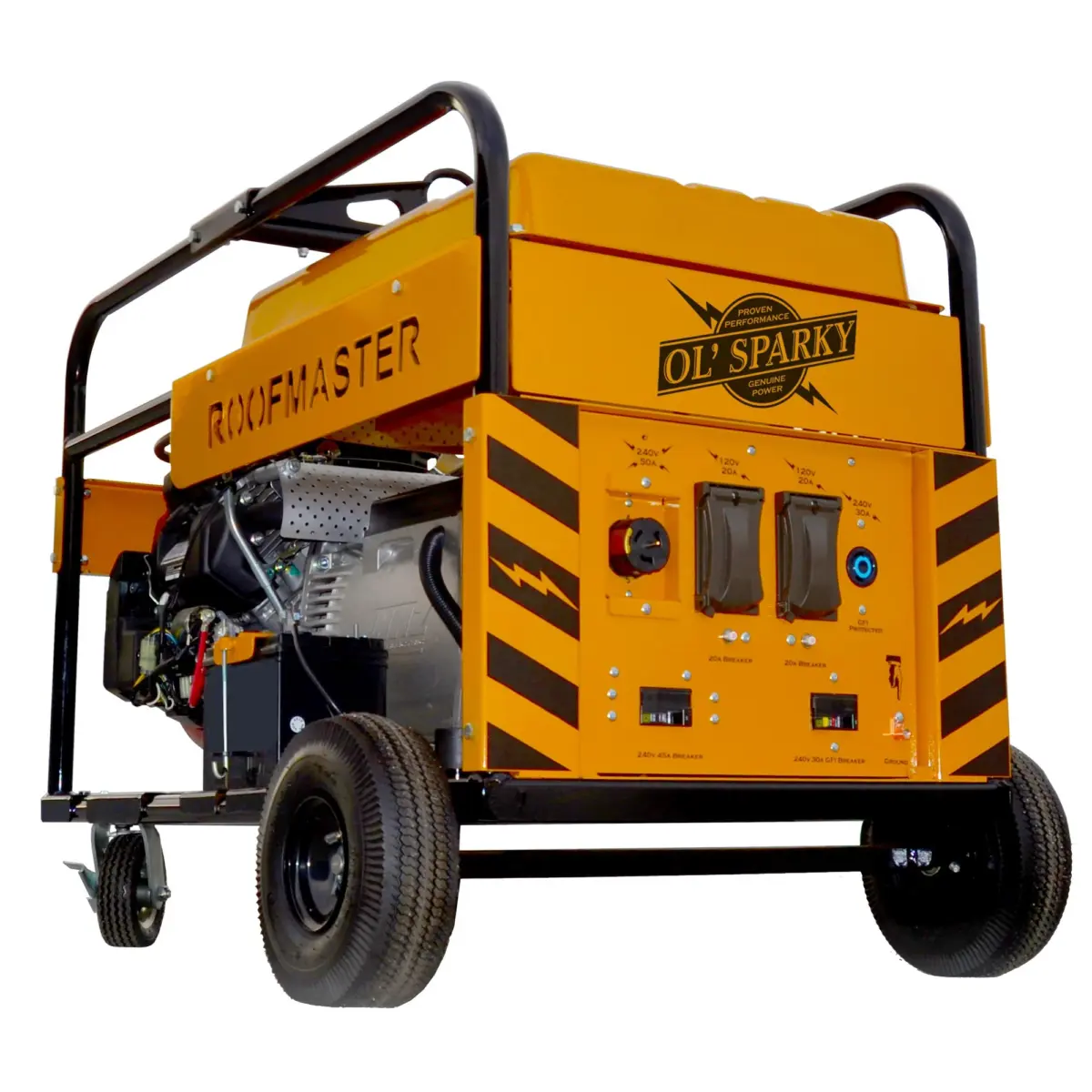
By Journal Staff
In the modern construction and industrial manufacturing sectors, the sophistication of field equipment has advanced at an exponential rate. Today’s job sites feature highly precise, microprocessor-controlled tools, such as automated hot-air plastic welders, digital induction heaters, and computerized diagnostic systems. However, this rapid technological leap has exposed a critical vulnerability: the quality of the portable electrical power used to run these tools in the field.
According to electrical engineers and industry experts, including Ryen Van Grol, an industrial equipment specialist and Territory Sales Manager, a silent killer of high-end tools is running rampant on job sites across the globe: Total Harmonic Distortion (THD). Produced by low-cost, retail-grade portable generators, poor power quality is causing premature equipment failures, costly repair bills, and catastrophic project delays. Far from a mere sales pitch designed to upsell premium generators, understanding and managing THD is now recognized as a fundamental operational necessity for modern contractors.
Main Facts: The Core of the Power Quality Crisis
To understand the threat to industrial tools, one must first understand the nature of portable generator power. Not all electricity is created equal. The power delivered by standard utility grids is highly regulated, clean, and exhibits a nearly perfect sinusoidal wave. In contrast, portable generators produce power locally through an internal alternator, and the purity of this power varies wildly depending on the generator’s design and component quality.
The primary metrics and facts surrounding this issue include:
- Definition of THD: Total Harmonic Distortion is a measurement of the degree to which an electrical voltage or current waveform deviates from a perfect, clean sine wave. It is expressed as a percentage; the higher the percentage, the more distorted and "dirty" the electrical power.
- The Critical 6% Threshold: For sensitive electronic equipment—especially tools containing microprocessors, digital displays, control boards, and solid-state relays—the maximum acceptable THD limit is widely established at 5% to 6%.
- Retail Generator Performance: Standard portable generators sold at mainstream "big-box" retail stores are designed primarily for emergency residential backup or basic construction tools. These units frequently produce power with a THD ranging from 25% to 30%.
- The Danger of Mixed Loads: Running "linear" loads (such as simple electric motors, incandescent lights, or resistive heaters) on the same generator as "non-linear" loads (such as computerized automatic welders) creates severe voltage fluctuations and electrical noise. This dynamic is a primary cause of blown control boards and ruined motors in high-end industrial tools.
Chronology of Power Quality and Industrial Tool Evolution
The current crisis on industrial job sites is the result of two converging historical timelines: the digital transformation of industrial tools and the mass consumerization of portable generators.
Industrial Power Quality Timeline

[Pre-1990s: Analog Era] -------------------> [2000s: Digital Revolution] -------------> [Present: The Collision]
- Heavy, robust analog tools                - Microprocessors & LCD screens integrated   - Sensitive digital tools paired
- Highly resilient to dirty power            - Precise control but highly sensitive      - Cheap retail generators (25-30% THD)
- Generators only needed basic wattage      - Legacy generator designs unchanged        - Widespread electrical failures
The Analog Era (Pre-1990s)
For decades, job site tools were robust, simple, and entirely analog. Drills, saws, and early hot-air welders relied on basic electromagnetic coils, carbon brushes, and simple resistive heating elements. These tools were highly resilient. If the voltage dropped or the frequency fluctuated, the tool might run slightly slower or cooler, but it would not suffer permanent damage. Generators during this era were designed with a simple mandate: provide raw wattage. Little attention was paid to waveform purity because the tools of the day did not require it.
The Digital Revolution (2000s–Present)
As industries demanded greater precision, efficiency, and data logging, tool manufacturers integrated advanced electronics. Modern automatic welders—such as those manufactured by industry leader Leister—now feature sophisticated digital control systems, onboard computers, LCD screens, and closed-loop feedback mechanisms to ensure perfect temperature and speed control.
While these advancements vastly improved output quality, they introduced highly sensitive microchips and delicate semiconductor components to the job site. These components require clean, stable electricity to function properly.
The Rise of Budget Portable Power
Concurrently, the global manufacturing market saw an influx of inexpensive, high-wattage portable generators. Designed to target homeowners seeking cheap storm backup power and contractors running simple power tools, these generators prioritized low retail pricing over power quality. Manufacturers achieved these low price points by using cheaper copper-clad aluminum windings, less precise mechanical governors, and rudimentary voltage regulation systems.
The Collision
The intersection of these two trends has proved disastrous. Contractors, unaware of the technical specifications of power quality, began plugging sensitive, multi-thousand-dollar digital welding equipment into cheap, consumer-grade generators. The resulting wave of unexplained tool failures, erratic behavior, and fried control boards forced industry experts to sound the alarm on THD.
Supporting Data and Technical Analysis
To fully comprehend why THD damages modern electronics, it is necessary to examine the engineering principles of electrical loads and generator design.
The Mathematics of a Distorted Waveform
In a perfect alternating current (AC) system, the voltage wave is a pure sine wave operating at a fundamental frequency (typically 60 Hz in North America or 50 Hz in Europe). Harmonic distortion occurs when unwanted frequencies—multiples of the fundamental frequency (e.g., 180 Hz, 300 Hz)—are introduced into the system.
      Clean Sine Wave (Low THD < 5%)             Distorted Sine Wave (High THD > 25%)

              +---+                                      +/_/+
             /                                         /
            /                                         /
  ---------+---------+---------              ---------+-----------+---------
                   /                                           /
                  /                                    /_///
              +---+                                      +---++
Mathematically, THD is calculated as the ratio of the sum of the powers of all harmonic components to the power of the fundamental frequency:
$$textTHD = fracsqrtV_2^2 + V_3^2 + V_4^2 + dots + V_n^2V_1 times 100%$$
Where $V_1$ is the root-mean-square (RMS) voltage of the fundamental frequency, and $V_2, V_3, dots$ are the RMS voltages of the harmonic components. When this percentage exceeds 6%, the electrical "noise" begins to interfere with the timing of digital circuits.
Linear vs. Non-Linear Loads
A critical operational error on job sites is the mixing of different load types on a single generator.
| Load Type | Equipment Examples | Electrical Characteristics | Impact on Generator |
|---|---|---|---|
| Linear Loads | Screw guns, circular saws, reciprocating saws, incandescent lights, basic heaters. | Current draw is continuous and directly proportional to the voltage sine wave. | Draws power smoothly but causes massive, temporary inrush current surges when switched on. |
| Non-Linear Loads | Leister welders, computers, battery chargers, variable frequency drives (VFDs). | Current is drawn in short, abrupt pulses rather than a smooth, continuous wave. | Distorts the voltage waveform back onto the generator, creating harmonic feedback. |
When a linear tool, such as a heavy-duty circular saw, is activated on the same generator powering a non-linear digital welder, the saw draws a massive inrush of current. This causes a sudden voltage drop on the generator, followed immediately by a high-voltage spike as the generator’s mechanical governor overcompensates.
To a simple saw, this spike is negligible. To the digital brain of an automatic welder, this transient voltage spike and the accompanying harmonic distortion can instantly melt microprocessors and fry delicate circuit board traces.
Alternator Construction: The Root of Generator Quality
The disparity in THD between industrial-grade and retail-grade generators lies in their internal construction:
- Winding Quality: Premium generators use high-grade, pure copper windings with a high density of turns, which naturally produces a cleaner electromagnetic field. Budget generators often use aluminum windings with fewer turns, leading to a degraded magnetic field and higher inherent distortion.
- Pitch of the Windings: High-quality alternators utilize a "2/3 pitch" winding design. This specific configuration is mathematically optimized to eliminate the third harmonic, which is the most destructive harmonic frequency in AC power generation. Cheap generators rarely feature this level of engineering.
- Voltage Regulation: Premium units utilize advanced Automatic Voltage Regulators (AVR) or digital inverter technology to actively monitor and smooth the output wave. Budget units rely on basic capacitor-based regulation or mechanical governors that cannot react fast enough to protect sensitive electronics.
Official Responses and Industry Standards
The industrial tool manufacturing sector has responded to the threat of THD by issuing strict operational guidelines and updating warranty policies.
Manufacturer Specifications
Leading hot-air welding equipment manufacturers, including Leister Technologies, have updated their user manuals and technical bulletins to explicitly address power quality.
"To avoid catastrophic damage to internal electronic components, digital automatic welders must only be operated on power sources with a Total Harmonic Distortion (THD) of less than 5% to 6%."
Furthermore, manufacturers warn that using an uncertified or low-quality power source can invalidate equipment warranties. When a damaged machine is sent to a certified repair center, technicians can easily identify power-surge damage. If the internal diagnostics or physical component degradation point to overvoltage or harmonic damage, the repair costs—often totaling thousands of dollars—must be borne entirely by the contractor.
Standards Organizations
The Institute of Electrical and Electronics Engineers (IEEE) provides clear benchmarks for power quality under the IEEE 519 standard, "Recommended Practice and Requirements for Harmonic Control in Electric Power Systems." This standard states that for general systems and sensitive electronic loads, the maximum voltage THD should be limited to 5%, with no single harmonic exceeding 3%.
This standard further validates the warnings issued by tool specialists: standard retail generators, operating at up to 30% THD, violate every recognized industrial electrical standard worldwide.
Implications and Best Practices for the Industry
The operational and financial implications of ignoring THD on the job site are severe. However, by implementing a few key strategies, contractors can safeguard their investments and ensure uninterrupted productivity.
               +----------------------------------------+
               |      JOB SITE POWER DECISION TREE      |
               +----------------------------------------+
                                   |
                     What type of equipment is it?
                                   |
                  +----------------+----------------+
                  |                                 |
         [Sensitive Digital]                [Simple Analog/Linear]
         (Welders, Computers)               (Saws, Drills, Lights)
                  |                                 |
        Verify Generator Specs               Standard Retail Gen
                  |                             Is Acceptable
          +-------+-------+
          |               |
     [THD < 6%]      [THD > 6%]
          |               |
     Safe to Use     STOP: Danger
                     to Equipment!
The Financial Equation
Consider the following real-world scenario: A roofing or civil engineering contractor purchases a state-of-the-art automatic membrane welder for $12,000. To power it, they purchase a $700, 8,000-watt generator from a local home improvement center.
Within three weeks of operation, the welder’s main control board burns out due to a high-voltage transient surge caused by a crew member running a heavy-duty saw on the same generator.
- Cost of Welder Repair: $2,500 (not covered by warranty).
- Cost of Downtime: $1,500 per day in idle labor and project delay penalties.
- Total Loss: Over $5,500.
In this scenario, spending $2,500 upfront on a high-quality, low-THD industrial generator or an inverter generator would have saved the contractor thousands of dollars and protected their primary asset.
Best Practices for Job Site Power Management
To eliminate the risks associated with Total Harmonic Distortion, industry professionals should adhere to the following protocol:
- Mandate Low-THD Generators: Ensure that all generators powering digital or electronic equipment are certified as having "clean power" with a guaranteed THD of less than 5% to 6%. Inverter generators are highly recommended for this purpose, as they convert AC power to DC and back to AC, creating a nearly flawless sine wave.
- Separate Your Loads: Establish a strict policy on job sites: Never mix linear and non-linear loads on the same power source. Keep heavy starting tools (saws, drills, compressors) on a separate utility generator, and reserve clean-power generators exclusively for sensitive digital welders and diagnostic equipment.
- Inspect Power and Extension Cords: Regularly check all extension cords, plugs, and connections. Damaged cords, loose connections, or excessively long cable runs can cause voltage drops and increase resistance, compounding the distortion issues already present in the system.
- Demand Technical Specifications: When purchasing or renting a generator, look for the manufacturer’s specification sheet. If the THD percentage is not explicitly listed, it is highly likely that the unit is a high-distortion model (>20% THD) and is completely unsuitable for sensitive electronic tools.
As Ryen Van Grol summarizes: "If you are willing to spend good money for top-of-the-line industrial equipment, protect your investment by purchasing the appropriate generator. It is not an accessory; it is the very foundation of your tool’s performance." By prioritizing power quality, modern contractors can eliminate the silent threat of THD, ensure the longevity of their tools, and secure their bottom line.
