

By Terrence O’Brien (Enriched & Expanded Edition)
The intersection of artificial intelligence and music creation has long been dominated by two extremes. On one end, traditional digital audio workstations (DAWs) and hardware synthesizers remain firmly anchored in deterministic physics, digital signal processing (DSP), and meticulous human arrangement. On the other end, modern cloud-based generative platforms—such as Suno and Udio—offer the frictionless allure of "push-button, get-song" workflows, churning out radio-ready tracks from simple text prompts within seconds.
Yet, a burgeoning subsector of electronic musicians and hardware designers has found this binary limiting. They are not interested in synthetic pop hits or automated radio singles. Instead, they crave the chaotic, unpredictable frontiers of sound design—the glorious accidents that happen when technology fails, breaks, or behaves in ways its creators never intended.
Enter music tech startup Thoughtful Things and its debut instrument: the Engram.
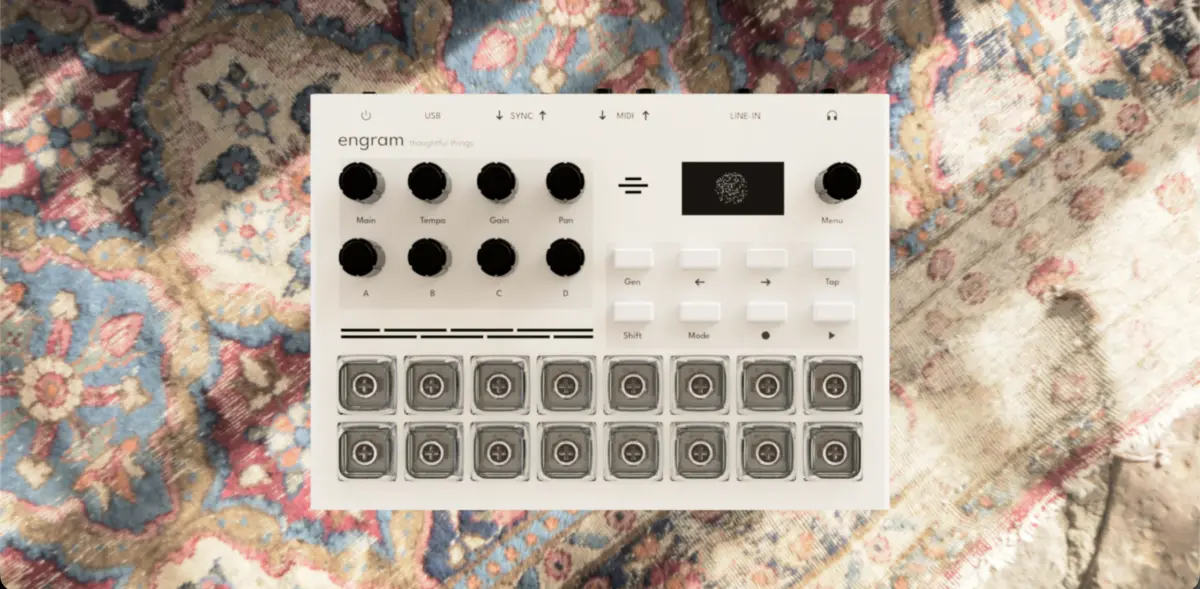
Launched today via a Kickstarter campaign, the Engram is a hardware sampler and groovebox that utilizes artificial intelligence not to generate clean, finished songs, but to aggressively mangle incoming audio and conjure entirely novel sonic artifacts. Eschewing the cloud-reliant, macro-compositional paradigm of modern AI music, the Engram is instead an offline, hackable exploration machine—what founder Evan King describes as a “field recorder for latent space.”
Main Facts
At its core, the Engram is a hardware electronic music instrument designed to sit alongside traditional samplers, drum machines, and synthesizers in a live or studio setup. However, its internal architecture diverges sharply from conventional gear.
- Local "Tiny AI" Processing: Unlike cloud-based tools that stream data back and forth to remote server farms, the Engram operates entirely offline. It runs a custom-designed, specialized AI model locally on internal hardware.
- Intentional Hallucination: Rather than reproducing pristine acoustic instruments or clean melodies, the Engram is engineered to warp, fragment, and "hallucinate" audio. Feeding the device a human voice asking for a "piano," for example, does not yield a Steinway grand; instead, it outputs a fractured, glitchy, vaguely acoustic hybrid.
- Circuit-Bending Philosophy: The instrument draws heavy inspiration from the counterculture tradition of circuit-bending—the practice of creatively short-circuiting low-voltage electronic audio devices to create unique, unexpected sounds and visual effects. Users are actively encouraged to push the device’s internal AI models to their breaking points.
- Ethical Dataset Sourcing: Acknowledging the widespread controversy surrounding copyright and machine learning, Thoughtful Things has publicly stated that its proprietary models are trained exclusively on open datasets containing commercially licensed audio (primarily CC-BY or equivalent). The company asserts it has never used, and will never use, non-commercial, pirated, or stolen data.
- Open Firmware Architecture: In a move calculated to appeal to the hacker and maker communities, Thoughtful Things plans to open-source the Engram’s firmware. This will allow advanced users to tweak the system architecture or load their own custom-trained machine learning models onto the device.
- Pricing and Availability: The initial hardware run is available exclusively through the Kickstarter campaign at a starting tier of $675 (marketed as a 30 percent discount). While a definitive retail price has not been formally announced, structural math on the campaign tiers suggests a future retail price point hovering between $850 and $900.
Chronology: From Concept to Kickstarter
The birth of the Engram did not happen in a vacuum; it is the culmination of years of shifting paradigms in both embedded machine learning and independent hardware manufacturing.
Phase 1: The Rise of Generative Audio (2022–2023)
As large language models proved their versatility, machine learning rapidly infiltrated the audio domain. Early experiments focused on neural synthesis—training networks to mimic specific synthesizers or acoustic environments. However, these models were massive, requiring powerful desktop GPUs running in cloud environments. For live electronic musicians, integrating AI into a hardware-centric workflow meant tethering a laptop running heavy Python scripts to an audio interface, introducing latency, stability risks, and setup complexity.
Phase 2: The Edge-AI Revolution (2024)
Simultaneously, advancements in edge computing—specifically the optimization of smaller, highly efficient neural networks capable of running on low-power system-on-chips (SoCs)—began to mature. Developers realized that artificial intelligence did not need to be monolithic or cloud-connected to be creatively interesting. Smaller models running locally could yield faster, more tactile, and more intimate interactions.
Phase 3: Prototyping and Ethical Foundations (Early 2024 – Late 2024)
Evan King and the team at Thoughtful Things began developing the Engram prototype with a specific thesis: AI should act as a musical instrument, not a ghostwriter. During this period, the team focused heavily on dataset curation. Recognizing the severe legal and ethical backlash facing companies scraping copyrighted music libraries, Thoughtful Things committed to building its custom models from the ground up using strictly verified, commercially licensed open-source datasets.
Phase 4: The Kickstarter Launch (Early 2025)
Following months of closed testing, whisper campaigns among gearheads, and demonstration clips showcasing the device’s strange, glitchy aesthetic, Thoughtful Things officially launched its Kickstarter campaign. The limited-run hardware release aims to gauge market demand among avant-garde producers, modular synth enthusiasts, and sound designers looking for tools outside the mainstream production ecosystem.
Supporting Data & Technical Architecture
To understand why the Engram feels so different from software plugins or cloud apps, one must examine its hardware philosophy and software constraints.
The Economics of Niche Hardware
Manufacturing independent electronic music instruments is notoriously punishing. Economies of scale favor massive conglomerates capable of churning out thousands of units in standardized overseas factories. For a boutique startup like Thoughtful Things, launching via Kickstarter mitigates financial risk while building an organic community of early adopters.
| Metric / Detail | Specification / Target |
|---|---|
| Kickstarter Entry Price | $675 (30% discount tier) |
| Estimated Retail Price | $850 – $900 |
| Connectivity | Completely offline (No Wi-Fi/Cloud required) |
| AI Training Data | 100% Commercially licensed (CC-BY and similar open datasets) |
| Extensibility | Open firmware for custom model loading and tweaking |
| Primary Design Ethos | Circuit-bending meets latent space exploration |
Local vs. Cloud: Why "Tiny AI" Matters for Performance
In a live performance setting, reliability is paramount. Musicians cannot afford network dropouts, server latency, or internet connectivity issues mid-set. By keeping the AI models localized on the device, the Engram ensures zero-latency interaction. The musician tweaks a knob, and the local neural network instantly recalibrates its weights and parameters, mutating the audio buffer in real time.

Furthermore, local processing gives the instrument its signature imperfection. Cloud models are heavily pruned and curated to deliver pristine, predictable results. A local "tiny AI" pushed to its computational limits, however, introduces artifacts, digital distortion, and unpredictable feedback loops—faults that experimental musicians actively covet.
Official Responses and Creator Philosophy
In promotional materials and campaign commentary, Thoughtful Things has been remarkably candid about what the Engram is not. Founder Evan King has repeatedly pushed back against the industry trend of using AI to replace human creativity.
"We’ve trained our audio models on open datasets that only contain audio licensed for commercial use (CC-BY or similar). We have not trained and will never train our models on non-commercial, pirated, or otherwise stolen data."
— Thoughtful Things Official Statement
This proactive stance on data provenance is a direct response to the existential dread gripping the music community. As major record labels and independent artists alike launch lawsuits against tech companies for scraping copyrighted tracks without permission or compensation, hardware developers are finding that ethical transparency is no longer optional—it is a vital market differentiator.
In the official Kickstarter launch video, King demonstrates the device by speaking a simple prompt into the unit: "piano." Instead of delivering a polished, concert-hall recording of a Steinway, the Engram processes the prompt through its localized latent space, spitting back a metallic, heavily fractured, glitch-laden echo that bears only a haunting, distant resemblance to a piano.
"Think of it as a field recorder for latent space," King explains in the demonstration. By treating the invisible, mathematical dimensions of a neural network’s hidden layers as a physical territory to be explored, sampled, and exploited, the Engram transforms machine learning from an automated labor-saving device into an unpredictable, organic collaborator.
Implications for the Future of Music Technology
The launch of the Engram signals a potential turning point for how hardware manufacturers approach artificial intelligence. For the past three years, the dominant narrative has been one of replacement: AI as a tool to write lyrics, generate full arrangements, and democratize pop music production for non-musicians.
The Engram rejects this narrative entirely. It suggests that the most compelling applications of machine learning in music are not found in automation, but in friction.
1. The Death of the "Black Box"
By promising open-source firmware and the ability for users to load their own custom models, Thoughtful Things is positioning the Engram as an open platform rather than a closed consumer appliance. This invites a community of programmer-musicians to hack the device, bending its neural networks into configurations the original creators never imagined. This democratization of AI architecture mirrors the early days of modular synthesis, where users patched cables across front panels to invent entirely new ways of making sound.
2. Redefining "Authenticity" in the Age of AI
For decades, electronic music has wrestled with the authenticity of its tools—from the initial skepticism greeting the Roland TR-808 drum machine to the debates over digital modeling versus analog warmth. The Engram bypasses the tired debate over whether AI "destroys human art" by reframing the technology as a physical medium. Just as a guitar distortion pedal clips a clean electrical signal to create warmth and grit, the Engram clips and fractures mathematical algorithms to create texture.
3. A Blueprint for Ethical AI Hardware
As regulatory scrutiny tightens around data scraping and intellectual property rights, hardware startups will look closely at Thoughtful Things’ playbook. By restricting training sets to verified, commercially licensed open datasets and prioritizing local, offline execution, the company has established a sustainable, legally sound framework for integrating machine learning into physical devices without alienating the artist community.
Conclusion
The Engram is not an instrument designed for everyone. It will not appeal to producers looking for effortless beat-making solutions, nor will it satisfy those seeking clean, traditional orchestration.
Instead, it carves out a vital, fiercely creative niche for sound designers, noise artists, ambient creators, and electronic musicians who view imperfection as an art form. By dragging artificial intelligence out of the sterile, corporate cloud and trapping it inside an offline, hackable metal box, Thoughtful Things has done something genuinely surprising: they have made AI weird again.
Whether the experimental music community embraces this "field recorder for latent space" on a mass scale remains to be seen, but as the Kickstarter campaign rolls out, one thing is certain—the future of electronic music hardware just got a whole lot more unpredictable.
