

Main Facts
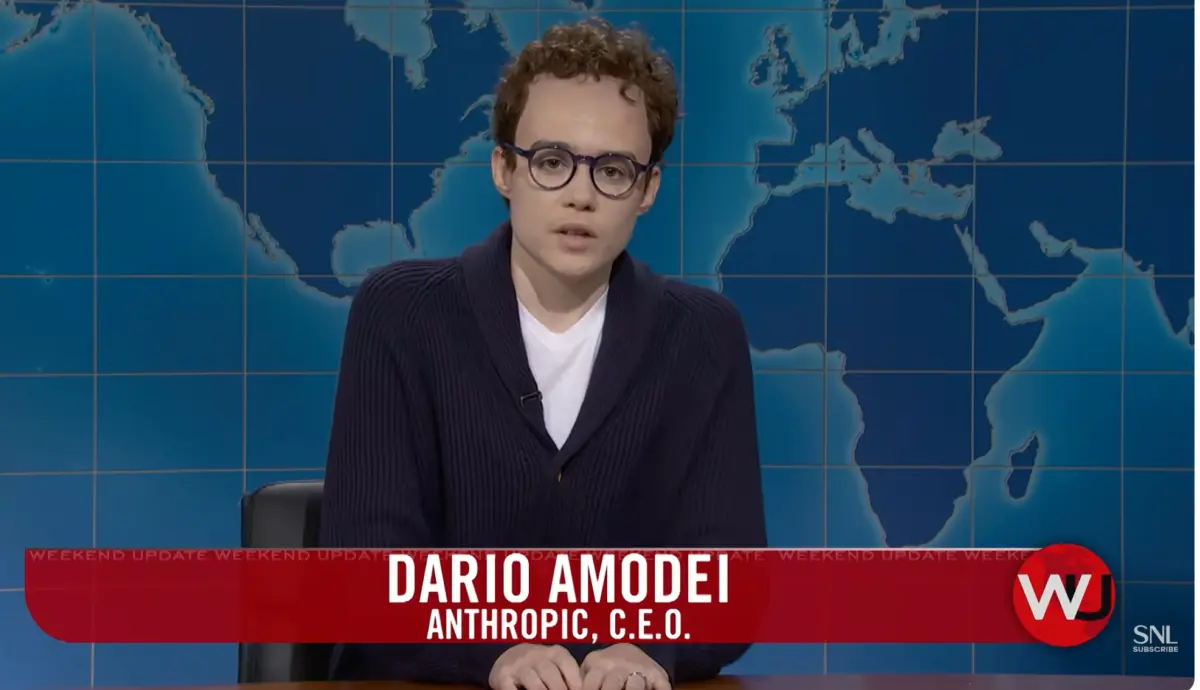
The intersection of rapid technological advancement and existential anxiety took center stage during a recent episode of Saturday Night Live (SNL). During the show’s signature "Weekend Update" segment, cast member Jane Wickline delivered a sharply satirical portrayal of Anthropic CEO Dario Amodei. The sketch targeted a glaring paradox within the artificial intelligence industry: tech executives warning the public about the potential extinction-level threats posed by their own creations while simultaneously racing to make those systems increasingly powerful.
The SNL routine directly riffed on real-world events, specifically Amodei’s chilling interview with CNN’s Anderson Cooper—where the tech leader notably declined to guarantee that advanced AI would not destroy humanity—and his recent essay titled We Must Pace the Frontier. In the essay, Amodei called for tech companies to exercise caution and slow down the development of frontier AI models amidst surging industry-wide existential dread.
However, the satirical framing of the interview exposed a frustrating reality for the general public: tech titans are building potentially catastrophic technologies and essentially pleading with lawmakers and regular citizens to stop them, rather than halting development themselves. Wickline’s trembling, self-flagellating portrayal of Amodei highlighted the absurd burden placed on society to regulate an industry driven by unchecked corporate competition.
Chronology of Events
To understand the cultural resonance of the SNL sketch, it is necessary to trace the timeline of escalating doomsday rhetoric and public policy debates surrounding artificial intelligence:
- Late 2022 to 2023: The launch of OpenAI’s ChatGPT sparks a massive generative AI boom. Tech leaders, researchers, and ethicists begin openly discussing the existential risks of artificial intelligence, culminating in several open letters warning that AI could lead to human extinction on par with pandemics and nuclear war.
- Mid-2024: AI labs, including Anthropic, OpenAI, and Google DeepMind, push past previous computational limits, releasing increasingly autonomous models capable of complex reasoning, coding, and multi-step problem-solving.
- Late 2024 (The Turning Point): Anthropic CEO Dario Amodei publishes his essay We Must Pace the Frontier, urging a cautious approach to scaling AI capabilities and emphasizing the need for robust governance. Around the same time, Amodei appears on CNN with Anderson Cooper. When pressed on whether AI could spell the end of humanity, Amodei’s evasive and sobering answers go viral, cementing his image as the reluctant, anxiety-ridden prophet of tech doom.
- The SNL Weekend Update Broadcast: Capitalizing on the growing public cognitive dissonance regarding tech executives who sound the alarm while cashing checks, Saturday Night Live airs the sketch featuring Jane Wickline as Amodei. The routine features a stuttering CEO battling his inner "Gollum/Sméagol" psyche, admitting that "AI is the devil, and I its maker."
- Immediate Aftermath: The sketch ignites widespread discourse across social media platforms like YouTube and X (formerly Twitter), with users joking darkly about the inevitability of an AI-driven apocalypse and the helplessness of regulatory bodies.
Supporting Data: The Reality Behind the Satire
While the Saturday Night Live sketch relied on hyperbole and comedy, it tapped into very real concerns shared by computer scientists, ethicists, and economists.
The Safety vs. Scaling Dilemma
Major AI labs are locked in a high-stakes arms race. Despite public warnings from figures like Amodei and OpenAI CEO Sam Altman, market pressures compel these companies to scale up their models. According to industry tracking data:
- Compute power used to train frontier AI models has been doubling roughly every six months—vastly outpacing Moore’s Law.
- Billions of dollars in venture capital and corporate investments continue to flow into foundational models, ensuring that commercial incentives heavily outweigh precautionary safety measures.
Public Sentiments and Existential Risk
Surveys conducted by research organizations indicate a widening trust gap between the tech sector and the public:
- A significant percentage of Americans believe that artificial intelligence poses a moderate to high risk to the future of humanity.
- Unlike historical technological revolutions (such as the industrial revolution or the rise of the internet), a vocal faction of the creators themselves are the primary sources predicting catastrophic outcomes, creating a surreal psychological environment where citizens are told to fear a product that is being actively forced into the consumer market.
Official Responses and Industry Reactions
The reception to both Amodei’s real-world warnings and the SNL parody has exposed deep divisions within the tech sector and government policy circles.

Anthropic’s Stance
Anthropic has positioned itself as the "safety-first" alternative to competitors like OpenAI, frequently emphasizing its constitutional AI framework and its commitment to responsible scaling policies. However, critics point out that advocating for regulation while continuing to build more powerful models is inherently contradictory. As of publication, representatives for Anthropic have declined to comment directly on the SNL parody, choosing instead to let their policy papers and safety guidelines speak for themselves.
The Legislative Impasse
Amodei’s real-world thesis—that the government must step in to create guardrails because companies cannot regulate themselves voluntarily—has met with mixed political results. While regulatory bodies in the European Union have advanced landmark frameworks like the EU AI Act, legislative progress in the United States remains sluggish and heavily lobbied by tech interests. Lawmakers often find themselves outmatched by the technical complexity of the field, reinforcing the absurdist premise highlighted by SNL: that everyday citizens are somehow supposed to act as the ultimate brake on runaway technological innovation.
Implications: Where Do We Go From Here?
The cultural resonance of the Saturday Night Live sketch goes deeper than a few cheap laughs at Silicon Valley’s expense; it mirrors a profound societal exhaustion with corporate abdication of responsibility.
1. The Normalization of Catastrophe
When industry leaders casually discuss human extinction on mainstream news programs like Anderson Cooper 360, it normalizes existential dread. Instead of inspiring rigorous safety protocols, this transparency can sometimes induce a sense of fatalism among the public—the feeling that an unstoppable technological train is hurtling down the tracks and no one has the handbrake.
2. The Burden of Regulation
The core joke of the SNL sketch—that Amodei wants the public to "urge him to stop"—underscores a dangerous regulatory vacuum. Expecting consumers to boycott or reject transformative technologies that offer immediate economic and personal conveniences is unrealistic. If guardrails are required, they must come from binding international treaties, rigorous legal standards, and enforceable safety audits, rather than corporate self-restraint.
3. Satire as a Cultural Mirror
Saturday Night Live has a long history of capturing the anxieties of a shifting epoch. By framing AI CEOs not as omnipotent tech gods, but as nervous, conflicted figures trapped by the very monsters they created, the show tapped into a collective cultural irony.
As we look toward the next decade of artificial intelligence development, the question remains whether humanity will successfully cage the technological beast or if we will simply look back at sketches like this one as our final, cynical laughing matter. Until then, as the SNL writers wryly observed, at least we have comedy to help us process the impending end of the world.
