

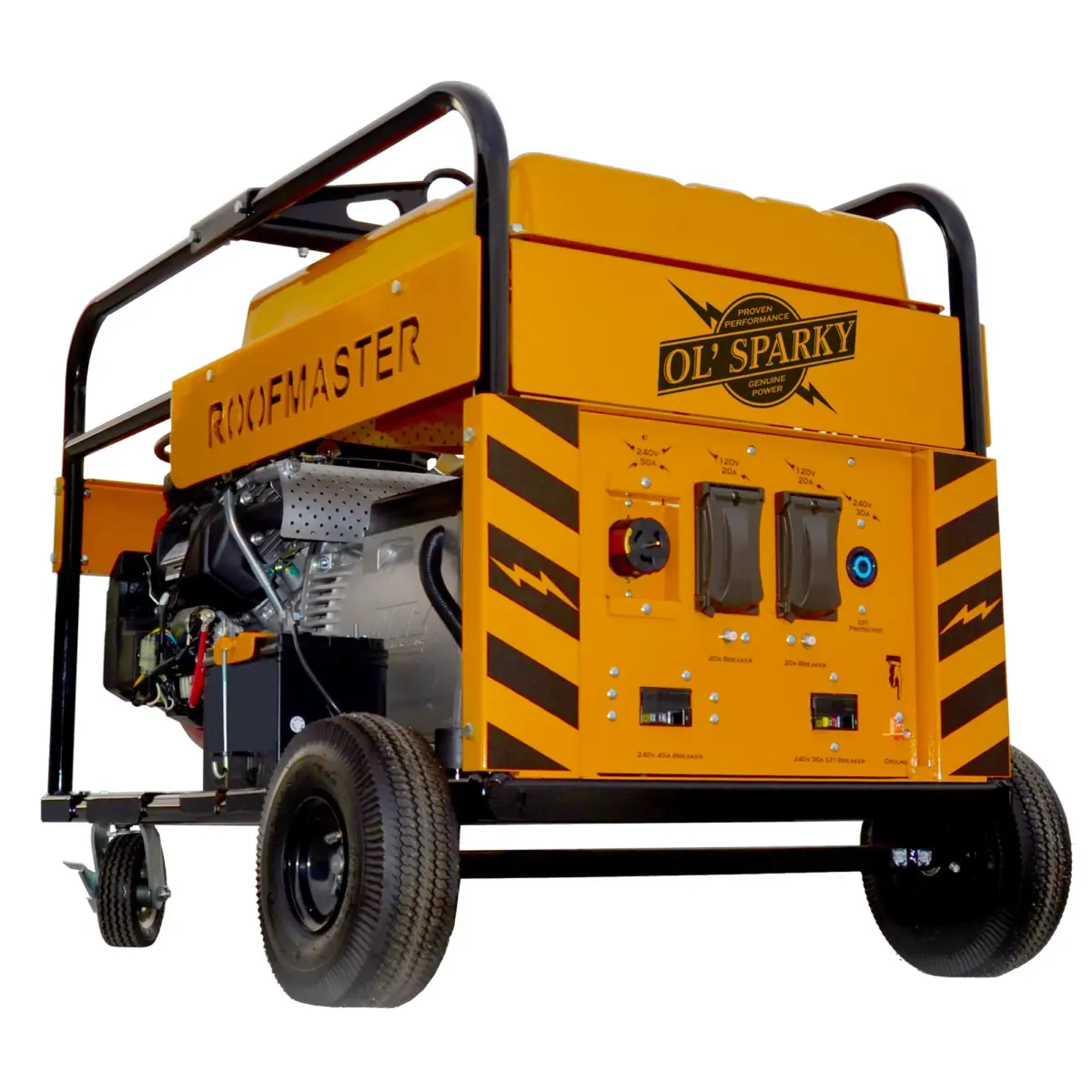
On any modern construction, roofing, or industrial job site, the reliance on advanced electronic equipment is absolute. From high-precision hot-air plastic welders to sophisticated digital control systems, today’s tools are marvels of micro-engineering. However, an invisible threat lurking within standard job site power sources is quietly costing contractors thousands of dollars in ruined components, lost productivity, and broken warranties.
That threat is Total Harmonic Distortion (THD).
While budget-friendly, retail-grade portable generators are widely available at big-box hardware stores, they are often fundamentally unsuited to power sensitive electronic machinery. Ryen Van Grol, an experienced Territory Sales Manager specializing in industrial equipment, warns that treating all electrical power as equal is a critical mistake. "Total Harmonic Distortion is a real thing; this is not a sales pitch trying to get a customer to buy additional equipment," Van Grol states. Understanding the relationship between generator quality, wave distortion, and tool longevity is essential for any contractor looking to safeguard their capital investments.
1. Main Facts: Demystifying Total Harmonic Distortion (THD) and Power Quality
To understand why some generators destroy high-end tools, one must first understand the nature of alternating current (AC) electricity. Ideally, utility-grade power is delivered as a clean, continuous, and symmetrical sine wave oscillating at a stable frequency (typically 60 Hz in North America or 50 Hz in Europe).
Clean Sine Wave (Low THD < 5%)        Distorted Waveform (High THD > 25%)
       ^                                     ^
      /                                    /   /  /
     /                                    /   /  /
----+-----+----->                         ----+--------+----->
   /                                    /
  /                                    /
What is Total Harmonic Distortion?
Total Harmonic Distortion (THD) is the measurement of how much an electrical voltage or current waveform deviates from a mathematically perfect sine wave. It is expressed as a percentage.
- Low THD (Clean Power): A percentage of less than 5% to 6% is the industry standard for clean, stable power. This is the quality level typically delivered by municipal utility grids and high-end inverter generators.
- High THD (Dirty Power): A percentage of 20% to 30% is common in budget-grade, open-frame portable generators. This waveform is highly distorted, jagged, and inconsistent.
Why Budget Generators Produce "Dirty" Power
The discrepancy in power quality comes down to manufacturing compromises. Generators sold at mass-market retail outlets are engineered to meet low price points. To save on manufacturing costs, these units often feature:
- Lower-quality copper or aluminum windings within the alternators.
- Substandard or absent automatic voltage regulators (AVR).
- Less precise engine governors, leading to rotational speed fluctuations that directly alter the output frequency.
While this "dirty" power is perfectly acceptable for rugged, non-sensitive equipment—such as incandescent job-site lighting, simple heating elements, or basic universal motors—it behaves like a slow poison to digital microprocessors and control boards.
2. Chronology: The Lifecycle of Power-Induced Equipment Failure
The destruction of high-end industrial tools, such as Leister automatic hot-air welders, rarely happens in a single, dramatic flash of lightning. Instead, it is typically a cumulative process of degradation. Below is the chronological progression of how a high-THD generator systematically destroys sensitive electronics on a job site.
+-------------------------------------------------------------+
| Phase 1: The Mixed-Load Setup                               |
| High-end welder and inductive tools share a cheap generator. |
+-------------------------------------------------------------+
                              |
                              v
+-------------------------------------------------------------+
| Phase 2: The Inductive Surge                                |
| A saw or drill cycles on, causing severe voltage drops.      |
+-------------------------------------------------------------+
                              |
                              v
+-------------------------------------------------------------+
| Phase 3: Thermal & Harmonic Stress                          |
| High THD forces microchips and capacitors to overheat.      |
+-------------------------------------------------------------+
                              |
                              v
+-------------------------------------------------------------+
| Phase 4: Catastrophic Component Failure                      |
| Control board fails mid-job, causing costly downtime.       |
+-------------------------------------------------------------+
Phase 1: The Mixed-Load Setup
A contracting crew arrives on-site. They set up a budget-grade, 8,000-watt generator purchased from a local big-box retailer. Into this single generator, they plug an expensive automatic hot-air membrane welder (containing digital thermostats, speed control microchips, and LCD screens) alongside several linear-load hand tools, such as a reciprocating saw, a radio, and a battery charger station.
Phase 2: The Inductive Surge
As the crew works, the reciprocating saw is cycled on and off. Every time the saw’s trigger is pulled, its electric motor draws a massive initial inrush current. Because the generator lacks sophisticated voltage regulation, its engine bogs down, causing a momentary voltage drop (sag), immediately followed by a high-voltage spike (surge) as the generator’s governor overcompensates to keep up.
Phase 3: Cumulative Thermal and Harmonic Stress
The sensitive control board of the automatic welder is forced to process this erratic power. Because the generator’s base THD is already sitting at 25%, the voltage peaks are uneven. The digital components inside the welder begin to run hot. Capacitors within the welder’s power supply section work overtime to smooth out the erratic current, generating internal heat far beyond their design parameters.
Phase 4: Catastrophic Component Failure
Over days or weeks of operation under these conditions, the internal insulation of the electronic components degrades. Eventually, during a routine power fluctuation, a capacitor ruptures or a microprocessor trace melts. The welder suddenly shuts down, displaying an error code or failing to power on entirely. The contractor is left with an expensive, non-functioning tool, an interrupted project schedule, and a potentially voided equipment warranty.
3. Supporting Data: The Physics of Linear vs. Non-Linear Loads
To understand why mixing tools on a single generator is so destructive, it is necessary to examine the electrical differences between linear and non-linear loads.
| Feature | Linear Loads | Non-Linear Loads |
|---|---|---|
| Typical Devices | Incandescent bulbs, space heaters, reciprocating saws, screw guns, basic electric drills | Leister welders, laptops, variable frequency drives (VFDs), LED lighting ballasts, PLC controllers |
| Current Draw | Continuous, proportional to the voltage sine wave | Drawn in abrupt, short pulses rather than a smooth wave |
| Impact on Generator | Simple load; causes predictable voltage drops under load changes | Creates harmonic currents that feed back into the generator, worsening THD |
| Tolerance to High THD | High; can run safely on distorted waveforms with minimal impact | Low; high THD causes overheating, data corruption, and hardware failure |
The Math Behind Harmonic Heating
When a non-linear load (like the digital control system of a Leister welder) is subjected to high THD, the harmonic frequencies (3rd, 5th, 7th order harmonics, etc.) cause an engineering phenomenon known as the "skin effect." This forces AC current to flow primarily on the outer surface of conductors rather than distributing evenly throughout the wire cross-section.
The mathematical consequence of this is an increase in effective AC resistance:
$$Ptextloss = I^2 cdot Rtexteffective$$
As resistance ($R$) artificially increases due to harmonic frequencies, power loss ($P_textloss$) in the form of heat rises exponentially. This heat degrades the delicate silicon wafers inside microchips, causing them to fail prematurely.
4. Industry Standards and Official Responses: What Manufacturers Require
The industrial manufacturing sector has long recognized the dangers of poor power quality. Consequently, leading tool and electrical equipment manufacturers have established strict input power guidelines to protect their products and clarify warranty boundaries.
Leister and Hot-Air Welder Manufacturers
Most reputable manufacturers of hot-air welding equipment explicitly state in their operating manuals that their machines must only be run on "clean" power. The general consensus among industrial heating tool manufacturers is that the maximum allowable THD for portable generator power must be strictly less than 5% to 6%.
If a machine fails and a diagnostic teardown reveals burned-out control circuitry consistent with overvoltage, undervoltage, or harmonic stress, manufacturers may deny warranty coverage. They attribute the failure directly to external power quality issues rather than manufacturing defects.
The IEEE 519 Standard
The Institute of Electrical and Electronics Engineers (IEEE) maintains the IEEE 519-2014 standard, which establishes "Recommended Practice and Requirements for Harmonic Control in Electric Power Systems." This standard states that for sensitive systems (including electronic equipment and hospitals), the voltage THD should be kept below 5%. This further validates the warnings of equipment distributors: industrial tools are designed to operate within the same power quality parameters as a high-tech office building or hospital.
THD Percentage Levels & Equipment Compatibility
[0% - 5%]     ======================> Optimal (Safe for all sensitive electronics)
[6% - 10%]    ===========> Caution (Marginal for microprocessors; risk of errors)
[11% - 30%]   ======> Danger (Strictly for linear loads; will damage digital tools)
The "Hidden Spec" Problem
Ryen Van Grol points out a common frustration for buyers trying to do their due diligence: generator manufacturers targeting the budget retail market often omit the THD rating from their product spec sheets.
"The manufacturer of your generator should have specifications regarding the THD," Van Grol advises. "If this information is not readily available, it is likely that the generator is not suitable for your sensitive equipment."
5. Strategic Implications: Protecting Capital Investments and Mitigating Risk
For business owners, project managers, and independent contractors, the choice of job site generator is not merely a purchasing decision; it is a critical risk management strategy.
The True Cost of "Cheap" Power
A direct cost-benefit analysis reveals that purchasing cheap generators to run premium tools is a losing financial strategy:
- The Cheap Option: A contractor buys a retail-grade 10,000-watt generator for $800 (THD: 25%). They plug in a $6,000 automatic roofing welder. Within six months, the welder’s main control board fries.
- The Consequences:
- Cost of replacement control board and professional repair: $1,500 – $2,500.
- Downtime cost (idle labor, missed deadlines, project delay penalties): $2,000 – $5,000.
- Total loss from a single failure event: $3,500 – $7,500+.
- The Clean Option: The contractor invests in a commercial-grade inverter generator or a high-end synchronous generator with a verified THD of <3% for $3,500. The automatic welder runs flawlessly for years without power-related interruptions.
Practical Field Recommendations
To eliminate the risk of THD-induced equipment failures, contractors should implement the following site rules:
- Invest in Inverter Technology: For sensitive electronic tools, only use inverter generators. Inverter units throttle power through a digital cleaning process: converting AC to DC, and then inverting it back to a highly stable, ultra-low THD AC sine wave.
- Implement Strict Power Segregation: Never run heavy cycling, linear-load tools (saws, compressors, rotary hammers) on the same generator circuit as digital welders or computer systems.
- Verify Cable and Connection Integrity: Inspect extension cords daily. A loose connection or an undersized extension cord (e.g., using a thin 16-gauge cord over a long distance) causes voltage drops that compound the issues of a high-THD generator. Use heavy-duty, properly rated cords (such as 10-gauge or 12-gauge) to maintain voltage stability.
- Demand Specification Transparency: Before renting or purchasing a generator, demand written confirmation of its THD rating under full load from the manufacturer.
Conclusion
High-end industrial tools are precision instruments designed to deliver consistent, high-quality output under demanding field conditions. However, they require a clean energy diet to do so. By understanding the invisible threat of Total Harmonic Distortion and investing in appropriate power delivery infrastructure, contractors can eliminate avoidable equipment failures, protect their warranties, and keep their projects moving forward without costly interruptions. As Van Grol concludes: "If you are willing to spend good money for top-of-the-line equipment, protect your investment by purchasing the appropriate generator."
