

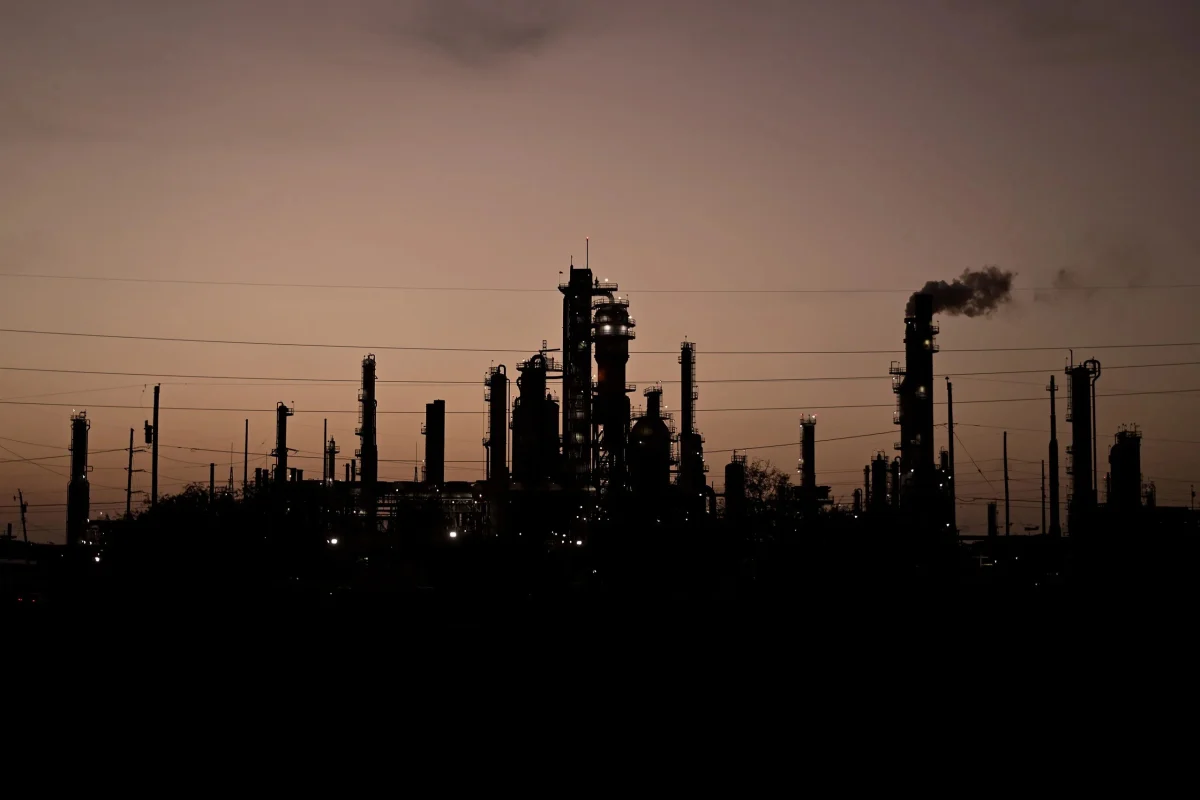
TEXAS — The Trump administration is actively weighing a contentious 90-day ban on diesel exports, a high-stakes policy maneuver intended to rapidly force down skyrocketing domestic fuel prices for American consumers. However, energy industry leaders, economists, and regional stakeholders warn that if enacted, the proposal would deliver a devastating blow to the sprawling constellation of Gulf Coast refineries in Texas, disrupt global energy markets, and potentially backfire by triggering domestic shortages and even higher prices down the road.
The proposal, which was first broken by Politico, comes amid severe geopolitical and economic pressures. Surging oil and fuel prices—exacerbated by the ongoing U.S.-Iran conflict—have transformed into a severe political liability for the administration as the nation barrels toward the November midterm elections. Facing voter anger at the pump, the White House is pressing domestic energy companies to curtail overseas shipments and redirect refined fuel back into the domestic supply chain.
Yet, this intervention has placed President Donald Trump at direct loggerheads with the very industry he campaigned to champion through deregulation and a platform of domestic energy dominance. Critics of the plan argue that halting exports fundamentally misunderstands the interconnected mechanics of global petroleum markets and threatens to derail the bedrock of the Texas economy.
Main Facts
At the core of the administration’s proposal is a simple, direct objective: increase domestic fuel availability by stopping the flow of American-made diesel to foreign buyers.
Texas plays a monumental role in this equation. Refineries along the Texas Gulf Coast process millions of barrels of crude oil daily, converting it into critical products like diesel and jet fuel that power agriculture, transportation, and aviation industries worldwide. According to data from the U.S. Energy Information Administration (EIA), Texas accounts for approximately one-third of the nation’s total diesel production, processing roughly 6.3 million barrels per day. Of that immense output, roughly 1.5 million barrels are sold overseas.
The administration’s proposal aims to capture a significant portion of those exported barrels to flood the domestic market, driving down prices for American drivers and industries.
However, energy analysts and executives point out that the U.S. refining sector cannot simply reroute these products at will. Gulf Coast refineries are intricately calibrated to balance domestic demand with international export markets. Imposing an abrupt 90-day moratorium would instantly create a massive logistical bottleneck, leaving refiners with nowhere to put excess product as storage tanks quickly reach maximum capacity.
Chronology of Events
The mounting pressure on fuel prices and the subsequent policy debate have unfolded rapidly against a backdrop of escalating international conflict:
- The Onset of the U.S.-Iran Conflict: Geopolitical tensions in the Middle East severely disrupt international crude flows, driving global oil prices upward and pushing refined product costs to uncomfortable heights for U.S. consumers.
- Political Fallout Pre-Midterms: As fuel costs climb through the spring and summer, rising gas and diesel prices emerge as a primary political vulnerability for the White House ahead of the November midterm elections.
- Early State-Level Action: Recognizing the mounting pinch on local industries, Texas Governor Greg Abbott issues a disaster declaration allowing the use of dyed diesel—a formulation functionally identical to standard highway diesel but traditionally reserved tax-free for farming and construction—in an effort to ease immediate localized supply pressures.
- The Leak: Politico breaks the news that the Trump administration is actively mulling a sweeping 90-day ban on diesel exports to artificially inflate domestic inventories.
- Immediate Industry Pushback: Trade associations, refinery operators, and economic experts immediately mobilize, warning that the administration’s emergency remedy poses an existential threat to refining margins, long-term infrastructure investment, and international alliances.
Supporting Data and Economic Mechanics
To understand why industry leaders are so alarmed, experts point to the complex chemistry and logistics governing Texas refining operations.
Ramanan Krishnamoorti, vice president of energy and innovation at the University of Houston, explains that the vast majority of crude oil extracted in Texas is "light crude"—a chemically complex and expensive liquid. When refined, light crude yields diesel and jet fuel while serving as the most cost-effective feedstock for producing gasoline. To balance their processing capabilities, Texas refineries also import heavier grades of crude from Canada and Venezuela, which are exceptionally well-suited for producing heavy-duty diesel used by freight trucks and locomotive trains.
Since the outbreak of the war with Iran, Gulf Coast refineries have been running at maximum capacity to meet relentless global and domestic demand. According to CITGO—a major refiner with substantial operations in Lake Charles, Louisiana, and Corpus Christi, Texas, representing roughly 690,000 barrels per day of refining capacity—international markets are essential to maintaining steady operations.
"An immediate ban on diesel exports would eliminate outlets for approximately 1.3 million barrels-per-day of U.S. diesel and create a significant product containment challenge across the U.S. Gulf Coast, which supplies 90% of these exports," a CITGO spokesperson stated. "The product containment challenge would force Gulf Coast refineries to reduce crude runs which, in turns, impacts overall fuel supply."
Jack Balaggia, executive director of the KBH Energy Center at the University of Texas at Austin, echoed these concerns at the Texas Tribune Festival, emphasizing that the U.S. lacks the physical pipeline infrastructure necessary to seamlessly redirect millions of barrels of trapped coastal diesel into inland domestic markets.
"When you quit making as much diesel, you also quit making as much jet fuel and gasoline, so those prices are going to go up when the storage facilities fill up," Balaggia noted. "It sounds like a simple problem and a very simple solution, but it is not. It is very complex… We live in a world market for crude oil and crude oil product; you cannot isolate yourself from the world market."
Official Responses
The proposed export ban has drawn sharp, unyielding condemnation from energy sector leaders and trade groups who argue the policy relies on flawed economic logic.
Todd Staples, president of the Texas Oil and Gas Association (TXOGA), issued a scathing critique of the White House’s proposal:
"Banning exports of diesel would cripple domestic jobs, lead to fuel shortages here at home and put power in the hands of China and Russia by forcing our allies to turn to those countries to meet their needs. America’s energy leadership is needed now more than ever, and the best way to protect Texas and American consumers is to encourage continued investment in infrastructure which means more production, pipelines, processing and refining."
Staples added that artificial market distortions will only prolong economic pain: "Global disruptions to the supply chain will eventually be resolved and Texas will emerge stronger and consumers better protected than ever. A ban today means a weaker America tomorrow and should be rejected by all Americans."
Independent academic experts have similarly cautioned that the administration is treating a symptom while damaging the underlying physiological health of the energy sector. Krishnamoorti warned that refiners have little incentive to maintain breakneck production speeds if profitability is legislatively capped or destroyed by storage gluts.
"Once they start to see that they’re not going to be able to maximize profits, they have less incentive to find ways to keep their refineries going at full strength," Krishnamoorti said. "If they start to go offline… you start to see a roll-on impact on gasoline prices because it will be in short supply."
Broader Implications
If the Trump administration moves forward with the 90-day diesel export ban, the repercussions will likely ripple far beyond the borders of Texas, creating a cascade of domestic and international consequences:
1. The Paradox of Higher Prices
While the White House’s stated goal is to lower fuel costs for everyday Americans, industry experts warn the policy will likely achieve the exact opposite. By forcing refineries to choke back crude processing due to storage saturation, the production of all refined petroleum products—including gasoline and jet fuel—will plummet. As overall supply shrinks, retail prices at the pump are expected to surge rather than fall.
2. Economic Devastation in Texas
The energy sector serves as the fiscal bedrock of the Texas economy, providing hundreds of thousands of high-paying jobs and generating billions of dollars in state and local tax revenue. Downsizing refining operations to cope with an export ban would translate directly into curtailed capital expenditures, operational layoffs, and fiscal strain for communities tethered to the Gulf Coast energy corridor.
3. Geopolitical Vulnerabilities
Cutting off international allies from stable American energy supplies forces traditional U.S. partners—particularly in Europe and Latin America—to seek alternative fuel sources. Critics like TXOGA point out that this vacuum would inevitably be filled by adversarial nations like Russia and China, undermining long-term U.S. foreign policy objectives and eroding American energy hegemony.
As the November midterms approach and political pressure mounts, the White House faces a critical juncture. The administration must decide whether to pursue short-term political relief through aggressive market intervention, or heed the dire warnings of economists and industry leaders who insist that protecting American consumers requires trusting the resilient, globalized mechanics of free-market energy production.
