

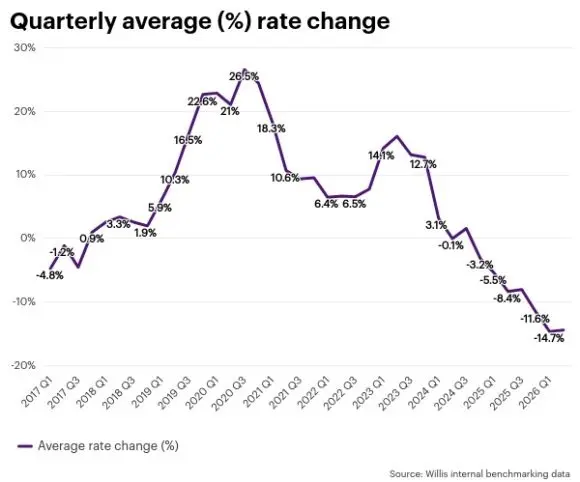
GEPOLS — The commercial insurance landscape is undergoing a decisive and broad-based shift toward a buyer-friendly market, according to the freshly released Insurance Marketplace Realities report for late 2026 by Willis, a WTW business. After nearly six years of challenging pricing dynamics, high retentions, and stringent underwriting criteria, commercial property rates are softening at an accelerating pace. Backed by surging primary capacity, moderate catastrophe losses during the first half of the year, and retreating reinsurance pricing, corporate buyers are finding much-needed financial relief across multiple lines of coverage.
However, industry experts caution that this new era of market softness is not uniform. While large property risks enjoy steep double-digit rate cuts, lines such as casualty and cyber continue to navigate complex crosscurrents, including social inflation, evolving artificial intelligence vulnerabilities, and persistent ransomware threats.
Main Facts
The overarching narrative of the fall 2026 report is the consolidation of a market correction that marks a sharp departure from the hard-market conditions that defined the industry from early 2018 through early 2024.
- Steep Property Reductions: Large and complex property risks within WTW’s portfolio plummeted by 14.5% in the second quarter of 2026. This is nearly double the 8.4% rate of decline recorded during the same period in 2025.
- Shared Layer Savings: Programs utilizing shared layers with five or more participating carriers experienced even more dramatic relief, logging average rate reductions of approximately 23.4% during Q2 2026.
- Plummeting Catastrophe Losses: Global insured catastrophe losses for the first half of 2026 totaled $42 billion—representing the lowest six-month total since 2020. This benign loss environment has directly fueled abundant primary and reinsurance capacity.
- Cyber Market Equilibrium: Cyber insurance rates are holding steady in a flat corridor ranging from a 5% decrease to a 5% increase. Despite rising risk exposures driven by AI and ransomware, market competition continues to favor policyholders.
- Casualty Moderation: While casualty rate increases are beginning to slow, underwriters remain disciplined due to persistent social inflation, adverse severity trends, and litigation risks.
Chronology of Market Dynamics: From Hard Market to Correction
To fully understand the significance of the 2026 market data, industry analysts look back at the trajectory that brought the commercial insurance sector to its current inflection point.
The Hard Market Era (Q1 2018 – Q1 2024)
For six consecutive years, commercial insurance buyers faced an unforgiving hard market. Beginning in earnest around 2018, insurers grappled with a convergence of adverse factors: compounding natural catastrophe losses from hurricanes, wildfires, and convective storms; historically low interest investment yields; and surging social inflation—characterized by nuclear verdicts and aggressive plaintiff litigation. During this era, premium rates climbed quarterly, deductibles expanded, capacity contracted, and policy terms and conditions were heavily restricted. Insurers pulled back from catastrophe-exposed zones, leaving many large commercial enterprises and real estate portfolios struggling to secure adequate limits at sustainable costs.
The Inflection Point (2024 – 2025)
Signs of market exhaustion and stabilization began to emerge late in 2024. As cumulative rate increases compounded, commercial property lines achieved technical adequacy. Insurers began generating healthier underwriting margins, which in turn attracted fresh capital back into the market. By 2025, rate deceleration became apparent, shifting from aggressive hikes to flat renewals, and eventually transitioning into early-stage softening for clean accounts with strong loss histories.
The Accelerated Softening (2026)
By the second quarter of 2026, the market trajectory had clearly reversed. According to WTW’s data, the influx of new capital, combined with a relatively quiet first half of the year for natural disasters, created intense competition among insurers. Carriers eager to deploy capital began aggressively discounting premium rates, particularly for large, complex property risks and shared-layer programs, setting the stage for the buyer-friendly conditions outlined in the fall 2026 report.
Supporting Data and Market Analysis
The Insurance Marketplace Realities report examines dozens of commercial business lines across North America, providing a granular look at where capital is flowing and where caution persists.
Property Insurance: Abundant Capacity Drives Steep Drops
The property segment is currently the epicenter of market softening. WTW reported that treaty reinsurance renewals have also softened significantly, providing primary insurers with cheaper reinsurance backing. This cost reduction at the wholesale level has trickled down to corporate buyers.
| Metric / Category | Q2 2025 Rate Change | Q2 2026 Rate Change | Market Implication |
|---|---|---|---|
| Large & Complex Property | -8.4% | -14.5% | Accelerated discounting due to high primary capacity. |
| Shared Layer Programs (5+ Carriers) | Moderate declines | -23.4% | Intense carrier competition for co-insurance participation. |
| First-Half Catastrophe Losses | Higher (historical multi-year average) | $42 Billion (Lowest since 2020) | Capital preservation and improved insurer balance sheets. |
WTW points out that shared-layer programs are seeing the most aggressive price compression. When five or more carriers participate in a single program, the desire to secure or maintain quota-share participation often drives underwriters to offer substantial pricing concessions.
Cyber Insurance: Flat Pricing Amid Rising Threat Vectors
The cyber insurance market presents a fascinating paradox. While rates remain stable—hovering between a 5% decrease and a 5% increase—the underlying risk environment is intensifying.
Ransomware continues to be the dominant driver of cyber losses, with threat actors deploying increasingly sophisticated extortion tactics. Concurrently, the rapid adoption of artificial intelligence (AI) is transforming corporate operations, improving business efficiency, and accelerating decision-making, but it is simultaneously expanding the attack surface. Threat actors are leveraging AI to automate phishing campaigns, discover network vulnerabilities faster, and execute complex social engineering attacks.
Despite these escalating risks, market conditions remain remarkably favorable for buyers. Insurers are willing to maintain flat or slightly declining pricing due to strong market capacity and improved baseline cybersecurity controls implemented by policyholders over the past several years.

Casualty Insurance: Cautious Moderation
Unlike property and cyber, the casualty sector is not experiencing widespread rate decreases. However, rate increases are visibly moderating.
The report underscores that casualty lines remain burdened by long-tail liabilities. "Severity loss trends, social inflation, and litigation risks continue to drive disciplined underwriting, higher retentions, and strategic program design," WTW noted. Third-party litigation funding, nuclear jury verdicts, and rising medical cost inflation keep liability risks elevated. Consequently, while capacity and market competition are slowly improving, underwriters are exercising selectivity, ensuring that rate increases—though slower—persist to protect against long-term reserve deterioration.
Official Responses and Expert Insights
Industry leaders and brokerage executives emphasize that while the current market environment offers exceptional opportunities for policyholders, strategic foresight is essential.
"The market trajectory has clearly reversed from the challenging period spanning Q1 2018 through Q1 2024," WTW stated in its executive summary. The firm highlighted that the return of predictability and market stability is a welcome relief for corporate risk managers who spent years managing budgeting volatility.
Regarding the cyber sector, Willis advisors noted: "Buyers may still have the opportunity to enhance their insurance programs through 2026, although signs of rate moderation are emerging across certain cyber insurers and classes of business." WTW actively advises clients to use current savings to buy higher insurance limits rather than simply pocketing the premium reduction, ensuring they are protected against catastrophic tail-end risks.
On the casualty front, the broker observed: "Signs of greater market stability are emerging as rate increases slow and predictability improves for buyers. However, underwriting discipline and selective capacity deployment remain key market characteristics." Underwriters are refusing to write unprofitable casualty books, meaning poorly managed accounts with heavy litigation exposure will still face harsh terms.
Strategic Implications for Commercial Policyholders
The shift toward a soft commercial insurance market carries profound implications for risk managers, chief financial officers, and insurance brokers across North America.
1. Reinvesting Premium Savings
With property rates dropping by double digits and cyber rates stabilizing, corporate buyers are realizing substantial capital savings compared to previous years. Risk management experts advise against treating these savings solely as a bottom-line windfall. Instead, organizations should consider reinvesting surplus funds into:
- Higher Policy Limits: Elevating aggregate limits to protect against hyper-inflation and catastrophic loss events.
- Risk Mitigation Technology: Upgrading internal cybersecurity infrastructure, physical property hardening, and supply chain redundancies.
2. Capitalizing on Competition
With reinsurers and primary carriers eager to deploy capital, policyholders have greater leverage during renewal negotiations. Risk managers should encourage their brokers to test the open market, solicit alternative quotes, and restructure shared-layer programs to maximize the benefits of carrier competition.
3. Maintaining Loss Control Discipline
The softening market does not mean underwriters have abandoned discipline entirely. As evidenced by the casualty and cyber sectors, insurers remain highly sensitive to loss history and risk quality. Organizations that fail to maintain robust safety protocols, risk management frameworks, and loss-prevention programs risk being isolated from the broader market’s pricing relief.
4. Preparing for Future Cyclical Shifts
Insurance markets are inherently cyclical. Risk professionals warn that the current softening phase—while robust in 2026—will eventually reach a floor. Factors such as a sudden spike in severe weather events, economic shocks, or unexpected legal precedent shifts could reignite underwriting discipline. Therefore, commercial buyers are encouraged to lock in multi-year agreements where appropriate and build long-term, stable relationships with carrier partners rather than chasing short-term price drops at the expense of program reliability.
The complete details, line-by-line analyses, and regional breakdowns can be found in the official WTW Insurance Marketplace Realities Report.
