

By Anthony Capkun
Published: October 1, 2026
Introduction: A Pivotal Month for the Metal Construction Industry
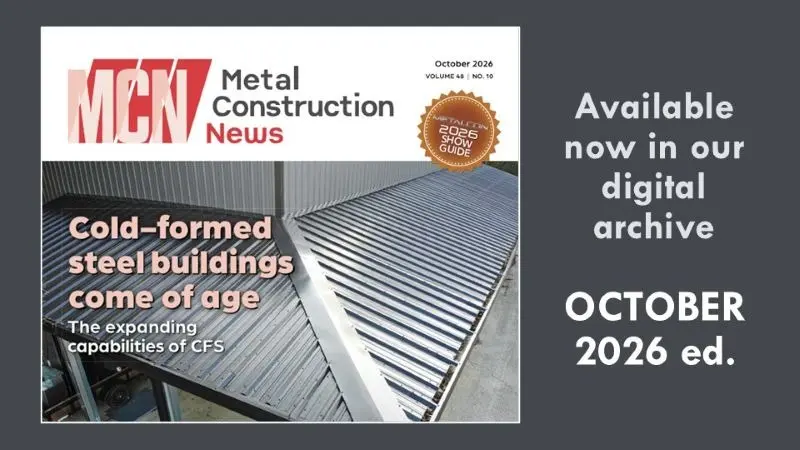
The October 2026 edition of Metal Construction News has officially hit digital newsstands, marking a critical milestone for the architectural, engineering, and metal construction sectors. As the industry navigates a rapidly shifting landscape defined by technological disruption, stringent environmental demands, and persistent workforce challenges, this month’s publication serves as an essential manual for modern builders.
From the evolution of cold-formed steel (CFS) framing systems to the upcoming highlights of METALCON 2026, the latest issue tackles the most pressing operational, technical, and regulatory realities facing contractors, architects, and manufacturers today.
Metal Construction News Editor-in-Chief Anthony Capkun notes that this issue captures an industry at a major crossroads. "We are moving past the experimental phases of smart-construction adoption and material optimization," Capkun writes. "The October 2026 lineup highlights a mature industry that is actively engineering solutions for extreme climates, tighter profit margins, and complex multi-site labor models."
Below is an in-depth exploration of the core features, structural analyses, and operational strategies highlighted in the October 2026 release.
Main Facts: What’s Inside the October 2026 Issue
The October 2026 edition is packed with deep-dive technical features, regulatory guides, and event roadmaps designed to keep industry professionals ahead of the curve. The primary focal points of this month’s issue include:
- The Evolution of Cold-Formed Steel (CFS): A comprehensive look at how digital engineering, automated panelization, and advanced metallurgical properties are enabling CFS systems to break into structural territories once dominated by heavy structural steel and concrete.
- The Official METALCON 2026 Show Guide: An exhaustive preview of the industry’s premier annual conference, detailing floor plans, major exhibitors, hands-on masterclasses, workshops, and high-impact educational tracks.
- Thermal Dynamics of Ice Damming: A diagnostic shift in how facility managers view ice damming on large-scale metal distribution centers—framing it not merely as a drainage issue, but as a severe structural thermal failure.
- Multisite Labor Tracking Complexities: A strategic analysis of how fragmented workforce mobility, misallocated travel hours, and inaccurate time-tracking distort project budgets and compromise future competitive bidding.
- Next-Generation Safety Equipment Standards: An evaluation of the growing chasm between basic OSHA compliance and cutting-edge ergonomic, smart-connected personal protective equipment (PPE).
- Hurricane-Ready Architectural Engineering: A crucial design primer on AMCA 550-certified louvers, offering vital compliance guidance for architects designing facilities across hurricane-prone Atlantic and Gulf Coast corridors.
Chronology: The Journey to the October 2026 Release
The publication of the October 2026 edition is the culmination of a year-long editorial tracking process that maps out the rapid technological and environmental pressures shaping the construction world.
Q1 2026: Identifying Emerging Industry Bottlenecks
At the beginning of the year, Metal Construction News editorial boards consulted with structural engineers, general contractors, and labor economists to identify primary pain points. Two major themes emerged: the spiraling complexity of managing mobile construction crews across multisite operations, and the urgent need to revisit building envelope thermal efficiency in light of shifting commercial real estate demands.
Q2 2026: The Rise of Advanced Materials and Severe Weather Concerns
During the spring quarter, supply chain stabilization allowed structural engineers to experiment more freely with high-tensile cold-formed steel. Concurrently, meteorological forecasts predicted an intense hurricane season along the southern and eastern seaboards, prompting an immediate push for educational content regarding wind-driven rain defense systems, specifically AMCA 550-certified louvers.
Q3 2026: METALCON Preparations and Field Research
Throughout the summer months, editorial teams collaborated with event organizers to assemble the definitive METALCON 2026 Show Guide. Simultaneously, field researchers investigated thermal imaging data from northern distribution hubs, confirming that ice damming in metal roofs is fundamentally driven by building envelope thermal bridging rather than simple snow loads.
October 1, 2026: Official Launch
The release of the October 2026 digital edition makes these critical insights immediately accessible to tens of thousands of industry professionals via the Metal Construction News digital archive.
Supporting Data & Technical Deep Dives
1. Cold-Formed Steel (CFS) Comes of Age
For decades, cold-formed steel was largely relegated to interior non-loadbearing partitions, light-gauge framing, and low-rise secondary structures. However, advances in Computer-Aided Engineering (CAE), Building Information Modeling (BIM), and roll-forming precision have changed the calculus.
The October 2026 feature on CFS highlights:
- Higher Strength-to-Weight Ratios: Modern high-strength steels allow for lighter framing packages that reduce foundation load requirements.
- Offsite Prefabrication: Panelized CFS systems manufactured in controlled factory settings reduce on-site waste by up to 20% and significantly shorten construction schedules.
- Expanded Structural Envelopes: New hybrid structural systems—combining hot-rolled steel skeletons with load-bearing CFS infill panels—are successfully scaling mid-rise commercial and multi-family residential structures up to 10 stories.
2. Ice Damming: A Thermal Failure in Distribution Centers
Large-scale metal distribution centers, often spanning hundreds of thousands of square feet, face unique building science challenges. While maintenance crews historically responded to winter roof leaks by clearing snow accumulation or applying chemical de-icers, the October issue argues that this approach treats the symptom rather than the disease.
"Ice damming on metal distribution facilities is rarely a drainage problem. It is an indictment of the building’s thermal boundary," notes an excerpt from the October technical feature.
When interior heat escapes through thermal bridges—such as poorly insulated purlins, roof penetrations, or unsealed parapets—it melts the underside of the snowpack. This meltwater runs down to the colder eaves, where it refreezes and forms ice dams, ultimately forcing water underneath standing seam panels. The feature emphasizes continuous exterior insulation (ci) and rigorous air-barrier continuity as the only permanent remedies.
3. Multisite Labor Tracking and Job Cost Distortion
Labor remains one of the most volatile variables in metal construction. With contractors increasingly deploying specialized crews across multiple regional jobsites within a single pay period, traditional manual time-tracking methods have proven dangerously inadequate.
The October 2026 issue examines how:
- Misallocated Travel Hours: Unaccounted-for transit time between disparate project sites silently drains operational margins.
- Distorted Bidding Data: Inaccurate historical labor metrics feed flawed estimating models, leading to either underbid projects that threaten company solvency or overbid projects that lose out to competitors.
- Technological Interventions: The article reviews emerging geofenced mobile time-tracking applications and integrated ERP systems designed to capture real-time labor distribution down to the specific task level.
Official Responses and Industry Expert Perspectives
Industry leaders and association executives have responded enthusiastically to the insights published in the October 2026 edition, highlighting their relevance to current market conditions.
Sarah Jenkins, Director of Technical Services at the Cold-Formed Steel Engineers Institute (CFSEI):
"The architectural community is finally recognizing that cold-formed steel is not just an alternative material—it is a primary structural medium capable of incredible architectural expression and structural integrity. The coverage in Metal Construction News this month accurately reflects how engineering software advancements are unlocking the full potential of CFS."
Marcus Vance, Vice President of Risk Management for National Industrial Contractors:
"Labor tracking has historically been the black box of heavy and metal construction. When you have crews bouncing between three different tilt-up and steel erection sites in a week, traditional timecards are pure fiction. The analysis presented in this month’s MCN regarding multisite labor tracking gives contractors a practical roadmap to protect their bottom lines."
Elena Rostova, AIA, Principal Architect at Coastal Design Group:
"With the increasing severity of coastal weather events, specification errors are something architects simply cannot afford to make. The spotlight on AMCA 550-certified louvers in the October issue is an invaluable reminder that life-safety and property protection begin with rigorous product compliance in high-wind zones."
Implications: What the October 2026 Issue Means for the Future
The release of the October 2026 edition of Metal Construction News carries significant implications for various stakeholders across the metal construction ecosystem:
For General Contractors and Subcontractors
Margin compression driven by inaccurate labor tracking and inefficient field operations can no longer be offset by loose bidding environments. Contractors must adopt automated tracking tools and lean operational frameworks, as highlighted in the labor and safety features of this month’s issue.
For Architects and Specifiers
The transition toward severe-weather resilience (such as hurricane-rated louvers) and sustainable material utilization (such as high-performance CFS framing) requires continuous education. Designers must integrate these standards early in the schematic design phase to avoid costly redesigns and liability exposures.
For Facility Owners and Operators
The redefinition of ice damming as a thermal failure rather than a maintenance annoyance shifts capital expenditure priorities. Owners of large distribution centers must invest in comprehensive thermal envelope audits and continuous insulation upgrades to prevent catastrophic interior water damage and reduce long-term energy loss.
Conclusion
As the industry prepares to gather for METALCON 2026, the October 2026 edition of Metal Construction News stands as a timely, authoritative compass for navigating the complexities of modern construction. By addressing everything from the molecular performance of advanced steel framing to the macroeconomic realities of labor tracking and severe-weather compliance, the publication equips professionals to build smarter, safer, and more profitably.
Industry professionals can access the full October 2026 issue, along with previous publications, by visiting the official Digital Edition Archive.
Metal Construction News extends its sincere gratitude to all contributing writers, engineers, trade associations, and industry partners who made this landmark edition possible.
