

By Anthony Capkun
Published: October 1, 2026
The metal construction industry stands at a transformative crossroads. Driven by rapid technological modernization, shifting regulatory requirements, and unprecedented labor and geographical challenges, the sector is undergoing a profound evolution. The October 2026 edition of Metal Construction News (MCN) captures this pivotal moment, offering industry professionals a deep dive into the innovations, operational hurdles, and design strategies shaping the built environment.
From the maturation of cold-formed steel engineering to crucial updates on hurricane-resistant architecture and the upcoming METALCON 2026 trade show, this month’s publication provides an essential roadmap for contractors, engineers, architects, and facility managers alike.
Below is an in-depth exploration of the core features, chronological developments, supporting data, expert insights, and broader industry implications featured in the October 2026 release.
Main Facts: Core Highlights of the October 2026 Edition
The October 2026 issue addresses the most pressing topics facing the metal construction sector today. The primary editorial focus areas include:
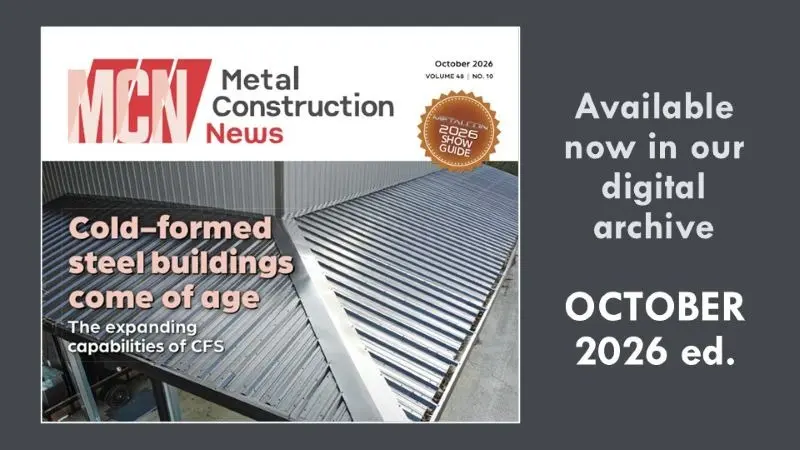
- The Evolution of Cold-Formed Steel (CFS): Moving past historical limitations, modern CFS design, advanced computer-aided engineering, and sophisticated prefabrication techniques are allowing cold-formed steel to capture market shares in larger, more complex building typologies.
- METALCON 2026 Show Guide: Serving as the definitive preview for the industry’s premier annual event, the guide details floor plans, key exhibitors, specialized workshops, masterclasses, and continuing education sessions.
- Thermal Dynamics of Ice Damming: A paradigm shift in how facility managers view roof maintenance. Rather than treating ice damming as a simple waterproofing failure, experts frame it as a critical thermal envelope failure affecting massive metal distribution centers.
- Multisite Workforce Management: Addressing the administrative and financial drain of decentralized labor tracking, where unaccounted travel time and misallocated hours distort job costing and skew future bidding accuracy.
- Next-Generation Safety Equipment: Highlighting a widening gulf between baseline OSHA-compliant gear and technologically advanced personal protective equipment (PPE) that prioritizes ergonomic comfort and real-time biometric monitoring.
- Coastal Resilience and AMCA 550 Louvers: An architectural deep-dive into wind-driven rain resistance standards for buildings situated along vulnerable Atlantic and Gulf Coast corridors.
Chronology: The Trajectory Leading to October 2026
To understand the urgency of the topics featured in this month’s Metal Construction News, it is vital to trace the recent timeline of structural, economic, and regulatory changes within the industry:
- Late 2024 – Throughout 2025: Supply chain normalization following post-pandemic disruptions allowed structural and cold-formed steel fabricators to focus heavily on R&D, particularly in software integration and BIM (Building Information Modeling) interoperability.
- Early 2026: Extreme weather events along the Atlantic and Gulf coasts prompted localized building code authorities to re-evaluate wind-driven rain standards. Concurrently, insurance claims regarding large-scale commercial roof failures—specifically related to unaddressed thermal bridging and freeze-thaw cycles—surged by over 14% year-over-year.
- Mid-2026: As commercial construction expanded into more decentralized, multisite footprints, contractors reported a noticeable squeeze on project margins driven by outdated field-reporting software and inefficient labor tracking.
- October 1, 2026: Metal Construction News releases its comprehensive October edition, coinciding with the industry ramp-up to METALCON 2026, offering timely solutions to these cumulative pressures.
Supporting Data and Technical Insights
The articles within the October 2026 issue are underpinned by shifting industry metrics, engineering realities, and regulatory milestones.
1. Cold-Formed Steel (CFS) Comes of Age
Historically relegated to interior partitions, residential framing, and low-load commercial infill, CFS has experienced a dramatic expansion in structural capability. Enhanced yield strengths (often exceeding 50 ksi), coupled with advanced roll-forming tolerances, allow CFS framing systems to support multi-story mid-rise structures without heavy structural steel or concrete cores. Engineering data cited in this month’s coverage demonstrates a 30% reduction in structural dead loads when comparing fully optimized CFS framing to traditional hot-rolled alternatives in equivalent low-rise applications.
2. Thermal Failure vs. Simple Leaks: The Ice Damming Phenomenon
In large-scale metal distribution centers—often spanning hundreds of thousands of square feet—roof maintenance teams have traditionally responded to winter ice dams with reactive snow removal and chemical de-icers. However, MCN’s thermal analysis reveals that ice damming is fundamentally a symptom of uncontrolled heat loss through the building envelope. Uninsulated thermal bridges, inadequate attic or plenum ventilation, and compromised continuous insulation create localized melting points on the roof surface. When meltwater runs down to the colder, unheated eaves, it refreezes, creating a structural dam that forces water under standing seams. The data indicates that interior heat loss rates as low as 5 BTUs/hr·ft² are sufficient to trigger the freeze-thaw cycle on metal roofs during sub-freezing ambient conditions.
3. The Labor Tracking Deficit in Multisite Construction
As contractors scale their operations across regional and national footprints, labor tracking has become a primary financial leak. Industry surveys highlighted in the October issue indicate that up to 7% of total billable hours are misallocated due to manual time-card entries, ambiguous travel-time policies between job sites, and delayed field reporting. In an industry operating on razor-thin net margins (frequently between 2% and 5%), unrecorded or misattributed labor hours can turn a profitable commercial build into a loss-maker, skewing estimating databases for future bids.
4. Safety Gear: Compliance vs. Performance
OSHA compliance has long served as the absolute legal floor for construction safety equipment. However, the 2026 safety landscape reveals a widening gap between minimum legal standards and human-centric design. Modern fall protection harnesses, cooling vests, and smart-hardhat sensors now incorporate ergonomic weight distribution, breathable moisture-wicking fabrics, and integrated fatigue-monitoring sensors. Field studies show that while older, compliant gear often faced worker resistance due to discomfort and restricted mobility, next-gen equipment yields a 22% increase in voluntary compliance and daily wear rates.
5. Wind-Driven Rain and AMCA 550 Certification
For architects and engineers designing commercial structures in hurricane zones, standard louver testing is no longer sufficient. AMCA 550 (Standard Test Method for High Velocity Wind-Driven Rain Resistant Louvers) has become the gold standard for verifying that building ventilation openings can withstand severe weather without allowing water infiltration into mechanical spaces or interior plenums. Certified louvers undergo rigorous testing involving 35 mph to 70 mph wind speeds paired with dynamic water-spray rates of up to 8 inches per hour, ensuring critical HVAC infrastructure remains operational during extreme weather events.
Official Responses and Industry Perspectives
Industry leaders, researchers, and event organizers have shared notable perspectives regarding the themes addressed in the October 2026 issue:
- On the Expansion of CFS: Structural engineering consultants note that building officials are increasingly receptive to engineered CFS solutions, provided design teams utilize advanced finite element modeling (FEM) to account for torsional-flexural buckling. One leading framing consultant remarked, "We are no longer asking if cold-formed steel can handle primary structural loads; we are optimizing how fast we can erect multi-story superstructures with a fraction of the heavy equipment traditionally required."
- On Roof Thermal Performance: Facility management associations have praised MCN’s spotlight on ice damming as a long-overdue correction. A prominent commercial roofing consultant stated: "Too many warehouse owners treat ice dams as an act of God or a minor nuisance. In reality, it’s a visible indicator of wasted energy dollars and poor building envelope design. Treating the symptom with a snow shovel ignores the thermal failure happening beneath the panels."
- On METALCON 2026: Event organizers have emphasized that this year’s conference is designed to be deeply practical and interactive. With dedicated masterclasses covering everything from lean manufacturing principles in metal fabrication to advanced software integration, the show aims to equip contractors with actionable tools to combat labor shortages and supply chain volatility.
Implications for the Future of Metal Construction
The insights compiled in the October 2026 edition of Metal Construction News point toward several long-term structural shifts within the design and construction sectors:
- Holistic Building Envelope Design: The traditional separation between structural engineering, thermal insulation design, and moisture management is rapidly dissolving. As energy codes tighten and climate volatility increases, metal buildings must be engineered as integrated, holistic thermal systems where framing, insulation, and cladding function seamlessly together.
- Technological Integration in Project Management: The hidden costs of multisite labor tracking and manual field reporting mean that contractors who fail to adopt automated, cloud-based labor and project management software will struggle to remain competitive. Precise data collection is no longer a back-office luxury; it is a prerequisite for accurate bidding and survival.
- Proactive Coastal Architecture: With extreme weather events becoming more frequent along the Atlantic and Gulf coasts, regulatory bodies are expected to mandate higher testing standards like AMCA 550 across a broader geographic footprint. Specifying certified components early in the design phase will protect architects and engineers from costly liability and retrofitting down the line.
Accessing the Full Publication
For professionals seeking comprehensive access to the original features, detailed schematics, and the complete METALCON 2026 Show Guide, the October 2026 edition of Metal Construction News is available now via their official publication portal. Readers can also explore the extensive Digital Edition Archive for historical back issues and ongoing industry updates.
