

Executive Summary
On January 1, 2024, California officially enacted a sweeping ban on the sale of new small off-road engines (SORE) rated under 25 gross horsepower. Originally popularized in public discourse as a measure targeting gas-powered lawnmowers and leaf blowers under Assembly Bill 1346 (AB 1346), the regulatory reality has proven far more expansive.
While residential lawn care remains the visible face of this transition, the legislation includes a vast array of industrial and construction equipment. Most notably, the roofing sector now faces a critical shortage of compliant machinery. Essential tools—including roofing pumps, material handling equipment, tear-off machines, asphalt applicators, and portable generators—fall squarely under the SORE definition and are now prohibited from being sold new in the state if powered by traditional gasoline engines.
As manufacturers and distributors exhaust their remaining pre-2024 inventory, California contractors are grappling with a market in transition. They must navigate the steep operational hurdles of adapting to battery-powered or electrified alternatives that many industry experts argue are not yet technologically viable for heavy-duty, commercial-scale applications.
Main Facts: The Scope of the SORE Ban
What is Assembly Bill 1346?
Passed in 2021 and implemented on January 1, 2024, Assembly Bill 1346 directed the California Air Resources Board (CARB) to adopt regulations to prohibit the sale of new engines classified as SORE. These are defined as spark-ignition engines rated at or below 19 kilowatts (equivalent to 25 gross horsepower).
The law targets the sale of new equipment. It does not criminalize the possession or continued use of existing gas-powered SORE equipment by homeowners, commercial landscapers, or construction contractors. However, it effectively halts the replenishment of fleet inventory with traditional combustion models once current distributor stockpiles are depleted.
The Overlooked Construction and Roofing Equipment
While early media coverage focused almost exclusively on domestic lawn and garden tools, the statutory definition of SORE captures any engine under the 25-horsepower threshold that is not specifically exempted. Although high-horsepower agricultural and heavy construction equipment (such as excavators and large diesel generators) escaped the ban, light-duty construction machinery did not.
For the roofing industry, the impact is immediate and profound. The following categories of equipment are now restricted from new sales in California if they utilize standard gasoline SORE engines:
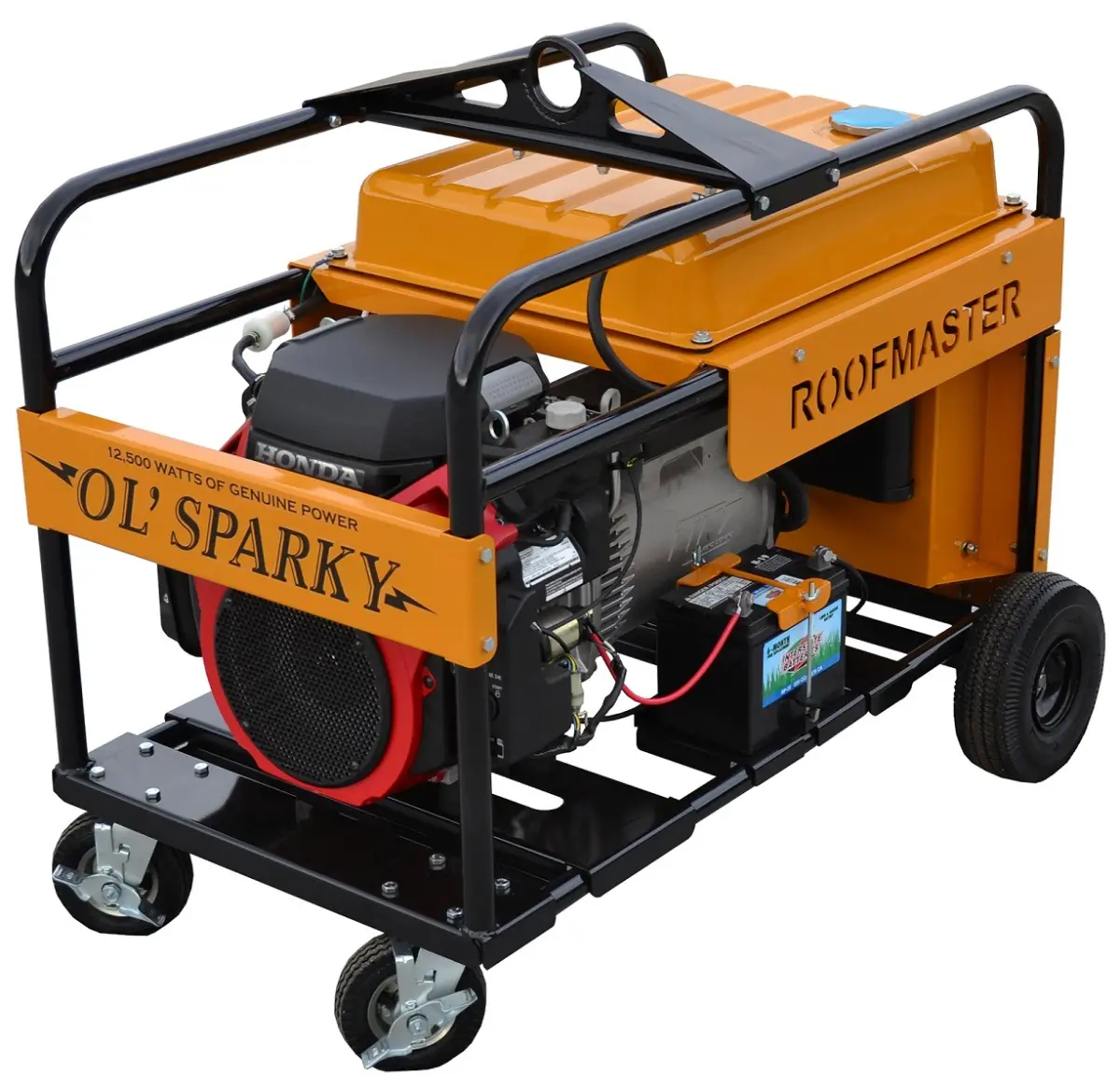
- Utility Generators: Crucial for providing localized, stable power on job sites lacking utility grid connections.
- Roofing Pumps and Spray Applicators: Used for transporting adhesives, coatings, and liquid-applied membranes.
- Tear-Off Machines: Heavy-duty, gas-powered scrapers used to strip old roofing materials off commercial decks.
- Material Handling Equipment: Small hoists, winches, and gravel spreaders designed to operate on rooftops where weight limitations prevent the use of heavy cranes.
The "Pre-2024" Loophole and Market Status
Under CARB guidelines, manufacturers and distributors are permitted to sell remaining inventory of equipment featuring engines manufactured before January 1, 2024. These are designated as "approved engines" because they were produced under prior regulatory frameworks.
Consequently, a temporary buffer exists: contractors can still purchase gas-powered roofing equipment and generators in California, provided the units were manufactured and stocked before the deadline. However, equipment distributors warn that this supply is finite and rapidly dwindling. Once these legacy stocks are exhausted, new gas-powered options under 25 horsepower will disappear from California retail shelves entirely.
Chronology of the Legislation
[Feb 2021] AB 1346 Introduced -> [Oct 2021] Signed into Law -> [Dec 2021] CARB Adopts Regulations -> [2022-2023] Transition & Stockpiling -> [Jan 1, 2024] Ban Takes Effect -> [Present] Inventory Depletion & Market StrainThe pathway to the 2024 ban was paved over several years of legislative maneuvering, regulatory rulemaking, and industry pushback:
- February 18, 2021: Assemblymember Marc Berman (D-Menlo Park) and Assemblymember Lorena Gonzalez (D-San Diego) introduce Assembly Bill 1346. The bill is framed as a critical public health measure aimed at reducing localized air pollution from highly polluting two-stroke and small four-stroke engines.
- October 9, 2021: Governor Gavin Newsom signs AB 1346 into law. The statute mandates that CARB adopt regulations to transition the state to zero-emission SORE sales by 2024, or as soon as CARB determines is "feasibly possible."
- December 9, 2021: Following public workshops and economic impact assessments, CARB officially adopts amendments to its SORE regulations. The board establishes January 1, 2024, as the hard deadline for the transition to zero-emission equipment (ZEE) for most SORE categories. It also sets a secondary deadline of 2028 for portable generators, though strict emission standards implemented in 2024 have already severely curtailed the availability of conventional models.
- 2022–2023: Industry associations representing landscaping, manufacturing, and construction lobby CARB for exemptions. While some specialized categories receive temporary reprieves, the roofing and general contracting sectors fail to secure broad exemptions for light-duty utility equipment. Manufacturers begin adjusting production lines, and distributors in California start stockpiling 2023-compliant engines to prepare for the upcoming sales freeze.
- January 1, 2024: The ban on the sale of new gas-powered SORE units takes effect across California. Retailers and commercial distributors are legally barred from ordering new non-compliant gas-powered stock.
- Present Day: The commercial construction sector enters a critical transition phase. Distributors report high demand for remaining 2023 gas-powered stock, while contractors face rising prices for compliant zero-emission alternatives and specialized low-emission engines.
Supporting Data and Environmental Context
The Environmental Rationale
The primary driver behind AB 1346 was the disproportionate volume of emissions generated by small, inefficient utility engines compared to modern passenger vehicles. Because passenger cars have been subject to decades of increasingly stringent catalytic converter and exhaust filtration standards, their emissions profiles have plummeted. In contrast, SORE technology remained relatively unregulated.
According to data compiled by CARB prior to the passage of the bill:
- Smog-Forming Emissions: In California, the total reactive organic gases (ROG) and oxides of nitrogen ($NO_x$) emitted by SORE exceeded those emitted by all light-duty passenger cars in the state. In 2021, SORE emissions were estimated at nearly 140 tons per day, compared to roughly 95 tons per day from passenger cars.
- The Camry Comparison: CARB researchers calculated that operating a commercial leaf blower for just one hour produced the same amount of $NO_x$ and ROG emissions as driving a 2017 Toyota Camry approximately 1,100 miles—the distance from Los Angeles to Denver.
- Public Health Impact: SORE operations often occur in close proximity to operators and residential communities, leading to elevated local concentrations of particulate matter ($PM_2.5$), carbon monoxide, and carcinogenic compounds like benzene.
Daily Smog-Forming Emissions in California (2021 Estimations)
==============================================================
Passenger Cars: [█████████████████████] 95 Tons/Day
SORE Equipment: [███████████████████████████████] 140 Tons/Day
The Technical Divide: Roofing Industry Realities
While the environmental data presents a compelling case for urban landscaping tools, roofing contractors argue that the physical demands of industrial construction make direct electrification technically challenging.
Commercial roofing projects present unique power challenges:
- Continuous High-Draw Electrical Loads: Installing single-ply membrane roofing (such as TPO or PVC) requires hot-air welders. These machines must maintain continuous temperatures of up to 1,100°F (593°C). A standard automatic walk-welder typically draws between 4,600 and 6,000 watts of power continuously.
- Lack of On-Site Infrastructure: On new construction sites or major commercial retrofits, permanent utility power is rarely active or accessible on the roof deck. Temporary power poles, when available, are often located hundreds of feet away at ground level, leading to severe voltage drops over long extension cords.
- Battery Limitations: To run a single commercial hot-air welder for an eight-hour shift without a gas generator would require a battery system capable of delivering at least 36 to 48 kilowatt-hours (kWh) of energy. For context, a standard Tesla Model 3 battery is roughly 57 to 75 kWh. A battery system of this scale designed for industrial job sites is prohibitively heavy, expensive, and logistically difficult to hoist onto rooftops. It also requires its own charging infrastructure, which cannot be easily serviced on an unpowered job site.
| Equipment Type | Typical Power Requirement | Battery Alternative Feasibility | Key Operational Hurdles |
|---|---|---|---|
| Screw Guns / Sawzalls | Low (Intermittent) | High (Standard Li-ion packs) | Minimal; widely adopted. |
| Tear-Off Machines | Medium (Continuous mechanical) | Low to Moderate | Heavy battery weight reduces machine maneuverability and run time. |
| Roofing Pumps | High (Continuous hydraulic/mechanical) | Low | Requires massive torque; battery depletion occurs rapidly under heavy load. |
| Hot-Air Welders | Very High (Continuous thermal load) | Very Low | Extreme continuous wattage requirements; battery systems are too heavy and costly. |
Official Responses and Stakeholder Perspectives
State Regulators: California Air Resources Board (CARB)
CARB maintains that the transition to zero-emission technology is not only necessary to meet California’s climate goals—including achieving carbon neutrality by 2045—but is also economically and technologically achievable. To ease the burden on commercial operators, CARB launched the Clean Off-Road Equipment Voucher Incentive Project (CORE).
The CORE program allocates millions of dollars in funding to provide point-of-sale discounts on zero-emission professional landscaping and construction equipment.
In official statements, CARB representatives have emphasized:
"The transition to zero-emission small off-road equipment is a critical step in protecting public health, particularly for commercial operators who bear the brunt of toxic exhaust emissions daily. We are committed to working with manufacturers to expand the availability of zero-emission options and providing financial assistance to help businesses make the transition."
However, roofing contractors note that the CORE program’s funding has primarily targeted landscaping equipment, leaving specialized construction tools with minimal financial support.
Industry Representatives: Roofing Contractors and Associations
Industry groups, such as the National Roofing Contractors Association (NRCA) and various California-specific roofing coalitions, have expressed deep concern over the pace of the mandate. They argue that the state’s regulatory timeline has outpaced the manufacturing sector’s ability to develop viable, heavy-duty electric alternatives.
A representative from a major California roofing supply distributor commented on the operational realities:
"We are fully supportive of reducing emissions, but the technology must match the demand. Telling a contractor they cannot buy a gas-powered generator or pump when there is no viable battery-powered alternative on the market does not stop the work—it simply forces contractors to keep old, less efficient, and dirtier engines running longer through constant repairs. You cannot weld a commercial roof with a tool powered by standard tool batteries."
Contractors also highlight the logistical complexity of managing multi-trade job sites. When multiple subcontractors require high-voltage power simultaneously, the absence of portable, gas-powered generators under 25 HP threatens to stall project timelines and increase overall construction costs.
Implications for Contractors and the Market
The implementation of the SORE ban is reshaping the construction landscape in California, forcing contractors to adapt their procurement strategies, operational workflows, and capital investment plans.
1. The Depletion of "Safe Harbor" Inventory
In the immediate term, the most pronounced market trend is the run on remaining pre-2024 gas-powered equipment. Because distributors are permitted to sell off their existing stock of units featuring pre-2024 engines, a temporary "safe harbor" exists.
Contractors who anticipate needing new generators, pumps, or tear-off machines over the next three to five years are actively purchasing these units now. Once this inventory is exhausted, California-based procurement of these traditional tools will cease. This has led to a common refrain among industry veterans: “The best time to buy new gas-powered equipment was yesterday; the second-best time is today.”
2. Rising Operational and Capital Costs
The shift toward zero-emission alternatives carries a steep financial premium. Commercial-grade battery systems and electric-drive machinery are significantly more expensive than their gas-powered counterparts.
- Initial Capital Outlay: A commercial-grade, zero-emission portable power station capable of supporting heavy construction tools can cost three to five times more than a comparable gas-powered generator.
- Battery Lifecycle Costs: Unlike gasoline engines, which can operate for decades with routine maintenance, industrial lithium-ion batteries have a finite lifespan of approximately 1,500 to 3,000 charge cycles. Replacing these massive battery packs represents a significant recurring capital expense.
- Charging Logistics: Contractors must establish complex charging protocols. This often involves transporting depleted batteries back to a central warehouse overnight or securing high-capacity charging stations on-site, both of which add to labor and logistical overhead.
3. Regulatory Workarounds and Interstate Commerce
The regional nature of the ban introduces potential regulatory loopholes and enforcement challenges. Because neighboring states like Nevada, Arizona, and Oregon do not restrict the sale of SORE equipment, California contractors may face temptation to purchase gas-powered machinery out-of-state and transport it across state lines.
While CARB regulations prohibit the sale of non-compliant new SORE equipment within California, enforcing a ban on the import and use of newly purchased out-of-state equipment on private job sites presents immense logistical challenges for state inspectors. However, contractors caught violating these regulations face substantial fines, and reputable commercial firms are unlikely to risk their licensing and public contracts on non-compliant equipment.
4. Acceleration of Hybrid and Low-Emission Technologies
In response to the ban, equipment manufacturers are pivoting toward hybrid designs and alternative fuel sources. While battery-only systems struggle with high-draw applications, hybrid configurations—such as small propane-powered engines or highly efficient diesel generators rated just above the 25-horsepower threshold—are gaining traction.
Furthermore, the ban is driving rapid innovation in solid-state batteries and hydrogen fuel cell technology. While these systems are currently in their infancy for construction applications, they may eventually provide the power density and rapid refueling capabilities that commercial roofing contractors require. Until then, the industry faces a challenging transition period characterized by high costs, regulatory friction, and a scramble for remaining legacy equipment.
