

Introduction: The Unintended Casualties of California’s Green Transition
As the calendar turned to January 1, 2024, California embarked on one of its most ambitious environmental milestones to date: a sweeping prohibition on the sale of new gas-powered equipment utilizing Small Off-Road Engines (SORE). While public discourse and media coverage surrounding Assembly Bill 1346 focused almost exclusively on residential lawn care—proclaiming the end of gas-powered lawnmowers and leaf blowers—a far more disruptive reality has begun to set in across the state’s industrial sectors.
Beneath the headline-grabbing promises of quieter neighborhoods and reduced urban smog lies a profound regulatory challenge for the commercial construction and roofing industries. Because the legislation targets engine displacement and horsepower rather than specific consumer activities, a vast array of heavy-duty construction tools has been caught in the regulatory net. From specialty asphalt pumps and material handlers to tear-off machines and portable generators, the machinery that builds and maintains California’s infrastructure is facing an unprecedented supply-chain squeeze. As existing inventories of compliant, pre-2024 engines dwindle, contractors are confronting a stark technological gap: a regulatory mandate to transition to zero-emission equipment before the battery technology required to power heavy-duty job sites is commercially viable.
Main Facts: Decarbonizing the Small Off-Road Engine (SORE)
What Does AB 1346 Actually Prohibit?
Passed in 2021 and implemented on January 1, 2024, California Assembly Bill 1346 directs the California Air Resources Board (CARB) to phase out the sale of new SORE-equipped machinery. By definition, SORE refers to spark-ignition engines rated at or below 19 kilowatts—equivalent to 25 gross horsepower (HP).
While the public face of the ban was the domestic landscaping industry, the law applies universally to any non-exempt spark-ignition engine under the 25 HP threshold. This includes:
- Landscaping tools: Lawnmowers, leaf blowers, weed trimmers, and chainsaws.
- Specialty vehicles: Gas-powered golf carts and utility vehicles.
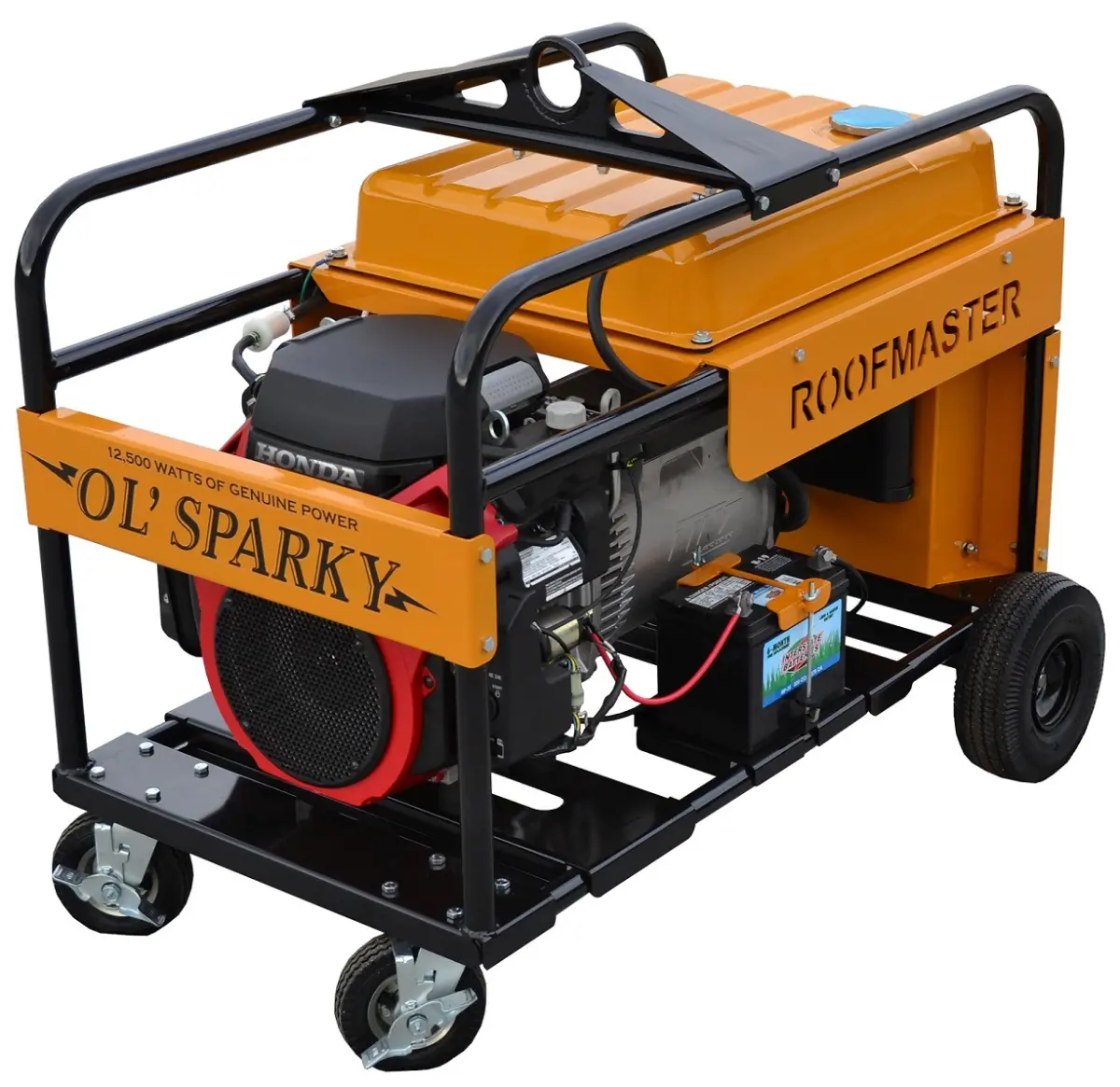
- Industrial and construction equipment: Portable generators, concrete saws, pressure washers, surface preparation equipment, and hydraulic pumps.
- Roofing-specific machinery: High-powered vacuum systems, tear-off machines, hot-melt asphalt pumps, felt-layers, and material hoisting equipment.
The Critical Loophole: Existing Use vs. New Sales
A crucial distinction in the enforcement of AB 1346 is the difference between operation and transaction. The law does not criminalize the possession or use of gas-powered SORE equipment purchased before the 2024 deadline. Contractors, landscapers, and homeowners are legally permitted to operate their existing fleets until the machinery reaches the end of its natural operational life.
However, the sale of new gas-powered equipment utilizing non-compliant engines is strictly prohibited. Manufacturers are barred from distributing new, non-compliant gas engines into the California market, and distributors are prohibited from selling them to end-users.
The only near-term reprieve for businesses is the "sell-through" provision: manufacturers and distributors can legally sell equipment built with engines manufactured before January 1, 2024, provided they carry certified pre-2024 engine serial numbers. Once these legacy inventories are exhausted, the purchase of new gas-powered equipment under 25 HP will effectively be impossible within state lines.
Chronology: From Legislative Pen to Jobsite Reality
The road to the 2024 ban was paved over several years of legislative maneuvering, regulatory drafting, and escalating concerns from industrial stakeholders.
[Oct 2021] Governor Newsom signs AB 1346 into law
    │
[Dec 2021] CARB adopts formal SORE regulatory amendments
    │
[2022-2023] Manufacturers rush to maximize pre-2024 engine production
    │
[Jan 1, 2024] Ban on new gas-powered SORE sales takes effect
    │
[Present] Distributors sell through remaining 2023 stock; industry faces technological gap- October 9, 2021: Governor Gavin Newsom signs Assembly Bill 1346 into law. Author Assemblymember Marc Berman (D-Menlo Park) champions the bill as a vital step toward meeting California’s statutory greenhouse gas reduction goals.
- December 9, 2021: The California Air Resources Board (CARB) formally adopts amendments to the SORE regulations, establishing the January 1, 2024 deadline for zero-emission emission standards for most SORE categories.
- 2022–2023: The Stockpiling Phase: Recognizing the impending disruption, equipment manufacturers and industrial distributors work to maximize production and import of 2023-compliant engines. Warehouses are stocked to capacity with gas-powered generators, pumps, and roofing equipment to create a buffer for California businesses.
- January 1, 2024: The Deadline: The ban on the sale of new SORE engines manufactured on or after this date goes into effect. The transition to zero-emission equipment officially becomes mandatory for all new retail and commercial purchases, save for a few highly specific emergency use-cases.
- Post-January 2024: The Depletion Phase: Commercial roofing contractors and industrial suppliers enter a race against time, purchasing the remaining stock of pre-2024 manufactured equipment while grappling with the absence of viable, heavy-duty electric alternatives.
Supporting Data: The Emissions Argument vs. Technical Reality
To understand the friction between state regulators and the construction industry, it is necessary to examine both the environmental data that drove the legislation and the physical, thermodynamic limitations of current battery technology.
The Environmental Rationale: SORE vs. Passenger Cars
According to data compiled by CARB, small off-road engines are disproportionately dirty compared to modern passenger vehicles. Because SORE units historically lacked the advanced catalytic converters and emissions-control systems standard in automobiles, their exhaust contains high concentrations of reactive organic gases (ROG) and nitrogen oxides ($NO_x$), which contribute to smog and ground-level ozone.
Emissions Comparison (1 Hour of Operation):
┌────────────────────────────────────────────────────────┐
│ Commercial Leaf Blower = 1,100 Miles Driven (Sedan)    │
├────────────────────────────────────────────────────────┤
│ Gas Lawnmower          = 300 Miles Driven (Sedan)      │
└────────────────────────────────────────────────────────┘
CARB’s regulatory impact analysis presented several key statistics:
- Disproportionate Pollution: In 2020, CARB estimated that SORE emissions of ozone precursors in California exceeded those produced by the state’s entire fleet of 35 million light-duty passenger cars.
- Extreme Point-Source Emissions: Operating a commercial-grade gas-powered leaf blower for just one hour emits the same quantity of smog-forming pollution as driving a standard light-duty passenger car 1,100 miles—roughly the distance from Los Angeles to Denver.
- Lawnmower Equivalency: Operating a standard gas-powered lawnmower for one hour produces emissions equivalent to a 300-mile car trip.
The Physics of Roofing: Why Batteries Fall Short
While these statistics provided powerful political leverage for banning consumer lawn care equipment, the commercial roofing industry operates under entirely different physical constraints.
Unlike a landscaping crew that can swap out small lithium-ion batteries throughout the day, commercial roofing contractors require massive, continuous power to operate heavy-duty machinery, often in off-grid environments.
Consider the power requirements of standard commercial roofing operations:
- Thermoplastic Membrane Welding: Modern commercial flat roofs utilize single-ply membranes (such as TPO or PVC) that must be heat-welded together to form a waterproof seal. Automatic walk-behind welders (such as the industry-standard Leister Varimat) require constant, unfluctuating power—typically 230 volts, single-phase, drawing up to 4,600 watts of electricity continuously.
- Continuous Operation Requirements: A standard commercial roofing crew utilizes multiple hand welders and automatic welders simultaneously. To run a single automatic welder and two hand welders for an eight-hour shift requires approximately 45 to 50 kilowatt-hours (kWh) of electricity.
- The Weight and Cost of Battery Alternatives: To deliver 50 kWh of usable energy on a rooftop using current lithium-ion technology, a battery system would weigh over 800 pounds and cost upwards of $15,000 to $20,000. In contrast, a highly portable, 6,500-watt gas-powered generator weighs roughly 200 pounds and costs under $3,000.
- The Structural Load Limitation: Rooftops under construction or renovation have strict structural load limits. Transporting half-ton battery packs onto a roof is not only logistically challenging but often structurally unfeasible.
Official Responses: Regulators Clash with Industry Pragmatism
The implementation of AB 1346 has drawn sharp contrasts between the optimistic projections of state environmental agencies and the boots-on-the-ground warnings of trade associations.
The California Air Resources Board (CARB) Position
CARB maintains that the transition is both technologically feasible and economically beneficial in the long run. To ease the transition, the state allocated funding to the Clean Off-Road Equipment Voucher Incentive Project (CORE), which provides financial assistance to businesses purchasing zero-emission equipment.
In public statements, CARB officials have emphasized:
- Public Health Imperatives: The reduction of localized emissions directly benefits the health of workers who operate these machines daily, reducing their exposure to carcinogenic exhaust fumes.
- Long-Term Cost Savings: While the upfront cost of electric and battery-powered equipment is higher, CARB argues that businesses will realize significant savings over the equipment’s lifecycle through reduced fuel costs and minimal maintenance requirements.
- Market Innovation: Regulators assert that aggressive mandates are necessary to force manufacturers to innovate and scale up the production of heavy-duty electric alternatives.
Industry Alarms: The Construction and Roofing Sector Responds
Trade organizations, including the Western States Roofing Contractors Association (WSRCA) and the National Roofing Contractors Association (NRCA), have expressed deep concern over the lack of practical exemptions for the construction sector.
Industry representatives argue that the state’s messaging led contractors to believe they were exempt, only to find that the technical definition of SORE left them highly vulnerable:
- The "Exemption" Misunderstanding: Early legislative drafts suggested that "construction and agriculture" would be shielded from the ban. However, because the final regulations target the engine itself (spark-ignition under 25 HP) rather than the industry using it, only highly specific diesel-powered or emergency standby systems escaped the restriction.
- The Jobsite Power Vacuum: "We are being told to transition to electric tools, but who is going to provide the electricity?" asks one commercial roofing contractor. On new construction sites, utility power is rarely active. Contractors rely on portable gas generators to run their entire operations. If new gas generators under 25 HP are banned, and utility power is unavailable, construction progress faces a literal power vacuum.
- The Three-Phase Dilemma: Many advanced industrial tools require three-phase power. Portable battery systems capable of delivering clean, continuous three-phase power are virtually non-existent in the commercial market at a scale that is portable or affordable for small-to-medium-sized contracting businesses.
Implications: Navigating the Post-2024 Landscape
The enforcement of AB 1346 is poised to trigger a series of economic and operational adaptations across California’s construction landscape.
The Depletion of Pre-2024 Inventory
For the immediate future, the commercial roofing market is survival-driven. Distributors who anticipated the ban are rationing their remaining stock of 2023-compliant gas-powered generators, pumps, and tear-off machines. Contractors are actively purchasing these units to buffer their fleets for the next three to five years. Once these inventories are exhausted, however, the primary market for new gas-powered SORE equipment in California will cease to exist.
Sourcing Strategies and Legal Risks
As compliant stock in California disappears, contractors are likely to explore alternative procurement strategies, some of which carry significant regulatory risks:
- Out-of-State Purchasing: A tempting option for many contractors will be purchasing gas-powered equipment in neighboring states like Nevada, Arizona, or Oregon, and transporting it back to California jobsites.
- Enforcement Risks: CARB maintains strict enforcement divisions. Operating a newly manufactured, non-compliant gas engine on a commercial jobsite in California can result in steep fines for both the contractor and the equipment owner. Regulators have the authority to inspect jobsites and audit equipment serial numbers to verify compliance.
- The Rise of a Secondary Market: The value of pre-2024 used equipment is expected to skyrocket. A robust secondary market for refurbished gas-powered SORE engines will likely emerge, mirroring the economic dynamics seen in other heavily regulated vehicle and engine sectors in California.
The Future of Jobsite Power and Technology Gaps
The ultimate success of California’s zero-emission mandate hinges on the speed of technological innovation. For the roofing and construction industries to fully transition, several developments must occur:
- Industrial-Scale Portable Power Banks: Manufacturers must develop high-capacity, rugged, and lightweight battery storage systems capable of outputting sustained single-phase and three-phase power under extreme weather conditions.
- Alternative Fuel Engines: While spark-ignition gasoline engines under 25 HP are banned, research is ongoing into small engines running on alternative, zero-emission fuels like hydrogen, though these remain far from commercial viability for standard construction crews.
- Increased Project Costs: In the interim, developers and building owners must prepare for rising construction costs. The capital expense of purchasing advanced battery systems, combined with the potential for slower project timelines due to power management constraints, will inevitably be passed down the supply chain.
For California’s commercial contractors, the regulatory message is clear: the era of cheap, reliable, and portable gas power is drawing to a close. Those who invest in securing remaining compliant inventory today will buy themselves the time needed to adapt, while those who wait may find themselves powerless in a rapidly decarbonizing market.
