

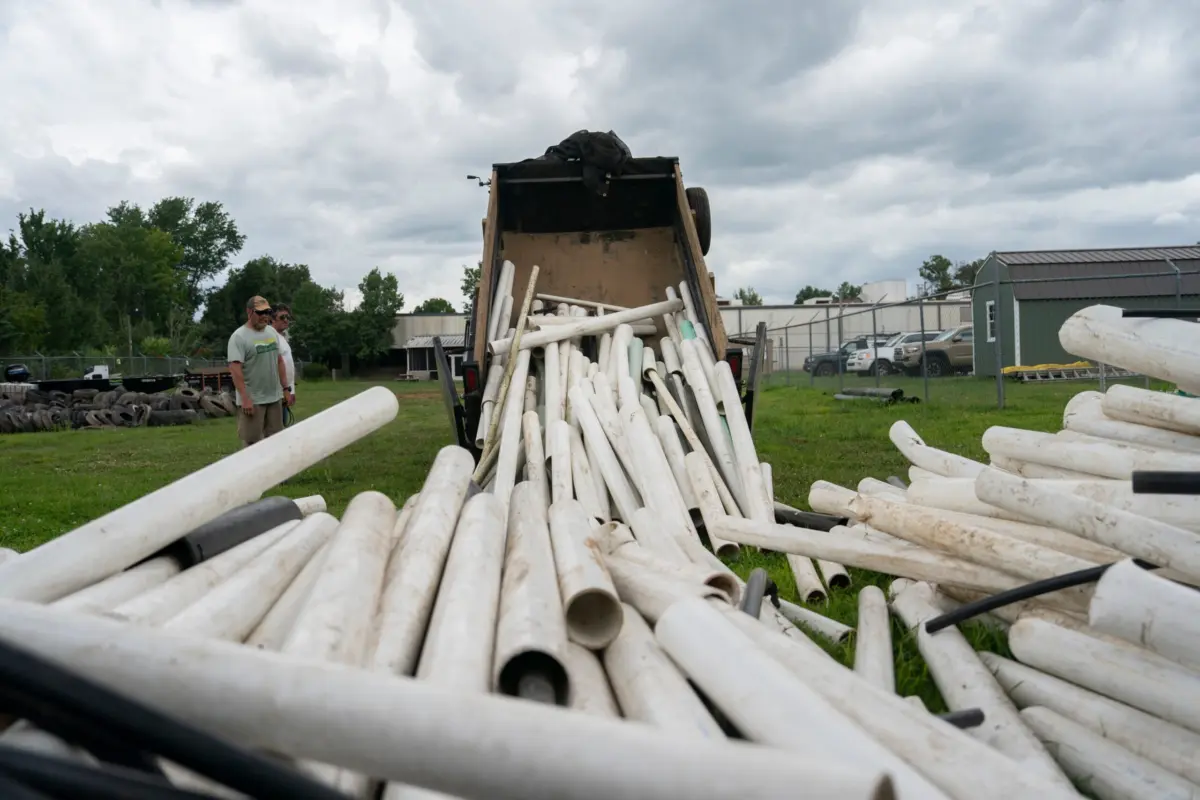
ASHEVILLE, N.C. — Two years after Hurricane Helene tore through the heart of western North Carolina—leveling mature forests, demolishing residential foundations, and instantly transforming serene mountain waterways into raging torrents of destruction—the region’s recovery remains painfully incomplete. While homes have been partially rebuilt and roads reopened, a surreal and pervasive environmental crisis continues to plague the iconic French Broad River and its surrounding ecosystems: millions of pounds of industrial PVC pipe.
Piled high on eroding riverbanks, deeply embedded in riverbed sediment, jammed tightly beneath massive uprooted logs, and tangled in towering debris jams reaching up to two stories high, the endless stretches of white plastic serve as a stark, lingering monument to disaster. For the environmental nonprofit MountainTrue, which has spearheaded exhaustive removal operations along the river, the undertaking has proven to be an exhausting, multi-year battle against both nature and corporate fallout.
As tropical storm systems continue to threaten the region, the enduring presence of the plastic industrial waste highlights a sobering reality: catastrophic climate-driven disasters do not end when the skies clear. Their ecological and economic consequences can disrupt communities, choke vital waterways, and burden local nonprofits for years—if not decades—to come.
The Scale of the Crisis: Main Facts
The scope of the PVC contamination along the French Broad River is staggering. MountainTrue estimates that its specialized crews have pulled hundreds of thousands of individual pipes out of the waterway, with an untold number still littering a 70-mile (113-kilometer) stretch downstream toward a massive reservoir near the Tennessee border.
In many areas, PVC pipes make up roughly 80% of all recovered debris. The items range from rigid, straight industrial conduits to massive, unraveled flexible coils. Their presence has radically altered local hydrology, disrupted natural water flows, posed severe physical hazards to recreational kayakers and tubers, and fundamentally disrupted river ecosystems.
- Massive Recovery Effort: MountainTrue has dedicated upwards of 50,000 work-hours and expended over $1.5 million solely on pipe removal along the French Broad River.
- Workforce of Experts: The cleanup operation relies on approximately 100 individuals organized into 10 crews. Many of these workers are former river and fishing guides who lost their livelihoods when Helene devastated the local outdoor tourism economy.
- Disposal Challenges: The vast majority of the recovered plastic is hauled directly to regional landfills. While a small percentage of undamaged pipe is gifted to local community members for construction projects, recycling options for industrial-grade PVC remain virtually non-existent in the region.
- Financial Lifelines: A critical $10 million state grant originally slated to expire in December 2025 has been extended through February, keeping cleanup operations afloat alongside a recent $500,000 settlement contribution from the manufacturer, IPEX.
Anatomy of a Catastrophe: A Chronology of the Disaster
To understand how millions of pounds of commercial plastic ended up scattered across 70 miles of mountain river, one must look back at the compounding factors that turned a major storm into a once-in-a-millennium catastrophe.
Pre-Storm Preparations (Late September 2024)
Situated in Woodfin, just north of Asheville, Canada-based manufacturer IPEX operated a massive storage facility sandwiched tightly between active railroad tracks and the banks of the French Broad River. Stacks of heavy-duty PVC pipe towered across the property, protected primarily by an engineered earthen berm designed to withstand high water.
As meteorologists tracked the ominous trajectory of Hurricane Helene in late September 2024, IPEX management monitored regional forecasts predicting a severe, yet historically understood, "100-year flood"—an event carrying a 1% statistical probability of occurring in any given year. Operating under these projections, company officials enacted their standard emergency protocols: they moved select materials away from immediate flood zones, secured the property as best they could, and sent factory workers home a full day before the worst of the weather was projected to hit.
The Deluge and the Breach
No one in western North Carolina was prepared for the meteorological anomaly that followed. Hurricane Helene stalled over the southern Appalachian Mountains, dumping an astonishing 30 inches (76 centimeters) of rain in isolated pockets over a span of less than 48 hours. The deluge triggered catastrophic, widespread landslides, uprooted ancient trees, and sent mountainous walls of water cascading down steep river valleys.
When the French Broad River crested, it did not produce a 100-year flood; it unleashed a catastrophic 1,000-year flood event—water levels and velocities roughly ten times worse than historical models had anticipated. The earthen berm protecting the IPEX facility was swiftly overwhelmed. Raging floodwaters tore through the property, sweeping an estimated 60% of all outdoor-stored PVC inventory directly into the violent current.
The Aftermath and Ongoing Recovery (2024–2026)
In the immediate aftermath of the storm, IPEX shuttered its Woodfin manufacturing plant for months, absorbing direct operational losses exceeding $100 million. While initial recovery efforts managed to quickly scoop up a portion of the pipes deposited near the facility, a massive volume of material had already traveled miles downstream, sinking into eddies, wrapping around bridge pylons, and burying itself beneath massive sediment deposits.
As communities began the agonizing process of digging out from the mud and rubble, local outdoor enthusiasts and river guides took to the water on their own accord. Driven by a shared sense of trauma and a deep affection for their natural environment, these groups began clearing debris. This grassroots effort eventually formalized into the professional cleanup crews now managed by MountainTrue, transforming individual grief into a grueling, highly technical regional restoration campaign.
Supporting Data and Environmental Implications
The physical challenge of extracting thousands of pounds of industrial plastic from remote, rugged river canyons cannot be overstated. According to Jemima Filiss-Cook, who oversees cleanup operations in heavily impacted Madison County, crews frequently encounter massive debris jams standing up to 20 feet (6 meters) high.
"We just sort of picture it as a jungle gym that we have to climb and balance on as we clear the pile," Filiss-Cook explains.
Because standard heavy machinery cannot access many remote gorges, the cleanup demands a rare breed of worker. MountainTrue’s French Broad Riverkeeper, Anna Alsobrook, notes that the organization heavily recruits avid outdoorspeople and experienced rock climbers who possess the technical skill, physical endurance, and comfort with risk required to operate chainsaws while balancing on unstable piles of logs and rushing whitewater.
The Looming Threat of Microplastics
Beyond the immediate hazards of physical entrapment for boaters and altered river hydraulics, environmental scientists and crew leaders harbor deep concerns regarding the long-term chemical degradation of the plastic.
As PVC pipes remain exposed to intense ultraviolet radiation from the sun along exposed riverbanks, the polymer structure begins to break down. Material that appeared durable just months after the storm is now growing brittle. Jon Stamper, operations director at MountainTrue, warns that time is running out to remove the material before it completely disintegrates.
"We want to avoid that stuff sitting there forever and just slowly deteriorating and breaking into smaller and smaller pieces," Stamper said. "Some of the pipe that’s been sitting out since Hurricane Helene that has been exposed to the sun all the time is getting to the point where you could crack it when you grab it."
Once the plastic shatters into micro-fragments, complete removal becomes mathematically impossible. These microplastics permanently infiltrate aquatic food webs, threatening native fish populations, macroinvertebrates, and downstream water quality. Furthermore, heavy debris wedged into riverbanks creates biological dead zones and alters natural sediment transport, threatening aquatic habitats across the watershed.
Official Responses and Corporate Accountability
As public scrutiny mounted over the lingering industrial waste, questions regarding corporate liability and preventative infrastructure took center stage.
IPEX leadership has defended the company’s initial preparations while acknowledging the unprecedented nature of the disaster. Company CEO Colleen Pritchett emphasized that corporate management has learned hard lessons from the disaster. Since the flood, IPEX has invested upwards of $100 million to completely repair, upgrade, and harden its Woodfin manufacturing facility against future climate shocks.
"We understand the ongoing challenge," Pritchett stated during a recent corporate update. "We recognize that recovery efforts are complex, they’re resource-intensive, and it’s constantly shaped by river conditions."
Despite these investments, tensions have occasionally flared regarding transparency. IPEX has consistently declined to publicly disclose the exact inventory volume of PVC pipes stored at the site prior to the storm, nor will it release the specific findings of its own internal, company-funded environmental assessments regarding remaining river contamination, citing those figures as "commercially sensitive."
However, under pressure from environmental advocates, local stakeholders, and state regulators, IPEX has agreed to provide financial restitution. The company recently finalized an agreement to disburse $500,000 directly to MountainTrue, funding specialized labor and equipment purchases that will allow cleanup operations to extend well into the coming year.
The Road Ahead: A Long-Term Burden
Despite the influx of state grant funding and corporate settlements, the people on the front lines of the French Broad River restoration remain realistic about the future.
The task of navigating treacherous whitewater rapids while towing boats laden with heavy metal saws and massive sections of industrial pipe is an inherently dangerous profession. While cleanup crews have successfully cleared high-priority navigational hazards and massive urban debris fields, thousands of individual pipes remain buried beneath layers of silt, tucked deep inside inaccessible logjams, or hidden within remote floodplains.
MountainTrue is actively pursuing additional philanthropic grants and government disaster-relief allocations to sustain its workforce once current funding streams dry up. Yet, directors acknowledge a sobering truth: nature has reclaimed a portion of the industrial waste, and complete remediation may never be fully achieved.
"We’re going to do our best as long as the funding allows," Stamper concluded, surveying a towering pile of white plastic waiting to be loaded onto a transport truck at MountainTrue headquarters. "Pero there’s going to be pipe out there that we can’t get ever."
For the residents of western North Carolina, the remnants of Hurricane Helene—embedded stubbornly in the banks of the French Broad—serve as an enduring reminder that recovering from a 1,000-year disaster is not a sprint, but an exhausting, generational marathon.
