

ASHEVILLE, N.C. — Two years after Hurricane Helene tore through the heart of western North Carolina with apocalyptic fury—leveling forests, bulldozing homes, and permanently reshaping the topography of the region—the stubborn, grueling labor of recovery continues.
Piled high along picturesque riverbanks, wedged deep within uprooted root wads, buried beneath layers of heavy sediment, and jammed menacingly beneath dense logjams, a distinct and pervasive artifact of modern industry dominates the landscape. Along the iconic French Broad River, globally celebrated for its roaring whitewater rapids and scenic valleys, millions of pounds of polyvinyl chloride (PVC) pipes tell a cautionary tale. Swept away en masse from a major manufacturing facility just north of Asheville when the storm struck in late September 2024, these industrial polymers serve as a stark reminder that the catastrophic ecological and structural damage of a major hurricane can disrupt human lives and natural ecosystems for years after the skies clear.
Main Facts: The PVC Crisis on the French Broad River
The sheer scale of the environmental disaster unfolding in western North Carolina’s waterways is difficult to overstate. MountainTrue, a prominent regional environmental nonprofit spearheading the cleanup across multiple affected river systems, estimates its specialized crews have successfully pulled hundreds of thousands of individual PVC pipes from the French Broad River. Yet, an untold number of additional pipes continue to litter a sprawling 70-mile (113-kilometer) stretch of the riverway, migrating downstream toward a massive lake near the Tennessee border.
In many localized sections of the river, PVC pipes account for a staggering 80% of all recovered debris. The omnipresence of the plastic has fundamentally altered the river’s character. The submerged and semi-submerged pipes disrupt natural water flows, create treacherous hazards for commercial rafters and recreational kayakers, and severely alter fragile aquatic ecosystems.
Furthermore, the physical removal process is as perilous as it is exhausting. Crews navigate volatile whitewater rapids in specialized watercraft loaded down with jagged fragments of plastic and heavy chainsaws, operating in hazardous environments where a single miscalculation could prove fatal.
Chronology: From the 2024 Cataclysm to the Ongoing Struggle
September 2024: The Unprecedented Deluge
When Hurricane Helene stalled over the southern Appalachian Mountains in late September 2024, it dropped an incomprehensible volume of water—exceeding 30 inches (76 centimeters) in several localized mountainous terrain pockets. The resulting flash floods triggered thousands of devastating landslides, toppled centuries-old trees, knocked massive commercial and residential structures off their foundations, and choked waterways with a chaotic mix of domestic and industrial detritus.
At the IPEX manufacturing facility in Woodfin, North Carolina, operations had been halted a day prior. Plant executives noted that the facility was buffered from the French Broad River by an engineered earthen berm and that outdoor storage yards had been cleared in anticipation of a standard "100-year flood"—a weather event with a 1% statistical probability of occurring in any given year.
However, Helene was no ordinary storm. It delivered a staggering 1,000-year flood event. Raging waters overtopped protections, and an estimated 60% of the massive, vertically stacked inventories of PVC pipe stored outdoors were violently swept into the current.
Late 2024 – 2025: Initial Shock and the Birth of a Recovery Workforce
Following months of factory closures and reconstruction efforts, IPEX reported financial losses well exceeding $100 million. In the immediate aftermath, ad-hoc cleanup efforts began organically. Local river guides, outfitters, and outdoor enthusiasts—many of whom had lost their entire livelihoods overnight when the tourism economy collapsed—began pulling debris from the water.
For these workers, the cleanup evolved into a form of communal "trauma bonding." Recognizing both the technical expertise required and the therapeutic value of the work, MountainTrue formally hired many of these seasoned outdoorspeople, incorporating rock climbers and whitewater veterans into specialized debris removal units.
2026: Extended Funding and Long-Term Realities
Now, two years past the initial disaster, the recovery effort has hit a critical juncture. A $10 million state grant awarded to MountainTrue in 2025, which was originally scheduled to sunset in December, has been extended through February. Meanwhile, IPEX has agreed to contribute an additional $500,000 toward continued remediation on the French Broad River, funding that will allow MountainTrue to sustain its operations well into the coming year.
Despite these capital injections, field operators acknowledge that they are fighting an uphill battle against time, weather, and the physical degradation of the plastics themselves.
Supporting Data and Operational Scale
The metrics compiled by MountainTrue and its municipal partners illustrate the massive logistical footprint required to sanitize a river system poisoned by industrial plastic:
- Work-Hours Invested: Cleanup crews have logged upwards of 50,000 grueling work-hours dedicated solely to pipe extraction on the French Broad River.
- Financial Expenditure: MountainTrue alone has pumped more than $1.5 million into pipe removal efforts, distinct from broader infrastructure and structural repairs across the basin.
- Geographic Spread: Debris fields span a continuous 70-mile corridor extending from the greater Asheville area down to the Tennessee border lake.
- The "Jungle Gym" Effect: Much of the pipe is trapped inside multi-tiered logjams rising up to 20 feet (6 meters) high. Workers must carefully scale these unstable structural piles—often compared by crews to hazardous obstacle courses—to saw apart tangled masses of rigid pipes and flexible coils.
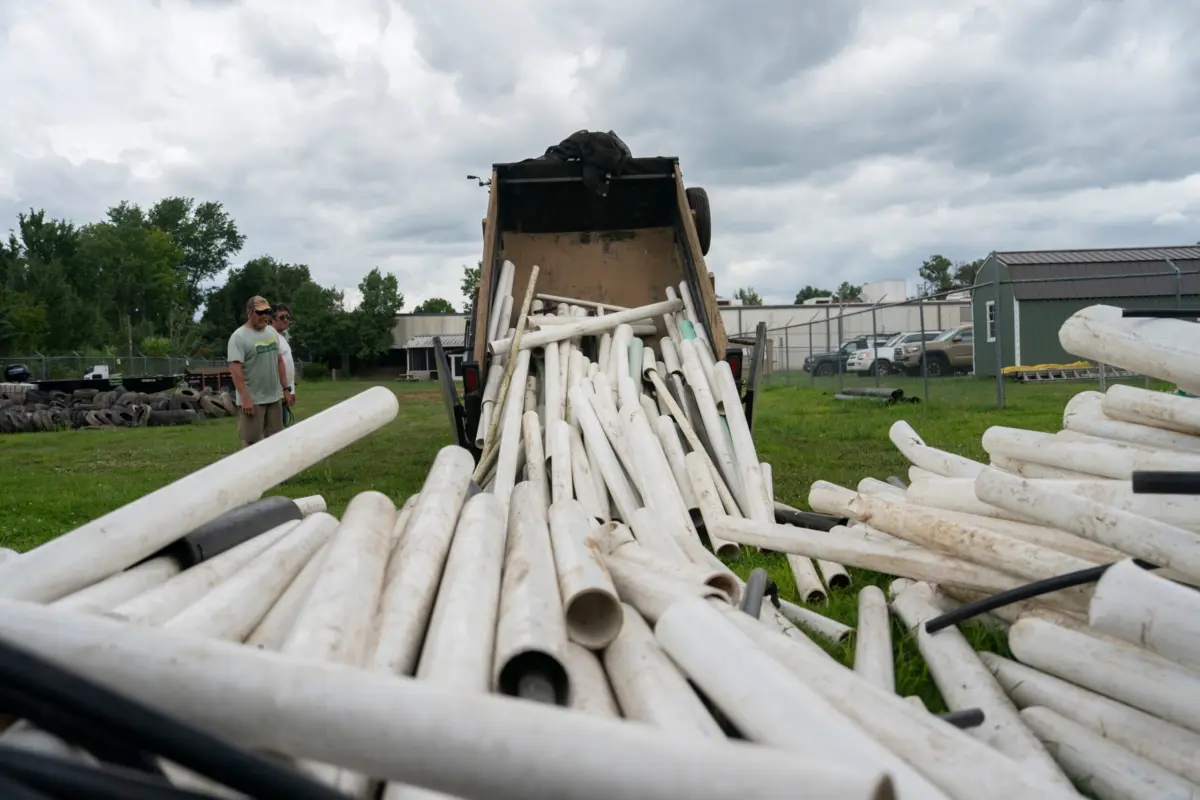
- Disposal Bottlenecks: While the vast majority of recovered PVC is hauled directly to regional landfills due to a lack of viable commercial recycling pathways for weathered industrial polymer, a small fraction of structurally sound pipe is diverted and gifted to local community members for creative building projects.
Official Responses and Corporate Accountability
The presence of corporate-sourced industrial debris in a public natural waterway has sparked complex discussions surrounding corporate responsibility, emergency preparedness, and environmental stewardship.
IPEX, a Canada-based building materials manufacturer, has faced intense scrutiny from local environmentalists and residents over its initial disaster preparedness. When questioned, company executives declined to disclose the exact tonnage of pipe stored at the Woodfin site prior to the storm, citing proprietary interests, and similarly withheld the specific metrics of a company-funded environmental impact study assessing remaining riverbed pollution.
Nevertheless, corporate leadership has acknowledged the ongoing crisis and defended its collaborative posture moving forward.
"We understand the ongoing challenge," said IPEX CEO Colleen Pritchett. "We recognize that […] recovery efforts are complex, they’re resource-intensive, and it’s constantly shaped by the river conditions."
Pritchett noted that the company has invested over $100 million to completely rebuild and structurally reinforce its Woodfin facility. Crucially, the company is actively researching and designing advanced containment systems to prevent future inventory loss should another extreme weather event strike the region—a mitigation measure MountainTrue representatives publicly advocated for months.
Jon Stamper, operations director at MountainTrue, expressed frustration at the sheer friction involved in coordinating large-scale remediation while acknowledging the utility of the corporate settlement funds.
"Just the amount of time and energy that we put into removing all this pipe is exhausting," Stamper said. "We still have stretches of river that haven’t been touched."
Implications: Long-Term Ecological and Public Health Concerns
While the immediate safety hazards—such as underwater entrapment risks for tubers, swimmers, and kayakers—have driven the initial phases of the cleanup, environmental scientists and field coordinators are increasingly sounding the alarm over long-term ecological consequences.
The extended exposure of PVC pipes to intense UV radiation and riverbed friction is changing the chemical and physical composition of the material. Over the past two years, sun-baked plastics have begun to dry out, grow brittle, and fracture under minimal pressure.
"We want to avoid that stuff sitting there forever and just slowly deteriorating and breaking into smaller and smaller pieces," Stamper warned. "Some of the pipe that’s been sitting out since Hurricane Helene that has been exposed to the sun all the time is getting to the point where you could crack it when you grab it."
The degradation of these plastics threatens to convert millions of pounds of rigid industrial material into microscopic plastic particles. Microplastics pose severe, cumulative risks to freshwater aquatic life, potentially bioaccumulating in fish populations and altering the chemical balance of the broader French Broad River basin.
Furthermore, removing the pipe is not simply a matter of lifting it out of the water. Over two years, the pipes have deeply embedded themselves into the sediment, becoming intertwined with root systems where aquatic creatures, including fish and macroinvertebrates, have established permanent habitats. Disturbing the pipes often risks disturbing recovering riverbed ecosystems.
Despite these hurdles, the dedicated cleanup crews—operating out of passion for their home watershed—vow to press on for as long as funding permits. Jemima Filiss-Cook, who oversees cleanup operations in heavily impacted Madison County, emphasizes that the specialized nature of the labor requires a rare blend of wilderness survival skills and psychological resilience.
Anna Alsobrook, MountainTrue’s French Broad Riverkeeper, shares this sentiment, noting that the unique skill set required to safely haul heavy, sharp-edged industrial plastics out of Class III and IV whitewater rapids is unmatched by standard municipal or contractor services.
As climate change increases the frequency and severity of extreme weather events across the globe, the ongoing tragedy of the French Broad River serves as a cautionary blueprint for industrial zones situated near vulnerable floodplains. For now, in western North Carolina, the recovery remains an uphill climb—one jagged plastic pipe at a time.
