

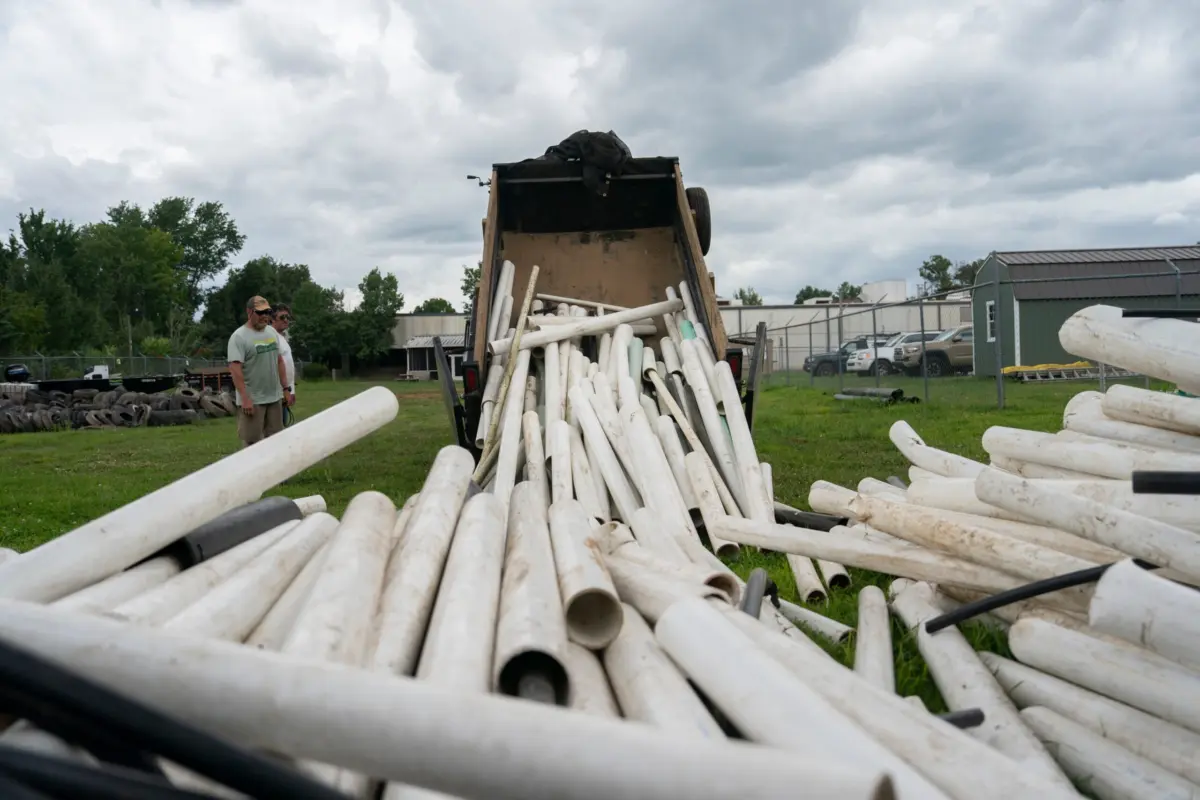
ASHEVILLE, N.C. — Two years after Hurricane Helene tore through the heart of Appalachia, flattening forests, demolishing homes, and reshaping the topography of western North Carolina, the region’s iconic waterways are still grappling with a massive and suffocating legacy. Piled high on riverbanks, wedged deep into uprooted root systems, buried in thick river sediment, and jammed beneath massive logjams are hundreds of thousands of industrial artifacts.
Along the picturesque French Broad River—renowned worldwide for its pulsing whitewater rapids—one material stands out above all others: millions of feet of polyvinyl chloride (PVC) pipe. Swept away en masse from a manufacturing facility just north of Asheville during the historic 2024 flood, these synthetic tubes have become a stark, enduring symbol of how industrial disasters can disrupt fragile ecosystems and local economies long after storm waters recede.
As new tropical weather systems intensify across the Atlantic basin, local environmentalists, river guides, and community leaders find themselves locked in a grinding, multi-year battle to extract the plastic intrusion before it permanently alters the region’s hydrology and introduces a toxic wave of microplastics into the food web.
Main Facts: The Scope of the Crisis
The sheer volume of plastic debris choking the French Broad River and its tributaries is staggering. MountainTrue, a leading regional environmental nonprofit spearheading the cleanup effort, estimates that its crews have pulled hundreds of thousands of individual PVC pipes from the water and surrounding floodplains. Yet, an untold number still litter a sprawling 70-mile (113-kilometer) stretch of the river system, winding all the way down to a massive lake near the Tennessee border.
In some heavily impacted sections of the waterway, PVC pipe accounts for an astonishing 80% of all recovered debris. The infiltration is not merely an aesthetic blight; it poses severe, immediate hazards:
- Recreational Dangers: Submerged and floating coils of rigid and flexible plastic create dangerous entrapment zones for whitewater rafters, kayakers, and tubers.
- Hydrological Alterations: Massive log-and-pipe jams divert natural water currents, accelerating riverbank erosion and altering the structural integrity of the riverbed.
- Ecological Disruption: The pipes have become embedded in sediment, frequently serving as artificial habitats for fish and aquatic insects. However, as they sit exposed to relentless UV radiation, they are beginning to degrade, threatening to splinter into microplastics that will linger in the ecosystem indefinitely.
To date, MountainTrue has dedicated more than 50,000 grueling work-hours and expended upward of $1.5 million solely on pipe removal along the French Broad River.
Chronology: From the 2024 Deluge to Ongoing Recovery
Understanding the presence of millions of pounds of industrial plastic in a wild mountain river requires looking back at the catastrophic timeline of late 2024 and the arduous recovery efforts that followed.
September 2024: The 1,000-Year Deluge
When Hurricane Helene stalled over western North Carolina in late September 2024, it unleashed historic rainfall, dumping upwards of 30 inches (76 centimeters) in localized mountain zones. The resulting deluge triggered catastrophic landslides, obliterated vital infrastructure, and transformed tranquil mountain rivers into violent, high-energy torrents.
At an industrial manufacturing site operated by Canada-based IPEX in Woodfin, North Carolina, tall outdoor stacks of PVC pipes sat sandwiched between railroad tracks and the banks of the French Broad River. Plant executives believed they had taken adequate precautions. Relying on historical flood models, they anticipated a "100-year flood"—a weather event with a 1% statistical chance of occurring in any given year—and proactively moved vulnerable inventory away from immediate low-lying flood zones behind an earthen berm.
They did not account for a 1,000-year flood.
The surging waters of Helene rose ten times higher than projected standards, overwhelming the site and sweeping away an estimated 60% of the outdoor pipe inventory directly into the violent current.
Late 2024 – 2025: Immediate Triage and Industrial Shutdown
In the immediate aftermath, the IPEX manufacturing plant was forced to shutter its operations for months, sustaining corporate losses exceeding $100 million. Simultaneously, traumatized local residents and displaced river guides initiated ad-hoc cleanups, bonding over the shared devastation of their home waters.
Recognizing the immense scale of the crisis, MountainTrue stepped in, organizing professional recovery crews. State and philanthropic funding mechanisms were initiated, including a vital $10 million state grant awarded in 2025 to assist with regional river debris removal.
2026 and Beyond: The Long Tail of Recovery
Today, cleanup operations continue under grueling conditions. While the initial state grant was originally slated to expire in December, officials secured an extension through February, providing a temporary lifeline. Furthermore, IPEX has agreed to contribute $500,000 directly to MountainTrue to fund continued remediation on the French Broad River through the upcoming year. Despite these infusions of capital, organizers warn that the work is far from finished.
Supporting Data and Field Realities
Removing thousands of tons of heavy industrial plastic from a dynamic, boulder-strewn river system is a painstaking, high-risk endeavor. The physical labor is so demanding that MountainTrue has largely staffed its specialized debris teams with former whitewater guides, fishermen, and expert rock climbers.
"I truly don’t think anybody else could do this work except for our debris team members," said Anna Alsobrook, MountainTrue’s French Broad Riverkeeper. The job requires navigating treacherous whitewater rapids while piloting flat-bottomed boats heavily laden with industrial saws and massive bundles of plastic pipe.
The "Jungle Gym" Phenomenon
Field teams routinely encounter nightmarish physical structures along the riverbanks. Rigid straight pipes and unspooled flexible coils are frequently caught beneath immense, multi-story piles of tangled logs and flood debris towering up to 20 feet (6 meters) high.
"Crews just sort of picture it as a jungle gym that they must climb and balance on as they clear the pile," explains Jemima Filiss-Cook, who oversees cleanup operations in Madison County, where the densest concentrations of pipe remain.
Once atop these unstable structures, workers must manually saw longer pipes into manageable chunks, load them onto watercraft, transport them to makeshift landing sites, and transfer them to heavy trucks. The vast majority of the recovered plastic is hauled directly to regional landfills. A small fraction of undamaged pipe is gifted to local community members for agricultural or construction use, as scalable industrial recycling options for contaminated river plastic remain scarce.
The Microplastic Threat
Perhaps the most alarming data point driving the cleanup crews is the clock ticking on material degradation. Jon Stamper, operations director at MountainTrue, points out that the sun-baked PVC is already losing its structural integrity.
"Some of the pipe that’s been sitting out since Hurricane Helene that has been exposed to the sun all the time is getting to the point where you could crack it when you grab it," Stamper noted.
Environmental scientists fear that if left unchecked, the plastic will continuously fragment into smaller and smaller pieces, embedding persistent microplastics into the soil and water column for generations.
Official Responses and Corporate Accountability
The presence of corporate-owned infrastructure debris in a public natural resource has sparked nuanced discussions regarding accountability, industrial preparedness, and environmental stewardship.
IPEX, the manufacturer responsible for the lost inventory, has defended its initial preparations while acknowledging its ongoing financial and moral responsibilities to the community.
"We secured the site as best we could, and we sent people home a day before the flooding was expected," said Johnny Drummond, IPEX vice president of manufacturing, emphasizing the unprecedented nature of the meteorological event.
Following the disaster, IPEX invested over $100 million to completely repair, fortify, and modernize its Woodfin facility. Company leadership is currently collaborating with engineers to design advanced containment systems capable of withstanding extreme flood scenarios—a mitigation strategy that local environmental advocates have demanded for years.
"We understand the ongoing challenge," said IPEX CEO Colleen Pritchett. "We recognize that recovery efforts are complex, they’re resource-intensive, and it’s constantly shaped by the river conditions."
In addition to funding facility upgrades, IPEX’s $500,000 financial contribution to MountainTrue represents a direct acknowledgment of the lingering environmental footprint left by their displaced products. However, company officials declined to disclose the exact tally of pipes originally stored at the site or share the complete findings of a company-funded environmental audit, citing commercial sensitivity.
Implications: A New Normal for Mountain Watersheds
As climate change supercharges the frequency and intensity of extreme weather events, the crisis on the French Broad River serves as a cautionary tale for industrial facilities situated within vulnerable river valleys across the globe.
Economic and Psychological Recovery
For the local community, the cleanup is deeply personal. Many of the cleanup workers are local river professionals whose traditional livelihoods were upended overnight by Helene. Organizing into removal teams has served a dual purpose: restoring the ecological health of the watershed while providing a therapeutic outlet for community trauma recovery.
The Limits of Remediation
Despite the dedication of MountainTrue, state grants, and corporate funding, experts caution that total restoration may be impossible.
"We’re going to do our best as long as the funding allows," Jon Stamper admitted, gazing out over a yet-unreached stretch of riverbank. "But there’s going to be pipe out there that we can’t get ever."
As water levels fluctuate with the seasons, buried PVC pipes continually re-emerge from the sediment, serving as a persistent reminder that while hurricanes pass in a matter of hours, their ecological scars can take decades—and millions of dollars—to heal.
