

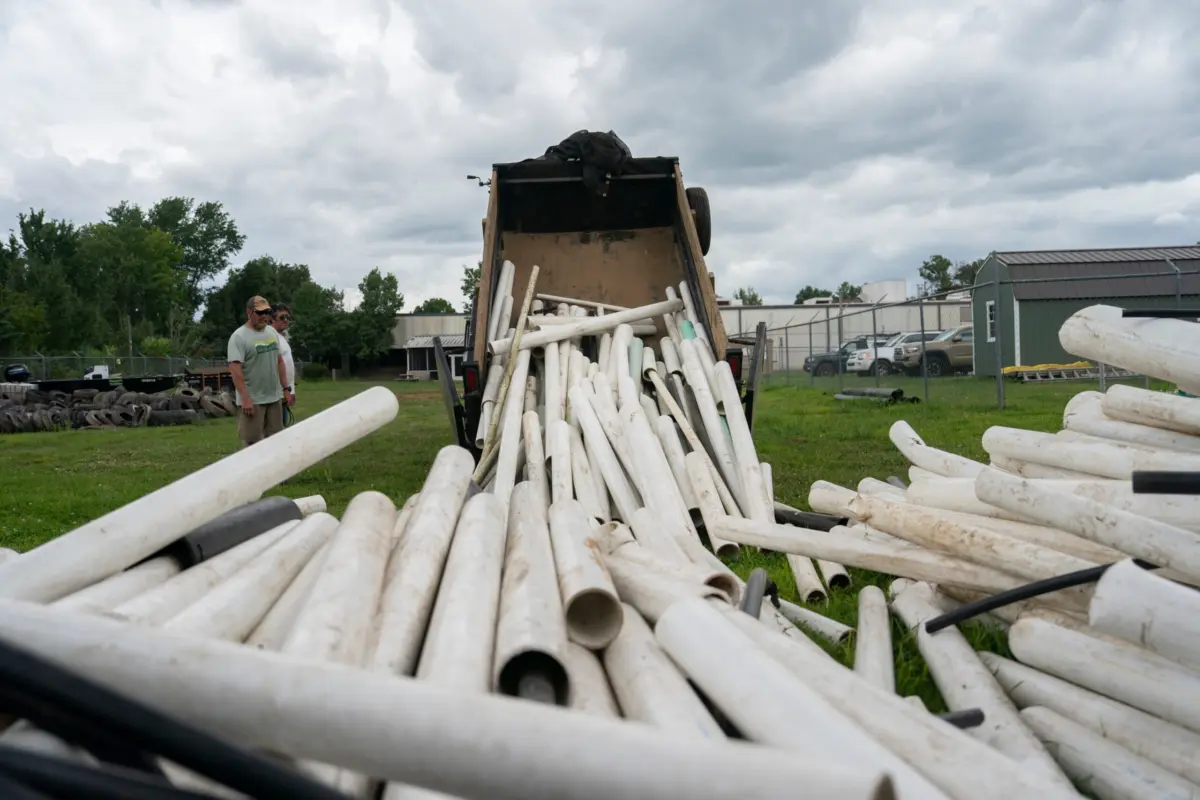
ASHEVILLE, N.C. — Two years after Hurricane Helene tore through the Appalachian landscape, leveling forests, bulldozing homes, and permanently altering the geography of western North Carolina, the region is still grappling with a surreal and stubborn reminder of the disaster: millions of pounds of polyvinyl chloride (PVC) plastic pipe.
Piled high on eroding river banks, wedged deeply into uprooted root systems, buried within heavy sediment, and jammed beneath massive logjams, the industrial debris dominates the iconic French Broad River. In some stretches, tangled mounds of PVC tubing rise up to two stories high, mingling with cars, refrigerators, and ruined household goods swept away during the 2024 deluge.
While heavy machinery and grassroots efforts have cleared vast stretches of waterways, the ongoing ecological and logistical crisis illustrates a sobering reality of modern extreme weather: catastrophic damage can disrupt local lives, economies, and ecosystems for years—long after the floodwaters recede and the national spotlight moves on.
Main Facts
The epicenter of the plastic debris crisis is a manufacturing facility in Woodfin, North Carolina, operated by Canada-based IPEX. When Helene struck in late September 2024, the plant—sandwiched tightly between active railroad tracks and the French Broad River—stored massive outdoor inventories of rigid and flexible PVC pipes.
An estimated 60% of that outdoor inventory was swept away when an unprecedented wall of water tore down the valley. Today, the pipes are so ubiquitous along a 70-mile (113-kilometer) stretch running to the Tennessee border that they account for up to 80% of all debris in certain areas.
MountainTrue, a regional environmental nonprofit leading the grueling cleanup, estimates its crews have pulled hundreds of thousands of individual pipes from the river system. The operation has required more than 50,000 work-hours and upward of $1.5 million in direct removal costs for the French Broad alone.
Despite an infusion of capital from both the state and the corporate manufacturer, the task is far from finished. Crew leaders warn that countless pipes remain embedded in riverbanks, trapped in log piles, or submerged in the riverbed, threatening to degrade into microplastics that could plague the ecosystem for decades.
Chronology of a Disaster and Recovery
September 2024: The Cataclysmic Flood
Hurricane Helene made landfall and tracked inland, dumping a staggering 30-plus inches (76 centimeters) of rain across mountainous western North Carolina in a matter of hours. The resulting torrent triggered thousands of catastrophic landslides, obliterated vital infrastructure, and transformed placid mountain streams into raging inland tsunamis.
At the IPEX facility in Woodfin, plant managers had monitored forecasts and taken precautions. Believing they faced a potential "100-year flood"—a weather event with a 1% statistical chance of occurring in any given year—workers moved inventory away from immediate low-lying areas and secured an earthen berm intended to protect the site. They sent employees home a day early.
However, the floodwaters generated by Helene shattered historical records, proving to be roughly ten times worse than a standard 100-year event. It was, by all hydrological accounts, a 1,000-year flood. The roaring river breached the berm, lifting massive stacks of PVC pipes and washing them downstream.
Late 2024 – 2025: Initial Shock and Grassroots Mobilization
In the immediate aftermath, the factory closed its doors for months, incurring structural and operational losses exceeding $100 million. Meanwhile, local outdoor enthusiasts, river guides, and community members—many of whom had lost their livelihoods overnight when the tourism and outfitting industries collapsed—began pulling debris out of the water as a form of communal healing and "trauma bonding."
Recognizing the immense scale of the crisis, the state of North Carolina awarded MountainTrue a $10 million grant in 2025 to spearhead river cleanup efforts across several affected western watersheds. Crews navigated treacherous rapids, hauling out massive quantities of twisted plastic and metal.
2026: Ongoing Battles and Extended Deadlines
As the cleanup enters its second full year, the work has evolved from emergency triage to a slow, methodical extraction process. The state grant, originally slated to expire in December, has been extended through February 2026 to accommodate the sheer volume of remaining waste.
Concurrently, IPEX has agreed to contribute an additional $500,000 to MountainTrue to fund continued recovery operations on the French Broad River, extending the nonprofit’s operational capacity well into the coming year.
Supporting Data and Scale of the Operation
The numbers behind the French Broad River cleanup illustrate the unprecedented nature of the disaster:
- 70 Miles: The length of the river corridor impacted by the plastic debris, stretching from north of Asheville down to a large lake at the Tennessee border.
- 80%: The proportion of total river debris composed of PVC pipe in the hardest-hit sections.
- 50,000+: The total number of labor hours logged by MountainTrue cleanup crews.
- $1.5 Million: The capital spent solely on pipe removal along the French Broad River.
- $100 Million+: The estimated financial loss suffered by IPEX due to plant destruction, coupled with a matching $100 million investment in site fortification and flood-containment studies since the storm.
- 100: The number of specialized crew members deployed across 10 teams, many of whom are former river and fishing guides.
Removing the pipe is a physically grueling and technically complex task. Because much of the plastic has become hopelessly intertwined with massive logjams—some towering 20 feet (6 meters) high—cleanup workers refer to the piles as "jungle gyms." Crews must balance precariously on unstable timber, use chainsaws to cut rigid and coiled pipes into manageable sections, load them onto whitewater boats, navigate churning rapids, and transfer the material to trucks for transport to local landfills. Only a small fraction of undamaged pipe is redistributed to community members due to a lack of viable commercial recycling options locally.
Official Responses and Accountability
Corporate and civic leaders have acknowledged both the devastation of the storm and the prolonged road to recovery, though tensions remain regarding corporate transparency and initial preparedness.
Colleen Pritchett, CEO of IPEX, addressed the ongoing challenges in a recent statement:
"We understand the ongoing challenge. We recognize that… recovery efforts are complex, they’re resource-intensive, and it’s constantly shaped by the river conditions."
Pritchett noted that the company has invested heavily to rebuild the facility and is actively researching advanced containment engineering to prevent future inventory loss—a mitigation measure MountainTrue had demanded for months.
However, criticism persists regarding corporate openness. IPEX has repeatedly declined to disclose the exact tonnage of pipe stored at the Woodfin site prior to the hurricane, nor has it released the complete findings of a company-funded environmental audit assessing how much plastic remains trapped in the river system, citing "commercially sensitive" data.
Johnny Drummond, IPEX vice president of manufacturing, defended the company’s pre-storm actions:
"We secured the site as best we could, and we sent people home a day before the flooding was expected. We did not anticipate a 1,000-year flood."
On the ground, environmental leaders emphasize that while corporate funding contributions are welcome, the physical toll on the landscape is staggering. Jon Stamper, operations director at MountainTrue, expressed the collective exhaustion of his field teams:
"Just the amount of time and energy that we put into removing all this pipe is exhausting. We still have stretches of river that haven’t been touched."
Implications: Environmental Risks and Future Resilience
The lingering PVC pipes represent more than just an aesthetic blight on a nationally recognized whitewater destination; they pose profound, long-term threats to regional ecology and public safety.
Ecological and Health Hazards
Rafters, kayakers, and anglers face constant hazards from submerged or partially hidden pipes that create sudden entrapment risks and alter natural water currents. Furthermore, wildlife—including fish, amphibians, and aquatic macroinvertebrates—frequently take up residence inside abandoned pipes, complicating extraction efforts.
Of even greater concern is the threat of material degradation. As rigid and flexible PVC sits exposed to intense mountain sunlight and weathering over the span of months and years, the material becomes brittle. Riverkeeper Anna Alsobrook and field operations leads note that some sun-baked pipes now crack under the mere pressure of a human hand gripping them.
This breakdown accelerates the formation of microplastics, which infiltrate the aquatic food web and threaten long-term water quality throughout the watershed.
"We want to avoid that stuff sitting there forever and just slowly deteriorating and breaking into smaller and smaller pieces," Stamper warned. "Some of the pipe that’s been sitting out since Hurricane Helene that has been exposed to the sun all the time is getting to the point where you could crack it when you grab it."
Lessons for Industrial Zoning
The disaster has sparked broader policy debates regarding the placement of heavy industrial storage facilities within vulnerable river floodplains. Environmental advocates argue that storing vast quantities of buoyant, persistent synthetic materials directly adjacent to major waterways is an unacceptable hazard in an era of climate volatility, where historical flood models are increasingly rendered obsolete by extreme weather events.
As MountainTrue looks toward future grant applications to sustain its operations, cleanup crews acknowledge a sobering truth: despite their most heroic efforts, complete restoration may be mathematically impossible.
"We’re going to do our best as long as the funding allows," Stamper concluded. "लेकिन (But) there’s going to be pipe out there that we can’t get ever."
