

Introduction: The Climate Crisis and the Urban Frontier
As European cities face the escalating threat of rising temperatures, extreme heatwaves, and the degradation of urban ecosystems, municipalities are scrambling to rethink the concrete-heavy environments of the 20th century. Urban centers are under immense pressure to adapt existing infrastructures to a changing climate while simultaneously improving pedestrian access to nature, enriching communal public spaces, and weaving environmental resilience into the fabric of everyday life.
Amidst this continental push for adaptation, the Horizon Europe initiative known as ReGreeneration has emerged as a crucial blueprint. Spanning nine diverse European cities, ReGreeneration tackles the monumental challenge of climate change through localized, neighborhood-scale urban renaturing. By combining concepts of the "complete neighborhood," flexible communal spaces, and nature-based infrastructure, the initiative provides a comprehensive framework for urban transformation.
In Barcelona, the ReGreeneration project focuses on the peripheral neighborhood of Trinitat Nova. Here, urban planners, architects, and local communities are examining how small, frequently overlooked, and residual urban spaces can act as catalysts for broader regenerative models. Rather than relying solely on top-down, capital-intensive megaprojects, Barcelona is testing how micro-interventions can scale up to influence municipal policy—transforming the "in-between" spaces of the city into vibrant ecosystems of climate resilience and social equity.
Main Facts: The Barcelona Blueprint in Trinitat Nova
The Trinitat Nova initiative operates at the intersection of climate science, architecture, and civic policy. Key facts defining the scope and ambition of the project include:
- The Core Objective: To integrate neighborhood-scale urban renaturing, biodiversity corridors, and climate-adaptation strategies into historically marginalized or peripheral urban fabrics.
- The Scale of Intervention: Rather than redesigning entire metropolitan zones, the project focuses on micro-spaces—abandoned lots, wide asphalt strips, school perimeters, and residual interstitial gaps between housing blocks.
- The European Framework: Trinitat Nova serves as one of nine pilot urban laboratories under the Horizon Europe ReGreeneration initiative, aiming to generate scalable models that can be replicated across the European Union.
- The Methodology: A hybrid model combining tactical urbanism (low-cost, temporary, reversible physical alterations) with long-term, legally binding municipal planning policies.
- The Local Partners: Collaboration between the Barcelona City Council, local architectural collectives like Leku Studio, neighborhood associations, and academic research institutions.
Chronology: A History of Tactical Adaptation in Barcelona
Barcelona’s engagement with tactical urbanism and public space reclamation is not a recent phenomenon; it is deeply rooted in a rich, layered history of civic struggle and progressive municipal design. Tracing this timeline reveals how small-scale interventions evolved into city-wide urban policy.
1. Post-Franco Democratic Transition (Late 1970s–1980s)
Following the death of Francisco Franco, Barcelona’s neighborhoods mobilized to demand basic civic dignity. Long neglected by the central dictatorship, working-class peripheries fought for parks, schools, and health centers. This era gave birth to the concept of urbanismo de los pequeños espacios (urbanism of small spaces), where architects and grassroots organizations reclaimed derelict industrial plots for public use.
2. The Olympic Catalyst (1992)
While the 1992 Olympic Games fundamentally reshaped Barcelona’s waterfront and global image, it also established a precedent for strategic urban planning linked to major events. However, the heavy focus on monumental infrastructure left some peripheral neighborhoods feeling disconnected from the city’s downtown renaissance.
3. The Superblock (Superadilles) Revolution (2010s)
Under the leadership of urban planners and municipal administrations, Barcelona introduced the Superblock model—grouping existing city blocks into traffic-calmed zones where pedestrian priority reigns supreme. Pioneered in areas like Poblenou, this strategy demonstrated that temporary road closures, modular urban furniture, and green patches could instantly transform the character of the street without requiring demolition.
4. Reversible Urbanism and School Streets (2020–2025)
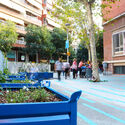
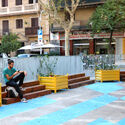
In recent years, design collectives such as Leku Studio began deploying reversible urbanization strategies around educational facilities. Transforming asphalt school perimeters into bio-diverse, shaded play areas during school hours and opening them to the community on weekends, these projects perfected the art of the tactical intervention.
5. The ReGreeneration Era (2026 and Beyond)
Entering the mid-2020s, Barcelona transitioned from viewing tactical urbanism merely as a temporary fix to treating it as a legitimate testing ground for permanent policy. Through the Horizon Europe ReGreeneration initiative, the focus shifted to Trinitat Nova to bridge the gap between temporary grassroots tactics and enduring legislative frameworks.
Supporting Data: Urban Heat Islands and Spatial Inequality
Data gathered by municipal agencies and environmental researchers underscores the urgent necessity of projects like ReGreeneration in neighborhoods like Trinitat Nova.
- The Urban Heat Island Effect: Studies show that densely built, asphalt-heavy peripheral neighborhoods in Barcelona experience summer temperatures up to 4°C higher than surrounding green or rural zones.
- Green Space Deficit: While affluent central districts boast linear parks and tree-lined avenues (such as the historic tree canopy of the Eixample), peripheral working-class districts often suffer from a severe deficit of accessible green infrastructure per capita.
- Runoff and Permeability: Traditional urban surfaces in Barcelona’s housing estates consist of over 85% impermeable materials, exacerbating flash flooding risks during intense Mediterranean downpours.
- The Tactical Success Rate: Pilot programs implementing reversible urban interventions across Barcelona schools and plazas have recorded a 35% increase in local biodiversity indicators (such as pollinator presence) within the first 18 months of installation, alongside a measurable reduction in ambient noise pollution.
Official Responses and Stakeholder Perspectives
The transition from tactical urbanism to formalized urban policy requires delicate coordination between municipal leaders, urban designers, and the communities directly affected by spatial transformations.

Municipal Leadership
Representatives from the Barcelona City Council emphasize that the municipality can no longer afford to design cities using 20th-century paradigms.
"We are moving away from rigid master plans that take decades to materialize," noted a senior urban planning official during the launch of the Trinitat Nova phase. "Climate change moves faster than traditional bureaucratic planning cycles. Tactical interventions allow us to co-create solutions with citizens in real-time, test their efficacy, and anchor the successful elements into binding municipal code."
Architectural and Design Collectives
Firms like Leku Studio, which have pioneered reversible infrastructure across the city, view the "in-between" spaces not as dead zones, but as untapped infrastructural resources.

"When we design a reversible pavement or an ephemeral rain garden in a schoolyard, we aren’t just decorating the street," explains a lead architect from Leku Studio. "We are running a live, full-scale experiment. We watch how children play, how elderly residents seek shade, and how water flows during a storm. That real-world data becomes the backbone of our policy recommendations."
Neighborhood Associations
Residents of Trinitat Nova have expressed cautious optimism, balancing a desire for immediate environmental relief with historical concerns regarding gentrification and displacement. Local civic leaders have insisted that greening initiatives must be accompanied by robust social housing protections so that climate-resilient neighborhoods remain accessible to working-class families.
Implications: Translating Flexibility into Long-Term Policy
The broader implications of Barcelona’s work in Trinitat Nova extend far beyond the Catalan capital. As European cities grapple with the dual crises of climate change and housing affordability, the fundamental question remains: How can the flexibility and responsiveness of temporary urban interventions translate into long-term planning and policy?
1. Redefining the Planning Timeline
Traditional zoning and master-planning processes are notoriously sluggish, often taking 10 to 15 years from conception to ribbon-cutting. By validating tactical interventions through scientific monitoring (as facilitated by the ReGreeneration framework), municipalities can fast-track proven designs into permanent legal frameworks, cutting bureaucratic red tape significantly.
2. Democratizing Urban Design
Tactical urbanism inherently lowers the barrier to entry for civic participation. When communities can physically participate in painting a crosswalk, planting a pocket forest, or assembling modular street furniture, they transition from passive recipients of municipal services to active co-creators of their built environment.
3. Institutionalizing Reversibility
Designing cities for climate adaptation requires institutional flexibility. Policies inspired by the Trinitat Nova project advocate for "reversible zoning"—designating spaces that can easily transition from parking infrastructure to stormwater retention basins or community green spaces depending on immediate climatic and social needs.

Conclusion
Barcelona’s integration of tactical interventions into urban policy through the ReGreeneration initiative offers a compelling roadmap for a warming Europe. By focusing on the "in-between" spaces of Trinitat Nova, the city demonstrates that systemic ecological transformation does not always require starting from scratch. Instead, by listening to the micro-rhythms of daily life, testing ideas through reversible design, and committing those lessons to policy, cities can successfully bridge the gap between emergency climate adaptation and enduring urban equity.
