

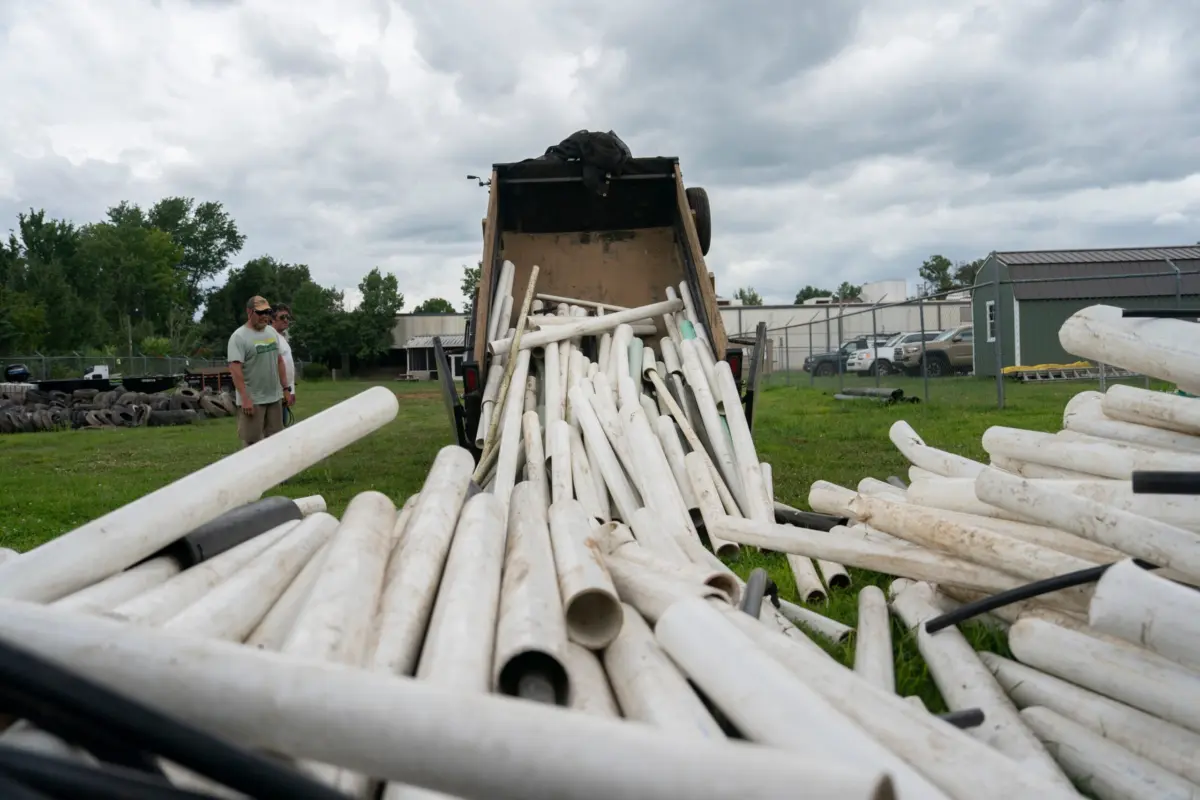
ASHEVILLE, N.C. — Two years after the apocalyptic fury of Hurricane Helene tore through western North Carolina, reducing homes to matchsticks, leveling ancient forests, and choking the region’s iconic waterways with an unprecedented deluge of wreckage, the war for the rivers is far from over.
Along the picturesque banks of the French Broad River—a legendary artery renowned for its roaring whitewater rapids and vibrant ecosystem—the physical scars of the 2024 disaster remain jarringly visible. High up in the branches of uprooted sycamores, deeply embedded in riverbed sediment, and jammed beneath massive logjams stretching two stories high, millions of pounds of polyvinyl chloride (PVC) pipe cling to the landscape. Swept away from a manufacturing facility just north of Asheville at the height of the storm, these industrial remnants have become the defining visual and ecological emblem of a catastrophe that continues to disrupt lives long after the floodwaters receded.
For the environmental nonprofit MountainTrue, which has spearheaded the painstaking cleanup efforts across several western North Carolina rivers, the task is as exhausting as it is endless.
"Just the amount of time and energy that we put into removing all this pipe is exhausting," said Jon Stamper, operations director at MountainTrue. "We still have stretches of river that haven’t been touched."
To date, MountainTrue estimates its crews have pulled hundreds of thousands of individual PVC pipes from the river system. Yet, an untold number of them still litter a 70-mile (113-kilometer) stretch of the French Broad, winding downstream toward a massive reservoir near the Tennessee border. As new weather systems threaten the region—including the early-season intensification of Atlantic storms—the lingering presence of this industrial plastic serves as a stark reminder that the true lifecycle of a natural disaster is measured not in days or months, but in years.
The Epic Flood: A 1,000-Year Catastrophe
To understand how millions of pounds of commercial plastic ended up miles away from their storage yards, one must look back to late September 2024, when Hurricane Helene made landfall and unleashed unimaginable devastation upon the Southern Appalachians.
In western North Carolina, the storm stalled against the mountain ranges, dumping more than 30 inches (76 centimeters) of rain in localized areas over a matter of days. The resulting catastrophe triggered thousands of catastrophic landslides, toppled millions of trees, pushed historic buildings off their foundations, and turned placid mountain streams into roaring, hyper-destructive tsunamis of mud and debris.
North of Asheville, in the town of Woodfin, the manufacturing plant operated by Canada-based industrial giant IPEX sat sandwiched precariously between railroad tracks and the banks of the French Broad River. At the facility, tall stacks of rigid and flexible PVC pipes were stored outdoors, separated from the rushing river by an engineered earthen berm.
According to company officials, IPEX had monitored forecasts and prepared for a traditional "100-year flood"—a high-water event carrying a 1% statistical probability of occurring in any given year. Acting on these projections, plant management scrambled to move inventory out of the anticipated flood zone and shuttered operations a day before the worst of the deluge hit, sending workers home.
They could not have anticipated what came next. The flooding generated by Helene was not a 100-year event; it was a staggering 1,000-year flood—ten times worse than the worst-case scenarios prepared for by local industry and emergency management.
"We secured the site as best we could, and we sent people home a day before the flooding was expected," said Johnny Drummond, vice president of manufacturing for IPEX.
When the French Broad breached its banks with terrifying velocity, the wall of water overwhelmed the earthen berm, sweeping an estimated 60% of the plant’s outdoor PVC inventory directly into the current. The factory itself was battered, forcing an extended closure and racking up financial losses that CEO Colleen Pritchett noted were "well over $100 million."
In the wake of the disaster, IPEX has invested heavily in site rehabilitation, pouring more than $100 million into structural repairs and reinforcements. The company is also engineering new containment strategies to prevent future inventory loss—a mitigation measure that MountainTrue and local advocates had publicly demanded for months.
A Chronology of Crisis and Recovery
The trajectory of the disaster recovery reads as a timeline of unrelenting labor, shifting institutional responses, and a grassroots movement born out of shared trauma.
- Late September 2024: Hurricane Helene drops record-breaking rainfall across western North Carolina. The French Broad River crests at historic levels, breaching the IPEX storage yards in Woodfin and washing massive quantities of PVC pipe into the waterway.
- Late 2024 – Early 2025: Local river guides, outfitter employees, and outdoor enthusiasts—many of whom lost their livelihoods overnight—begin informal, volunteer-led cleanups along the French Broad as a form of communal healing and "trauma bonding." MountainTrue formalizes these efforts, organizing specialized river crews.
- Mid-2025: MountainTrue is awarded a $10 million state grant to spearhead major debris removal across several western North Carolina rivers impacted by Helene. Meanwhile, the organization calculates that its crews have already logged tens of thousands of work-hours focusing solely on the intractable PVC pipe problem.
- Late 2025 – Early 2026: As the initial deadline for the state grant approaches, the sheer volume of persistent industrial waste proves overwhelming. The state grants a crucial extension through February, allowing cleanup operations to push deeper into difficult terrain.
- Current Operations: IPEX agrees to contribute a $500,000 settlement toward MountainTrue’s ongoing French Broad operations, extending the nonprofit’s financial runway into the following year. Yet, cleanup leaders warn that without additional funding renewals, thousands of pipes will remain trapped in the ecosystem indefinitely.
Supporting Data and Scale of the Problem
The physical and financial metrics surrounding the PVC debris crisis highlight the sheer scale of the challenge facing western North Carolina:
- 50,000: The estimated number of work-hours MountainTrue crews have dedicated exclusively to pipe removal on the French Broad River alone.
- $1.5 Million: The direct financial investment made by MountainTrue into pipe extraction, funded through a combination of grants and private contributions.
- 80%: The proportion of total river debris that consists of PVC pipe in the hardest-hit stretches of the French Broad.
- 70 Miles (113 km): The continuous length of the river corridor impacted by the industrial migration, stretching from Woodfin to a massive lake near the Tennessee border.
- 60%: The estimated percentage of outdoor-stored inventory at the IPEX facility that was swept away during the initial 2024 flood peak.
- $500,000: The financial contribution agreed upon by IPEX to support MountainTrue’s ongoing mitigation efforts on the river.
- $10 Million: The total value of the state grant awarded for regional river debris cleanup, which received a crucial extension to February to accommodate the slow pace of extraction.
Official Responses and Corporate Accountability
As the public cleanup enters its second year, questions of corporate responsibility, long-term environmental liability, and institutional support remain at the forefront.
IPEX leadership has acknowledged the immense logistical hurdles facing the region, while balancing corporate privacy concerns regarding the exact volume of lost inventory. Company executives have declined to publicly release the exact figures of pre-storm pipe storage or share the complete findings of a company-funded environmental audit assessing remaining river deposits, citing "commercially sensitive" information.
Nevertheless, corporate executives maintain that they are committed to being part of the solution.
"We understand the ongoing challenge," said IPEX CEO Colleen Pritchett. "We recognize that… recovery efforts are complex, they’re resource-intensive, and it’s constantly shaped by the river conditions."
On the ground, local environmental advocates emphasize that while IPEX’s financial contribution of $500,000 is a welcome acknowledgment of responsibility, it represents only a fraction of the true cost required to heal the watershed. MountainTrue is actively pursuing additional state and federal grants to sustain its operations, fully aware that the current funding streams have a finite expiration date.
Environmental and Human Implications
The presence of millions of pounds of rigid and flexible plastic tubing in a dynamic mountain river system creates cascading complications for both human recreation and ecological health.
Navigational Hazards and Whitewater Risks
For the recreational community that forms the economic backbone of western North Carolina’s tourism sector, the pipes are a constant, invisible hazard. Rafters, kayakers, and inner-tubers navigate a river transformed into an obstacle course. Submerged pipes act as physical traps, while exposed ends can puncture watercraft or injure swimmers.
Ecological Alteration
Ecologically, the pipes disrupt the natural flow of the river, altering sediment transport, changing local water velocities, and destroying aquatic habitats. Ironically, the discarded cylinders have become artificial micro-habitats: cleanup crews frequently find fish and other aquatic organisms taking up residence inside the hollow tubes, complicating extraction efforts.
The Microplastic Threat
Perhaps the most insidious danger is long-term environmental degradation. As the PVC pipes remain exposed to intense ultraviolet radiation from the sun along exposed riverbanks and floodplains, the material grows brittle.
"We want to avoid that stuff sitting there forever and just slowly deteriorating and breaking into smaller and smaller pieces," Stamper warned. "Some of the pipe that’s been sitting out since Hurricane Helene that has been exposed to the sun all the time is getting to the point where you could crack it when you grab it."
If allowed to fully degrade, the plastic will shatter into microplastics, permanently embedding synthetic toxins into the food web of the French Broad River watershed.
The Human Element: An Elite Crew of River Warriors
The labor of extracting hundreds of thousands of heavy, waterlogged pipes from treacherous river environments cannot be accomplished by traditional municipal sanitation crews. It requires a specialized breed of worker.
MountainTrue’s 10 cleanup crews—totaling roughly 100 people—are largely composed of former whitewater guides, commercial fishermen, and outdoor professionals who lost their livelihoods when Helene devastated the local adventure tourism industry. Led by field coordinators like Madison County cleanup lead Jemima Filiss-Cook and French Broad Riverkeeper Anna Alsobrook, these workers bring elite outdoor skills to an industrial cleanup operation.
"Crews just sort of picture it as a jungle gym," Filiss-Cook said, describing the massive, 20-foot-high (6-meter) logjams where flexible plastic coils and rigid pipes are tightly bound together by tons of river silt and timber.
Because many of the extraction sites are inaccessible by road, workers must use chainsaws to slice longer pipes into manageable segments on unstable log piles, load them onto specialized watercraft, and navigate class-level whitewater rapids with boats heavily laden with industrial plastic and heavy machinery. Rock climbers and technical rigging experts have been recruited to help manage the vertical and high-risk extraction sites.
"I truly don’t think anybody else could do this work except for our debris team members," Alsobrook said.
Despite their heroic efforts, the physical limitations of the job are sobering. Team members know they are racing against time, weather, and material degradation. While priority has rightly been given to clearing immediate entrapment hazards and securing sections vulnerable to the next major flood, cleanup leaders admit a sobering reality.
"We’re going to do our best as long as the funding allows," Stamper concluded, staring out over a bend in the river where pale blue and white plastic fragments still peek through the autumn foliage. "But there’s going to be pipe out there that we can’t get ever."
