

By the Environmental Reporting Desk
Two years after the catastrophic fury of Hurricane Helene tore through western North Carolina—leveling ancient forests, bulldozing residential neighborhoods, and choking fragile waterways with everything from family sedans to household refrigerators—the monumental task of ecological restoration continues. Along the iconic, roaring rapids of the French Broad River, a singular, ubiquitous symbol of the disaster persists: massive quantities of industrial PVC pipe.
Washed away from a massive manufacturing facility north of Asheville during the 2024 deluge, these endless coils and rigid tubes remain wedged in river banks, anchored in deep sediment, and jammed beneath uprooted trees. In many areas, they are tangled in colossal mounds of organic debris reaching up to two stories high. As seasonal tropical storms continue to test the region’s vulnerable infrastructure, the stubborn presence of the plastic stands as a stark, enduring reminder that the catastrophic damage of a major hurricane can disrupt communities, economies, and ecosystems for years after the skies clear.
Main Facts
The ongoing crisis along the French Broad River highlights a complex intersection of extreme weather, industrial manufacturing safety, and environmental stewardship.
- The Scope of the Disaster: Hurricane Helene struck western North Carolina in late September 2024, dropping upwards of 30 inches of rain in isolated mountain pockets. The resulting 1,000-year flood event sent wall-of-water surges down regional river valleys.
- The Industrial Source: An estimated 60% of the outdoor-stored PVC inventory at the IPEX manufacturing facility in Woodfin, North Carolina, was swept directly into the French Broad River.
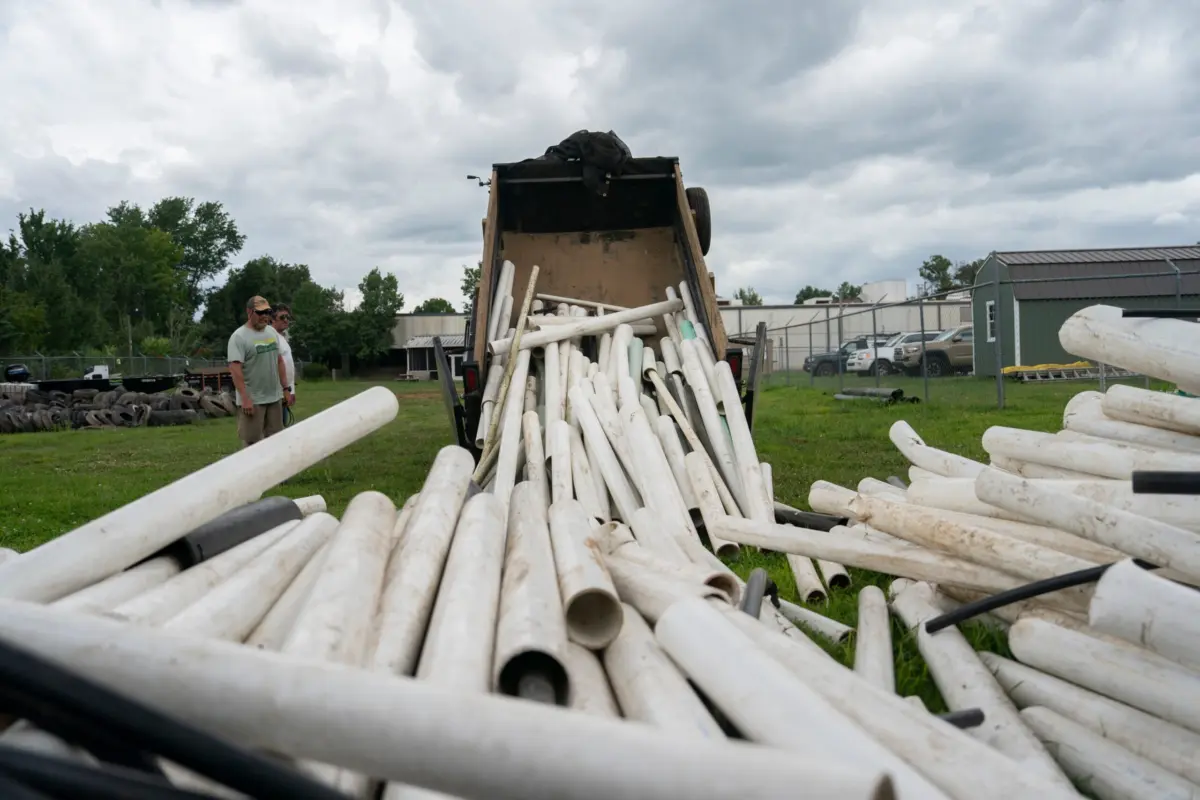
- The Cleanup Burden: The environmental nonprofit MountainTrue has spearheaded the grueling recovery effort. Crews estimate they have pulled hundreds of thousands of individual pipes from a 70-mile stretch extending to the Tennessee border, spending over 50,000 work-hours and $1.5 million on this specific cleanup effort.
- Environmental Hazard: PVC pipe currently accounts for roughly 80% of the debris in heavy concentration zones. As the plastic is exposed to relentless UV radiation from the sun, it grows brittle, raising severe concerns about long-term microplastic contamination in regional drinking water and aquatic ecosystems.
- Financial and Legal Repercussions: IPEX has agreed to provide MountainTrue with $500,000 to fund ongoing operations. Meanwhile, state grants totaling $10 million have been extended to support the exhaustive labor required to clear the remaining waterways.
Chronology of a Disaster and Recovery
September 2024: The 1,000-Year Deluge
When meteorologists tracked Hurricane Helene inland, few anticipated the historic scale of precipitation that would stall over the southern Appalachian Mountains. On the eve of the storm, executives at the IPEX manufacturing facility in Woodfin—sandwiched tightly between active railroad tracks and the French Broad River—believed they had taken adequate precautions. Relying on standard flood models, staff moved inventory away from the low-lying zones, trusting an engineered earthen berm to protect the towering outdoor stacks of PVC pipe.
They prepared for a 100-year flood event (a disaster with a 1% annual probability). Instead, Helene unleashed a cataclysmic 1,000-year flood. The water surged ten times higher and faster than worst-case projections, completely overtopping the site’s defenses, breaching the berm, and sweeping millions of pounds of raw industrial product into the raging torrent.
Late 2024 – 2025: Initial Shock and the Birth of a Recovery Force
In the immediate aftermath, the factory closed its doors for months, sustaining damages and losses exceeding $100 million. Downstream, local communities were in shock. For river guides, outfitters, and outdoor enthusiasts who suddenly lost their livelihoods, the river became a site of collective trauma.
A specialized cleanup workforce organically formed. Many early participants were whitewater guides, fishermen, and rock climbers who found a sense of "trauma bonding" and purpose in clearing the blocked waterways. MountainTrue formally organized these grassroots efforts, deploying swiftwater-trained crews equipped with chainsaws, ropes, and specialized watercraft to begin the grueling recovery process.
2026: The Ongoing Battle and Extended Horizons
Two years post-storm, the cleanup is far from complete. While initial state funding was slated to expire in December 2025, extended grants and infusions of corporate accountability funds have pushed the timeline into early 2026 and beyond. Crews are still discovering buried caches of pipe every time heavy rains alter water levels and shift the riverbeds.
Supporting Data and Scale of the Operation
The logistical challenges faced by MountainTrue and its partners are staggering. Quantifying the scope of the plastic pollution reveals the immense physical and financial toll the disaster has taken on the region:
- 70 Miles of Impact: Debris spans a 70-mile corridor of the French Broad River, terminating at a massive lake situated right at the Tennessee border.
- Labor Intensity: MountainTrue’s operations director, Jon Stamper, oversees a dedicated team of roughly 100 workers spread across 10 specialized crews. Many of these workers are former river guides whose professional lives were upended by the destruction of the local ecotourism industry.
- Financial Investments: IPEX has invested more than $100 million in rebuilding its physical plant and redesigning its flood-containment strategies. To date, the company has contributed $500,000 directly to MountainTrue’s river restoration budget. Additionally, the state of North Carolina allocated a $10 million grant specifically targeting western river basins, with deadlines extended to accommodate the sheer volume of remaining work.
- Volume and Disposal: Hundreds of thousands of pipes have been extracted and hauled to regional landfills. A tiny fraction of structurally sound pipe is redistributed to local communities for makeshift construction projects, as viable industrial recycling options for contaminated PVC remain severely limited.
Official Responses and Corporate Accountability
The relationship between the impacted communities, environmental watchdogs, and corporate entities like IPEX has evolved from early shock and friction into a complex working partnership.
IPEX CEO Colleen Pritchett acknowledged the extraordinary scale of the crisis in recent statements. "We understand the ongoing challenge," Pritchett noted, emphasizing that recovery efforts are deeply complex, resource-intensive, and constantly dictated by unpredictable river conditions. The company reported operational losses well north of $100 million and confirmed that it is actively collaborating with engineers to design next-generation containment measures to prevent a repeat disaster.
Johnny Drummond, IPEX vice president of manufacturing, defended the company’s initial preparation, explaining that staff followed all standard protocols based on historical weather patterns. However, he conceded that the unprecedented nature of the storm caught industrial planners completely flat-footed.
On the nonprofit side, leaders like MountainTrue Riverkeeper Anna Alsobrook emphasize that specialized skills are non-negotiable for this line of work. "I truly don’t think anybody else could do this work except for our debris team members," Alsobrook said. Navigating class-rated whitewater rapids while hauling boats laden with heavy PVC and vibrating chainsaws requires a rare blend of technical climbing ability, river rescue training, and sheer physical endurance.
Implications: Environmental Risks and Future Resilience
As cleanup crews continue their methodical sweeps, scientists and environmental advocates are casting an anxious eye toward the future. The primary nightmare facing the French Broad River is not just the physical obstruction caused by massive piles of logs and plastic, but the molecular breakdown of the material itself.
PVC pipe is remarkably durable, but prolonged exposure to Appalachian sunlight degrades its chemical bonds. Jon Stamper points out that much of the pipe exposed on river banks since September 2024 is already reaching a critical breaking point.
"We want to avoid that stuff sitting there forever and just slowly deteriorating and breaking into smaller and smaller pieces," Stamper warned. "Some of the pipe that’s been sitting out since Hurricane Helene that has been exposed to the sun all the time is getting to the point where you could crack it when you grab it."
When brittle PVC fragments, it sheds microplastics directly into the aquatic food web. These synthetic polymers can be ingested by fish, macroinvertebrates, and wildlife, ultimately threatening the broader biodiversity of the French Broad River basin and potentially contaminating downstream drinking water sources.
Furthermore, the physical presence of the pipes alters natural water flows, creates dangerous entrapment hazards for recreational kayakers and tubers, and physically binds river sediment in ways that choke native aquatic habitats.
Ultimately, the ongoing struggle along the French Broad River serves as a cautionary tale for industrial facilities operating in flood-prone mountain valleys nationwide. As a changing global climate increases the frequency and severity of extreme weather events, corporations and municipalities alike must reckon with the reality that historical "1,000-year flood" benchmarks are no longer safe margins for error. For western North Carolina, the price of that miscalculation is being paid one heavy, sun-bleached plastic pipe at a time.
