

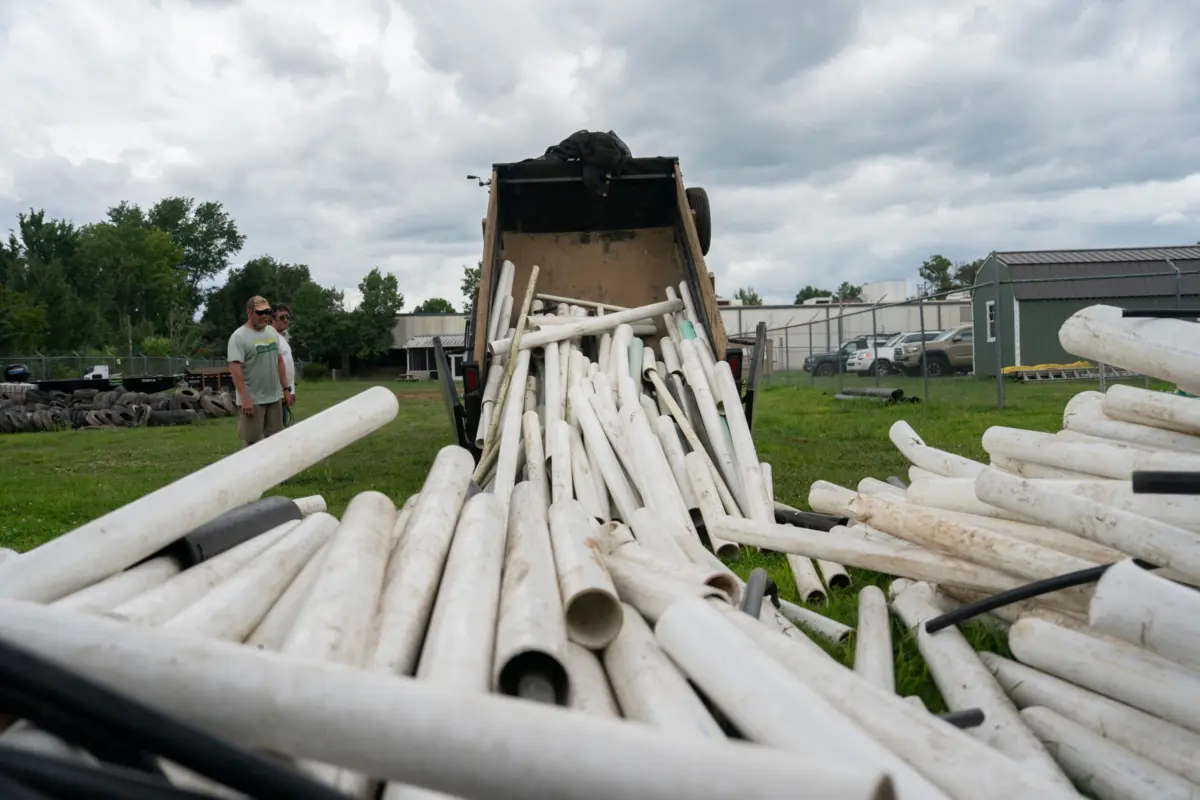
ASHEVILLE, N.C. — Two years after Hurricane Helene tore through the mountainous terrain of western North Carolina, leaving a catastrophic trail of leveled forests, obliterated homes, and choked waterways, the grueling physical labor of environmental recovery persists. While initial emergency rescues and structural rebuilding dominated the headlines in the wake of the late-September 2024 storm, a quieter, more stubborn crisis remains embedded in the region’s iconic river systems.
Along the French Broad River—historically celebrated for its roaring whitewater rapids, thriving outfitting culture, and vital ecological diversity—millions of pounds of industrial plastic refuse continue to define the landscape. Massive quantities of polyvinyl chloride (PVC) pipes, swept away from a manufacturing facility north of Asheville during the storm’s historic surge, remain piled high on riverbanks, wedged deep into uprooted root systems, buried in heavy sediment, and jammed beneath towering logjams.
For the environmental nonprofit MountainTrue, which has spearheaded extensive river remediation efforts, the undertaking has proven to be a monumental, emotionally taxing, and physically dangerous ordeal. As new seasonal storms threaten the region, the persistent plastic crisis serves as a stark reminder that the ecological and infrastructural damage of a major natural disaster can disrupt communities, ecosystems, and local economies for years after the floodwaters recede.
Main Facts: The Scope of the Crisis
The sheer volume of industrial debris choking the French Broad River and its surrounding tributaries is staggering. According to environmental assessments conducted by MountainTrue, crews have extracted hundreds of thousands of individual PVC pipes from the waterways, logging an estimated 50,000 work-hours and expending upwards of $1.5 million solely on pipe removal along a 70-mile stretch extending to the Tennessee border.
In many areas, PVC pipes account for up to 80 percent of the total debris field. The materials vary widely in form—ranging from rigid, straight industrial pipes to massive, unraveled flexible coils. These items frequently become tightly bound with other storm wreckage, forming towering two-story debris piles that trap sediment, alter natural water flows, and present severe navigational hazards for kayakers, rafters, and tubers.
The primary source of this industrial pollution was a manufacturing plant operated by Canada-based IPEX, located in Woodfin, North Carolina. Sandwiched precariously between railroad tracks and the French Broad River, the site stored vast quantities of outdoor inventory that were completely overwhelmed by the rampaging floodwaters. While company officials note that a significant portion of the displaced inventory was recovered in the immediate aftermath of the disaster, an untold number of pipes remain scattered across riverbanks, floodplains, and the river bottom.
The remediation effort has relied on a mix of state funding, private manufacturer settlements, and grassroots grit. MountainTrue operates roughly 10 dedicated cleanup crews comprising about 100 individuals—many of whom are former river and fishing guides who tragically lost their livelihoods when the hurricane devastated the local outdoor recreation economy.
Chronology: From the 2024 Catastrophe to Ongoing Remediation
To understand the scale of the current cleanup, environmental scientists and disaster planners trace the timeline of events from pre-storm preparations to the ongoing multi-year recovery:
- Late September 2024: Hurricane Helene makes landfall and stalls over the southern Appalachians, dumping more than 30 inches (76 centimeters) of rain in localized pockets of western North Carolina. The resulting catastrophic flooding triggers widespread landslides, destroys vital infrastructure, and pushes rivers far beyond historical flood stages.
- September 2024 (The Flood Event): At the IPEX manufacturing facility in Woodfin, an earthen berm fails to hold back the surging French Broad River. Waters rise rapidly, sweeping away approximately 60 percent of the outdoor pipe inventory stored at the site. The company shuts down operations, sustaining losses exceeding $100 million.
- Late 2024 – 2025: Local river guides and outdoors enthusiasts begin spontaneous, grassroots cleanups along the French Broad River, utilizing whitewater navigation and climbing skills to clear dangerous debris as a form of community healing and "trauma bonding." MountainTrue formalizes these efforts, backed by state grants and initial corporate support.
- 2025: The State of North Carolina awards MountainTrue a $10 million grant to fund extensive river debris cleanup across multiple western counties. IPEX agrees to contribute a $500,000 settlement to support the French Broad River remediation.
- Late 2025 – Present: The state grant deadline, originally slated to expire in December, is extended to February to account for the immense backlog of work. Cleanup crews continue the grueling daily task of cutting, hauling, and processing submerged plastics, while corporate officials invest more than $100 million in rebuilding and flood-proofing the Woodfin manufacturing plant.
Supporting Data: Numbers Behind the Recovery
The metrics quantifying the western North Carolina river cleanup illustrate an unprecedented logistical challenge:
- 70 Miles: The length of the French Broad River corridor impacted by migrating industrial plastics, stretching from north of Asheville to a large reservoir at the Tennessee border.
- 80 Percent: The proportion of total river debris composed of PVC pipe in the hardest-hit zones.
- 50,000 Work-Hours: The labor time invested by MountainTrue field teams on pipe extraction alone.
- $1.5 Million: The direct expenditure incurred by MountainTrue for pipe removal operations on the French Broad River.
- $10 Million: The total value of the state-allocated debris removal grant, which received a crucial deadline extension into early 2026.
- $500,000: The financial contribution agreed upon by IPEX to fund ongoing cleanup operations managed by MountainTrue.
- $100 Million+: The estimated financial loss suffered by IPEX during the flood, mirrored by subsequent investments in facility reinforcement and flood mitigation infrastructure.
Official Responses: Corporate Accountability and Environmental Stance
The disaster has sparked complex dialogues regarding industrial site management, corporate responsibility, and the unpredictable nature of extreme weather events intensified by a changing climate.
IPEX executives have defended their pre-storm precautions while acknowledging the staggering severity of the disaster. Company leadership explained that site managers anticipated a traditional "100-year flood"—a weather event carrying a 1 percent statistical probability of occurring in any given year—and relocated vulnerable inventory accordingly. However, manufacturing vice president Johnny Drummond noted that the flooding from Helene exceeded expectations by an order of magnitude, constituting a catastrophic "1,000-year flood."
"We secured the site as best we could, and we sent people home a day before the flooding was expected," Drummond stated.
IPEX Chief Executive Officer Colleen Pritchett emphasized that the company recognizes the ongoing operational and environmental complexities faced by the community. "We understand the ongoing challenge," Pritchett said. "We recognize that… recovery efforts are complex, they’re resource-intensive, and it’s constantly shaped by the river conditions."
In the wake of the disaster, IPEX has invested heavily to repair its crippled manufacturing infrastructure and is actively developing advanced engineering strategies to contain stored materials during future extreme weather events—a preventative measure MountainTrue advocates had demanded for months.
From the environmental advocacy perspective, leaders like Jon Stamper, operations director at MountainTrue, express persistent frustration over the opacity surrounding the exact volume of missing materials. IPEX has declined to disclose pre-storm inventory counts or share the full findings of a company-funded environmental assessment detailing remaining river debris, citing "commercially sensitive" information.
Despite this friction, MountainTrue leadership acknowledges that financial contributions from the corporation have been vital in keeping boats on the water. "Just the amount of time and energy that we put into removing all this pipe is exhausting," Stamper said. "We still have stretches of river that haven’t been touched."
Implications: Long-Term Environmental and Health Hazards
Beyond the immediate aesthetic blight and navigational hazards, environmental scientists and cleanup crews warn of severe, long-term ecological consequences if the submerged plastics are left unaddressed.
The removal process itself is fraught with peril. Jemima Filiss-Cook, who leads cleanup operations in heavily impacted Madison County, describes the towering, 20-foot-high logjams interwoven with flexible plastic coils as a treacherous "jungle gym." Field crews—many of whom are skilled rock climbers and whitewater guides—must carefully balance on unstable, waterlogged timber to saw massive pipes into manageable segments before hauling them onto motorized boats.
"I truly don’t think anybody else could do this work except for our debris team members," said Anna Alsobrook, MountainTrue’s French Broad Riverkeeper, highlighting the unique skill set required to navigate dangerous rapids while transporting heavy industrial waste.
The biological impact is equally troubling. As the PVC pipes sit wedged in riverbeds and sediment, local aquatic life, including fish and macroinvertebrates, frequently take up residence inside the hollow cylinders. Furthermore, prolonged exposure to ultraviolet sunlight causes the exposed plastic to degrade, becoming brittle and prone to shattering.
Stamper warns that time is running out to prevent a secondary chemical and physical crisis: the proliferation of microplastics within the river ecosystem.
"We want to avoid that stuff sitting there forever and just slowly deteriorating and breaking into smaller and smaller pieces," Stamper explained. "Some of the pipe that’s been sitting out since Hurricane Helene that has been exposed to the sun all the time is getting to the point where you could crack it when you grab it."
While a fraction of recovered pipes in sound condition are salvaged and distributed to local community members for creative building projects, the overwhelming majority are hauled to municipal landfills. However, with state funding streams and corporate grants facing eventual expiration, MountainTrue organizers recognize a sobering reality: despite their exhaustive efforts, complete remediation may be impossible.
"We’re going to do our best as long as the funding allows," Stamper concluded. "But there’s going to be pipe out there that we can’t get ever."
