

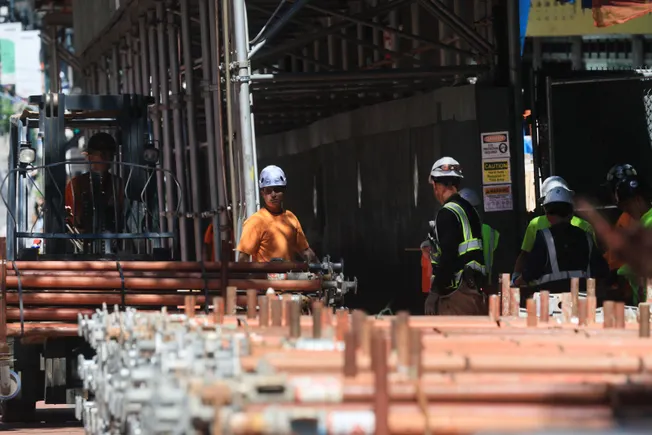
NEW YORK — New York City’s ambitious push to transform aging, underutilized office towers into modern residential housing is facing a severe regulatory reckoning. Following a high-profile structural failure at a major adaptive reuse project earlier this summer, the New York City Department of Buildings (DOB) has unleashed an unprecedented wave of scrutiny across Manhattan.
The enforcement surge has already resulted in partial or total construction stoppages at multiple high-profile conversion sites, sending shockwaves through the city’s real estate, legal, and engineering sectors. While municipal officials defend the aggressive posture as a necessary precaution to protect public safety, industry experts warn that the heightened oversight could delay timelines, inflate project budgets, and fundamentally alter how developers approach office-to-residential conversions in the nation’s densest metropolis.
The Main Facts: A Cascade of Stoppages
The regulatory clampdown centers on a string of enforcement actions targeting major Manhattan office-to-residential conversion projects:
- The Catalyst: On July 7, a alarming structural failure occurred at the former Pfizer headquarters building in Midtown Manhattan, where structural columns buckled during adaptive reuse construction.
- The First Domino: Prompted by the Pfizer incident, DOB inspectors launched a sweeping outreach and inspection initiative. This led city officials to order a partial construction stoppage at 750 Third Avenue on July 28.
- The Second Domino: Just two days later, on July 30, work was abruptly halted at another major conversion site, 222 Broadway.
- The Scope: Legal and engineering experts note that while municipal agencies routinely ramp up enforcement following headline-grabbing accidents, the sheer scale, speed, and aggression of the DOB’s current response are entirely unprecedented.
Chronology of Crisis: From Pfizer to 222 Broadway
To understand the current regulatory freeze, industry observers point back to a timeline of escalating structural scares and municipal reactions over the past several years:
- April 2023: A catastrophic parking garage collapse on Ann Street in Lower Manhattan results in a fatality, prompting the DOB to launch a citywide aggressive outreach and inspection campaign characterized by a wave of sweeping violations.
- July 7, 2024: Structural columns buckle at the former Pfizer building office conversion project, sending immediate alarm bells through municipal engineering offices and triggering heightened scrutiny of adaptive reuse projects across the five boroughs.
- March 2024 (Retroactive Discovery): At 222 Broadway—a major office conversion project—structural beams crack. While construction crews rapidly execute physical repairs, the incident is never properly reported to municipal authorities according to the mandated timeline.
- July 28, 2024: The DOB orders a partial construction stoppage at 750 Third Avenue as part of its enhanced post-Pfizer inspection sweep.
- July 30, 2024: City officials slap a stop-work order on 222 Broadway. Investigators clarify that this particular stoppage stems primarily from a paperwork and timeline discrepancy—specifically, failing to report the earlier beam repairs—rather than an active, catastrophic structural failure.
Supporting Data and Realities of New York Real Estate
The sudden proliferation of stop-work orders highlights a deeper, systemic reality of construction in New York City: the labyrinthine complexity of municipal building codes.
According to seasoned civil engineers and construction attorneys, achieving 100% compliance on any major Manhattan project is virtually impossible.
"It’s impossible to find a building in New York City that doesn’t have a violation on it," said Joe DiPompeo, president of New Jersey-based Structural Workshop. "If you go out and scrutinize every major construction project in Manhattan, I expect you’ll find a violation on most or all of them."
Adaptive reuse projects face unique hurdles. Unlike ground-up construction, which follows clean blueprints from day one, conversions of existing mid-century or vintage office towers constantly confront unpredictable field conditions. Crews frequently uncover hidden structural elements, outdated materials, or layout anomalies once walls and ceilings are stripped away. These surprises mandate field design modifications.
However, Trent Cotney, a partner at the law firm Adams & Reese in Tampa, Florida, emphasizes that the issue is rarely the engineering fix itself; rather, it is the administrative trail.
"The key question is whether those changes were properly documented, inspected, and approved," Cotney explained. "A sound field modification can still create a compliance issue if the required process was not followed." At 222 Broadway, for instance, the physical work to fix cracked beams was executed adequately, but the failure to navigate the city’s rigorous reporting protocols triggered the administrative hammer.
Official Responses and the Psychology of Enforcement
Municipal officials and legal experts agree that the DOB is operating under an established playbook—albeit dialed up to maximum intensity. When a high-profile structural failure threatens public trust, inspectors naturally err on the side of caution.
"Whenever a major incident occurs, the government often responds with more scrutiny. That is normal," noted Dan Rosenberg, a principal at Much Shelist in Chicago. "The pure scale and scope of this incident is staggering, however."
Carol Sigmond, a New York City-based partner at the law firm Nossaman, points out that the DOB is legally mandated to continuously evaluate safety trends in order to update local construction codes.
"If they are seeing issues in conversions, they may consider making code changes in the interests of public safety," Sigmond said. She suggests that the city may soon mandate stricter structural steel evaluations specifically tailored to the unique weight loads and architectural demands of office-to-residential conversions.
At the same time, experts like DiPompeo view the current inspection blitz partly as a public relations and signaling campaign. By blanketing Manhattan with inspectors and writing violations "left and right for anything and everything," the DOB is sending an unmistakable message to developers, property owners, and the public that regulatory oversight is absolute.
Crucially, DiPompeo does not believe a fundamental lack of building regulations caused the Pfizer building columns to buckle. Instead, he suspects a breakdown in protocol during a specific step of execution by contractors or field inspectors. "I don’t think the wheel has to be reinvented here," he said.
Broad Implications: What This Means for the Future of NYC Construction
While the targeted stop-work orders may eventually be lifted once engineers submit required documentation and undergo additional safety reviews, the ripple effects of the DOB’s crackdown will be felt across the real estate landscape for years to come.
1. Slower Project Timelines and Financial Strain
For developers racing to convert vacant commercial space into much-needed housing, time equates directly to capital. Rosenberg warns that the entire New York City development community must brace for tighter, more intrusive inspections.
"For projects underway, that likely means slower progress," Rosenberg said. "And as we all know in construction, time is money. I don’t think this stops most projects underway, it slows them down."
2. Legal Disputes and Contractual Friction
Delays caused by unbudgeted engineering reviews and municipal stop-work orders are breeding grounds for litigation. Cotney notes that stalled projects inevitably lead to friction and contract disputes between developers, general contractors, and subcontractors over who absorbs the mounting costs of downtime.
3. A Cautious Financial Ecosystem
The impact of the DOB’s aggressive stance will not be confined to municipal agencies. Financial institutions, investment funds, and insurance companies are taking notice.
"Developers, lenders, and insurers may also become more cautious, with greater emphasis on independent structural reviews, stronger inspection controls, and larger contingencies," Cotney predicted.
As New York City continues to grapple with an ongoing housing crisis and a surplus of obsolete office inventory, adaptive reuse remains a vital policy goal. However, the events at 750 Third Avenue, 222 Broadway, and the former Pfizer building serve as a stark reminder: in the complex ecosystem of Manhattan real estate, speed can never be allowed to outpace safety.
