

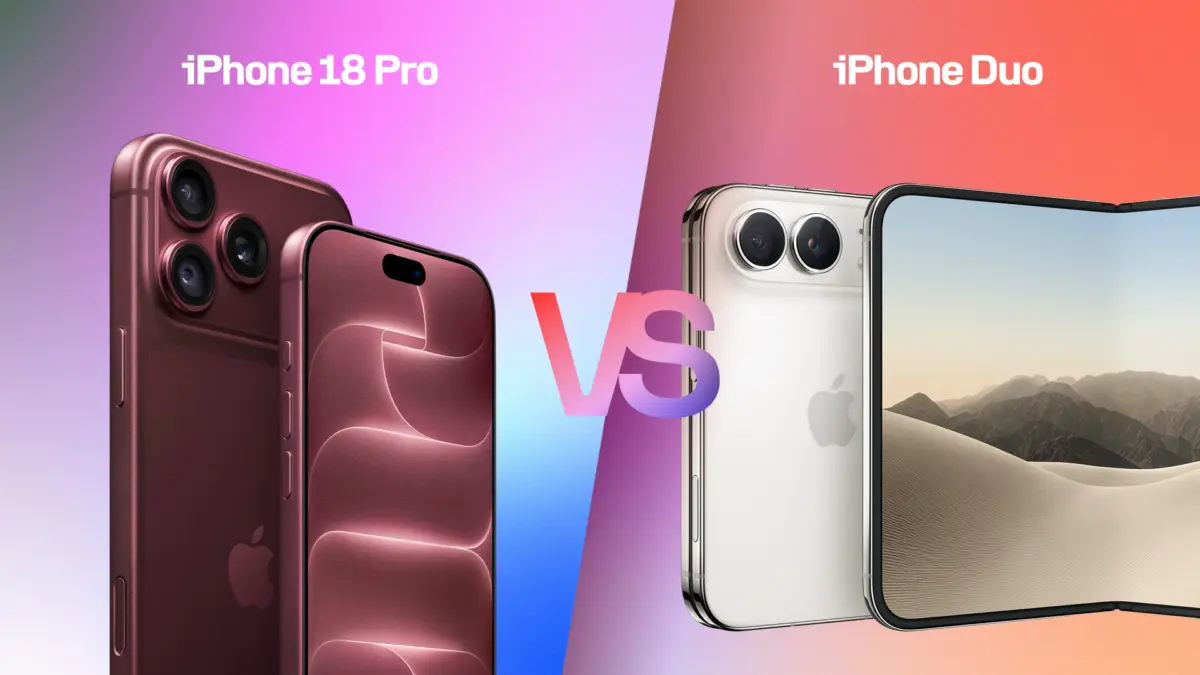
Apple has officially entered a new era of mobile hardware, presenting consumers with a stark choice between the pinnacle of traditional smartphone engineering and a revolutionary reimagining of form factor. While the traditional iPhone 18 Pro is already available on store shelves, the tech giant’s heavily anticipated first-ever foldable handset, the iPhone Duo, represents a major milestone in mobile design.
Though both devices sit comfortably at the absolute apex of the premium smartphone market, they cater to radically different user philosophies. The iPhone 18 Pro doubles down on uncompromising performance, cutting-edge camera capabilities, and thermal efficiency. Conversely, the iPhone Duo challenges the status quo with a passport-style bookable design that transforms an ultra-portable closed device into a massive, near-tablet viewing experience when opened.
Evaluating these two powerhouses requires looking closely at how they differ across design, camera systems, internal processing, and pricing structures—providing a clear roadmap for consumers trying to decide where to invest their money.

Main Facts: At a Glance
The launch of the iPhone 18 Pro and the iPhone Duo marks a pivotal moment for Apple’s product roadmap. Here are the core details defining both devices:
- iPhone 18 Pro: A traditional slab-style flagship featuring a 6.3-inch OLED display, a triple-lens 48-megapixel camera array with an industry-first variable aperture, an internal vapor chamber for advanced cooling, and a starting price of $1,199 for the 256GB model.
- iPhone Duo: Apple’s inaugural foldable device, featuring a squat 5.4-inch outer cover screen and an expansive 7.6-inch inner matte display. It utilizes a side-mounted Touch ID sensor, an IP68 dust and water-resistance rating, a dual-camera system, and a luxury starting price of $1,999 for the 256GB tier.
- Shared Silicon: Both handsets are powered by Apple’s cutting-edge A20 Pro chip, manufactured using a pioneering 2-nanometer process that delivers staggering performance and energy efficiency.
- Release Timeline: The iPhone 18 Pro is currently on sale, while the iPhone Duo is slated for its official market debut on October 23.
Chronology of the Launch and Evolution
To understand how Apple arrived at this dual-device launch strategy, it helps to review the timeline of recent mobile developments and release cycles leading up to this point.
- Preceding Generations: Apple laid the groundwork for these releases through iterative updates, such as the thermal and design foundations laid by the iPhone 17 Pro and the ultra-slim profile explored in earlier concept devices like the iPhone Air.
- Product Announcement: Apple officially unveiled both the iPhone 18 Pro and the iPhone Duo during its autumn hardware event, immediately sparking global discussion over the company’s long-awaited entry into the foldable market.
- Current Availability Phase: Following the keynote, the iPhone 18 Pro launched immediately, drawing large queues at flagship retail locations such as Apple’s Fifth Avenue store in New York City. Meanwhile, the build-up to the iPhone Duo’s release has generated intense anticipation, culminating in a scheduled launch date of October 23.
Detailed Comparison: Design and Display
The iPhone 18 Pro: Refined Familiarity
The primary design ethos of the iPhone 18 Pro is refinement. Retaining the classic slab configuration that users have grown accustomed to over the years, the 18 Pro measures 5.9 by 2.3 by 0.3 inches—identical to its predecessor, the iPhone 17 Pro. This consistency means consumers can seamlessly reuse existing cases.

Constructed with an aluminum unibody design, the front of the device houses a vibrant 6.3-inch OLED display supporting a smooth 120Hz refresh rate. Apple has further minimized the Dynamic Island cutout, which houses the front-facing camera and Face ID hardware. Notably, this refined Dynamic Island can now display up to three Live Activities simultaneously, significantly boosting multitasking visibility.
The iPhone Duo: A Foldable Paradigm Shift
The iPhone Duo breaks away from traditional Apple design conventions. When closed, it adopts a compact, passport-style footprint with flat titanium sides and rounded corners on the upper and lower right, measuring 4.6 by 3.3 by 0.4 inches. This closed configuration features a squat 5.4-inch cover display.
Unfolding the device reveals a sweeping 7.6-inch OLED internal display running at a 120Hz refresh rate. Unlike the glossy glass used on the outer cover screen, the internal foldable screen features a specialized matte nano-textured finish engineered to drastically cut down reflections and minimize the appearance of the central screen crease.

Furthermore, when fully open, the Duo measures a remarkably slim 0.2 inches thick—making it thinner than previous ultra-slim iterations. In a major hardware shift, the Duo omits Face ID entirely, relying instead on a side-mounted fingerprint sensor for Touch ID. Both devices feature an IP68 dust and water-resistance rating, an impressive engineering feat for the Duo, which joins a very select group of book-style foldables to achieve true dust resistance.
Camera Systems: Creative Flexibility vs. Foldable Utility
iPhone 18 Pro: The Ultimate Photographer’s Tool
For users prioritizing raw photography power, the iPhone 18 Pro offers Apple’s most advanced camera ecosystem to date. It features a triple-lens rear array consisting of three 48-megapixel sensors: wide, ultrawide, and telephoto.
The standout hardware addition is the variable aperture system. This feature grants manual control over how much light strikes the camera sensor, dramatically improving low-light photography, enhancing depth-of-field control for macro and close-up shots, and providing professional-grade flexibility for shutter speed and exposure adjustments.

iPhone Duo: Practical Versatility
Despite its significantly higher price tag, the iPhone Duo’s camera system leans closer to the standard iPhone line rather than the Pro series. It features a dual-lens rear array comprising a 48-megapixel wide camera and a 48-megapixel ultrawide camera, lacking both the dedicated telephoto zoom lens and the variable aperture found on the 18 Pro. It supports a 2x optical-quality zoom and digital zoom up to 10x.
However, the Duo introduces unique compositional advantages. While closed, users have access to a 12-megapixel cover selfie camera and a hidden under-display FaceTime camera on the main screen. More importantly, when the phone is unfolded, users can utilize the high-powered 48-megapixel rear camera system for selfies, using the outer cover display as an oversized viewfinder.
Performance, Thermal Management, and Battery Life
Under the hood, both the iPhone 18 Pro and the iPhone Duo share Apple’s cutting-edge A20 Pro processor. Built on an advanced 2-nanometer manufacturing process, this chip delivers exceptional transistor density, translating to a 20% faster CPU and a 40% faster GPU compared to previous generations.

To manage the intense thermal loads generated by the A20 Pro during heavy usage, Apple has implemented structural redesigns:
- The iPhone 18 Pro features an expanded internal vapor chamber inside its unibody chassis to dissipate heat efficiently during sustained high-performance tasks.
- The iPhone Duo leverages the thermal efficiency of the 2nm architecture across its dual-chassis layout to maintain stable operating temperatures.
Battery and Charging Performance
Apple officially rates the iPhone 18 Pro for up to 24 hours of typical daily usage. Real-world preliminary testing indicates the device easily clears a full day of use and stands out as one of the fastest-charging phones on the market, jumping from 0% to 82% in just 30 minutes.
The iPhone Duo, owing to its larger physical footprint and dual-battery layout, boasts extended media playback times—offering up to 44 hours of video playback when closed and 31 hours when open. Charging metrics for the Duo indicate it can reach a 50% charge in roughly 15 to 20 minutes using a 60W (or higher) power adapter, or hit 50% in 30 minutes via a 35W wireless MagSafe charger.

Official Responses and Market Positioning
Apple’s leadership has framed this dual-launch strategy not as internal competition, but as an expansion of the iOS ecosystem into entirely new product categories. By releasing the iPhone 18 Pro alongside the iPhone Duo, Apple is directly addressing two distinct consumer segments:
- The Productivity & Creator Segment: Addressed by the iPhone 18 Pro, which targets users who demand elite camera capabilities, absolute thermal stability, and a traditional, durable form factor at a more accessible flagship price point.
- The Early Adopter & Power User Segment: Addressed by the iPhone Duo, which targets consumers willing to pay a luxury tax for cutting-edge foldable engineering, dual-screen multitasking, and tablet-like screen real estate that fits inside a pocket.
Industry analysts note that while the steep entry price of the Duo positions it as a niche, ultra-premium status symbol, the technological breakthroughs embedded within it—such as the crease-minimizing nano-texture display and IP68 foldable rating—will likely influence future generations of mainstream Apple hardware.
Implications for the Mobile Industry
The arrival of the iPhone Duo alongside the refined iPhone 18 Pro carries significant implications for the broader smartphone landscape:

- Validation of the Foldable Format: Apple’s entrance into the foldable market all but validates the book-style foldable form factor as a permanent pillar of consumer technology rather than a fleeting industry trend.
- Pricing Pressures: With the iPhone Duo starting at $1,999 (scaling up to $3,199 for the 2TB model) and the iPhone 18 Pro starting at $1,199, Apple continues to push the ceiling of what consumers are expected to pay for mobile devices. This trend reinforces a widening financial split between standard flagships and ultra-luxury hardware.
- Software Ecosystem Evolution: The necessity of optimizing iOS 27 for both a traditional 6.3-inch slab display and an expansive 7.6-inch foldable canvas forces developers to rethink app layouts, multi-window workflows, and media consumption controls (such as split-screen streaming configurations seen with platforms like Netflix).
Ultimately, whether consumers choose the precision engineering and variable-aperture photography of the iPhone 18 Pro or the transformative dual-screen experience of the iPhone Duo, Apple has firmly signaled that the future of mobile computing is customizable, powerful, and deeply diversified.
