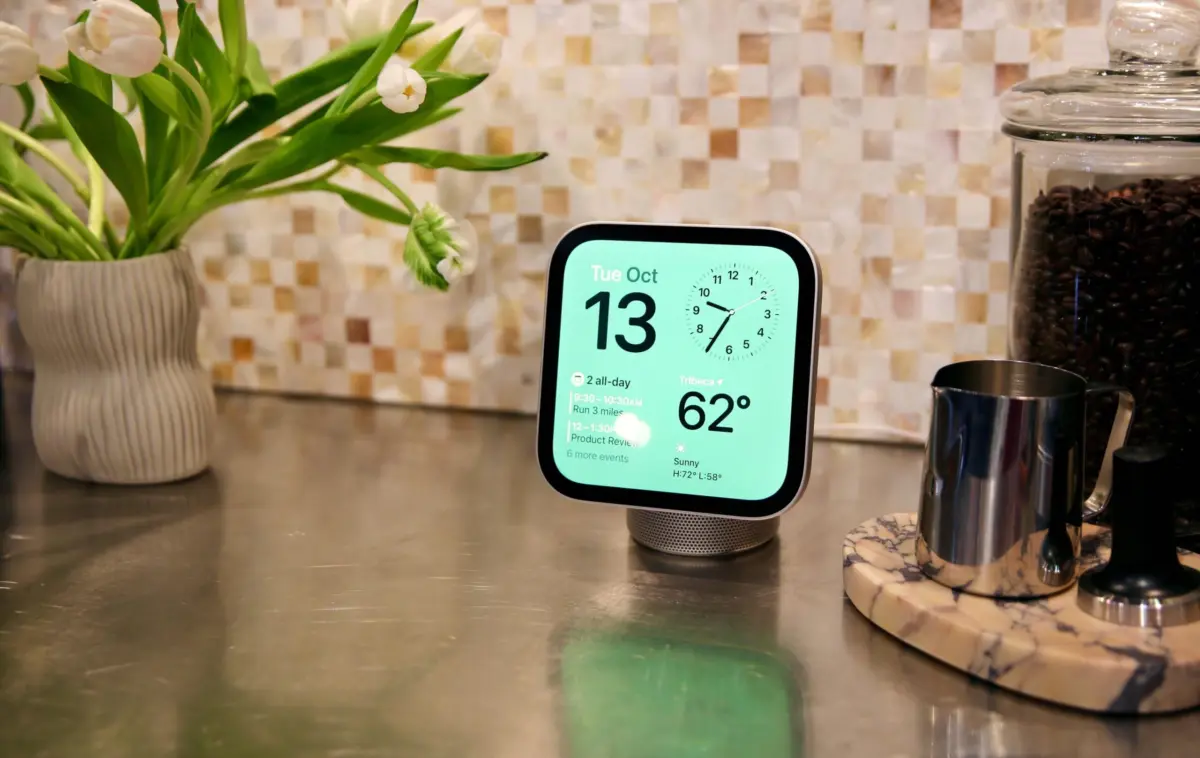
Apple has officially entered the smart display market with the announcement of the HomeView, a $299 dedicated household hub. Blending design elements of a giant Apple Watch with a flattened, metallic HomePod Mini, the stationary device is engineered to act as a permanent, always-on focal point for the modern connected home.
Unlike an iPad or an iPhone, which are inherently personal devices designed to wander off or get lost under couch cushions, the HomeView is built specifically for communal use. It features a permanent physical footprint, a fixed location on a wall or kitchen counter, and integrated multi-user support designed to accommodate up to six household members.
Priced competitively against legacy competitors like the Amazon Echo Show and Google Nest Hub, the HomeView bypasses third-party advertisements and relies heavily on Apple’s newly unveiled Siri AI and its privacy-first "personal context" features. By pulling contextual data from trusted personal devices—such as an AI-capable iPhone—the HomeView promises to deliver quick calendar lookouts, smart home control, and seamless family communication without demanding constant interaction or endless follow-up questions from the user.
Chronology of Smart Home Interventions: From In-Wall iPads to Dedicated Hubs
For years, tech enthusiasts and smart home automation hobbyists have attempted to solve the central problem of domestic technology: how to provide a unified, accessible interface for everyone in a household.
The Early DIY Era: For many years, users relied on makeshift solutions, mounting standard iPads into walls or keeping dedicated tablets plugged into kitchen counters. In practice, these setups frequently failed. iPads are notoriously expensive, feature inferior internal audio speakers, and suffer severe battery degradation when left plugged into a power source continuously. Furthermore, Apple’s iOS ecosystem has historically struggled to act as a smooth multi-user device without forcing family members to log in and out of individual personal iCloud accounts.
The Rise of Alternative Smart Displays: Over the last decade, Amazon and Google captured a substantial segment of the market with devices like the Echo Show and Google Nest Hub. However, these systems have increasingly been criticized for intrusive advertising models and hardware churn, highlighted by Google’s recent phasing out of the Pixel Tablet.
The Shift to Ambient AI Integration: Recognizing the limitations of personal devices for shared spaces, Apple developers began aligning advanced, natural-language AI processing with a dedicated, stationary hardware profile. This convergence ultimately culminated in the development of the HomeView, representing Apple’s most aggressive and cohesive push into the domestic IoT (Internet of Things) space to date.
Supporting Data and Hardware Specifications
To understand how the HomeView fits into the broader smart home ecosystem, it helps to examine its hardware footprint, software integrations, and structural limitations compared to other form factors:
Pricing: Retails at $299, positioning it in the mid-to-high tier of smart displays.
Design & Form Factor: Resembles an oversized Apple Watch mounted to a metallic, flattened HomePod Mini base. It possesses a significantly smaller physical footprint than most competing smart displays on the market.
Power & Portability: Features no battery and no detachable screen. This design choice ensures the device remains permanently plugged in, powered on, unlocked, and pinned to a predictable physical location.
Multi-User Capabilities: Capable of serving up to six individual household members. While user profiles leverage an AI-capable iPhone or iPad for backend context, basic communal functions—such as turning on smart lights or adjusting thermostats—can be operated by anyone walking past the display.
Ecosystem Advantages: Unlike competitor hardware, the HomeView is completely ad-free and directly functions as a primary Apple Home hub, an architectural requirement that standard iPads cannot fulfill.
Official Responses and Executive Insights
Apple’s leadership team has emphasized that the HomeView is less about reinventing the wheel and more about lowering the friction barrier for mainstream smart home adoption.
Kaiann Drance, Apple’s Vice President of Product Marketing for Home, explained the rationale behind the product’s timing:
"With the magic of Siri AI, it comes together in a way that we haven’t been able to deliver before. As the Siri AI capabilities continue to evolve, the home experience is fitting to be able to interact with in a natural way." Drance specifically pointed to Apple’s overarching "privacy story" as the foundational shield protecting the personal context data shared across household profiles.
Lilian Rincon, Vice President of Product Marketing for AI at Apple, highlighted how natural-language processing serves as the bridge for multi-generational usability:
"Because now it can be… my mother-in-law or the Gen Z who’s in college, both of them can use this in the way that they naturally speak and get what they want."
Rincon also addressed a common user complaint regarding competing smart assistants: their tendency to stall interactions with endless clarifying questions.
"A lot of these assistants out there are always asking questions because they want more information. For us, it isn’t about that. We’re there to get it done, take an action for you, show you what you need to get done, and then really get out of the way."
Implications for the Smart Home Industry
Bridging the Tech Divide for Non-Techies
For years, home automation enthusiasts have built complex, highly customized dashboards using platforms like Home Assistant running on Raspberry Pis, paired with elaborate tablet interfaces. Yet, the persistent issue remains: family members often refuse to use these complicated systems, treating them as overly technical anomalies.
By feeding complex scenes and automations from third-party hubs directly into Apple Home, enthusiasts can now leverage the HomeView as a clean, highly approachable front-end interface. When a spouse or child walks into the kitchen, they are greeted by a familiar, responsive screen rather than a wall of code or an intimidating dashboard.
Redefining Household Communication
Beyond controlling thermostats and viewing live security camera feeds via the Apple Home widget, the HomeView transforms home communication. Traditional phone calls frequently fail when teenagers or family members leave their phones on silent or let batteries die. The HomeView’s integration with home video calling allows incoming calls from family members outside the home to ring directly onto the stationary display, effectively modernizing the old-school household intercom.
A Strategic Victory for Apple’s Ecosystem
While power users may lament the initial lack of deeper, hyper-advanced Apple Intelligence customization features directly inside the Home app, the HomeView serves a more vital strategic purpose. It solves the communal computing problem.
By offering an accessible, ad-free, always-on interface that respects user privacy and relies on natural conversational commands, Apple has crafted a device that does not need to run every iPad app or replace an iPhone. It simply needs to make the smart home accessible to every single person living under the same roof—and in doing so, it may reshape consumer expectations for what a household hub should be.