

By Matt Elliott
Senior Editor, Hardware & Computing
Apple has officially refreshed its desktop lineup with the launch of the highly anticipated M6 Mac Mini, arriving nearly two years after the debut of its predecessor. Skipping the M5 generation for its flagship desktop form factor, the Cupertino giant has introduced a machine built from the ground up for the era of local artificial intelligence agents, creative multitasking, and demanding professional workflows.
However, this generational leap comes amid shifting market dynamics. With supplies of older models dwindling and consumer demand spiking due to the surge in always-on local AI applications—such as OpenClaw and localized large language models (LLMs)—the M6 Mac Mini arrives precisely when the market needs it most. Yet, questions surrounding steep configuration pricing and stagnant chassis designs remain front and center for prospective buyers.

Main Facts: What’s New in the M6 and M5 Pro Mac Mini
The new Mac Mini lineup splits into two primary architectures: the standard M6 model, starting at an increased base price of $899, and the high-end M5 Pro variants, which stretch into Mac Studio territory starting at $1,699.
- The 2nm Advantage: The standard M6 processor is Apple’s first silicon fabricated using an advanced 2-nanometer process. This allows for higher transistor density, enabling increased core counts and clock speeds without expanding the physical footprint of the chip.
- Core Count Bumps: The M6 features a 12-core CPU and a 12-core GPU, stepping up from the 10-core configurations found on the M4.
- Next-Gen Neural Engines: Designed specifically for AI processing workloads, the M6 boasts a groundbreaking dual 16-core Neural Engine (32 cores total), doubling the capacity of previous generations.
- Unified Memory and Bandwidth: Memory bandwidth has seen a significant boost. The M6 model delivers up to 153 GB/s with 16GB of RAM, and up to 170 GB/s for configurations with 24GB or more. The M5 Pro pushes this ceiling even higher to 307 GB/s.
- Modern Connectivity: Standard across the new lineup is Apple’s N1 networking chip, bringing support for cutting-edge Wi-Fi 7 and Bluetooth 6.
Chronology: The Evolution of Apple’s Smallest Desktop
To understand the positioning of the M6 Mac Mini, it is necessary to examine how Apple’s desktop strategy has evolved over the last two decades.
- 2005–2024 (The Budget Era): For the majority of its tenure, the Mac Mini served as the entry-level gateway to the macOS ecosystem. Debuting two decades ago at $499 and lingering comfortably around $599 for years, it was prized as an affordable, bring-your-own-display workstation.
- Early 2026 (The Price Shift): The Mac Mini lost its crown as Apple’s cheapest Mac when the price jumped to $799, followed shortly by the spring introduction of the MacBook Neo at $699 (powered by an iPhone-derived A18 Pro chip).
- Late 2026 (The AI Surge): As "the year of the AI agent" took hold, consumer demand for always-on local AI servers caused widespread inventory shortages of the M4 Mini. Consumers increasingly sought out the compact, power-efficient desktop to run continuous local workloads.
- Today (The M6 Launch): Apple bypasses the M5 for the standard Mac Mini line, introducing the 2nm M6 chip at a starting price of $899 while offering robust M5 Pro configurations for heavy creative and enterprise workloads.
Supporting Data: Specifications and Benchmark Performance
Apple supplied two review units for early testing: a mid-tier M6 model and a loaded M5 Pro configuration.

Tested System Configurations
| Feature | Mac Mini M6 (Tested) | Mac Mini M5 Pro (Tested) |
|---|---|---|
| Price as Reviewed | $1,299 | $2,899 |
| CPU Architecture | M6 (12-core CPU) | M5 Pro (18-core CPU) |
| Unified Memory | 24GB LPDDR5 | 48GB LPDDR5 |
| Graphics (GPU) | Integrated 12-core GPU | Integrated 20-core GPU |
| Storage (SSD) | 512GB SSD | 1TB SSD |
| Networking | Wi-Fi 7, Bluetooth 6, 2.5Gb Ethernet | Wi-Fi 7, Bluetooth 6, 10Gbps Ethernet |
| Operating System | macOS 27.0 Golden Gate | macOS 27.0 Golden Gate |
Early Performance Insights
Initial benchmark testing reveals that the M6 architecture is exceptionally well-suited for on-device AI tasks. Thanks to its dual 16-core Neural Engine and neural accelerators embedded in each GPU core, the M6 Mac Mini outperformed both the M4 Mini and standard M5-based MacBooks on the Geekbench AI benchmark.
However, competition in the mini-PC space remains fierce. For instance, the Asus Ascent QN10—powered by a Qualcomm Snapdragon X2 Elite CPU boasting an NPU capable of 80 trillion operations per second—still holds an edge in specific dedicated AI throughput tests.
On general application benchmarks, the M6 Mini turned in stellar single-core results on Geekbench 6 and Cinebench 2024, frequently outpacing its more expensive M5 Pro sibling in single-threaded tasks. Conversely, the M5 Pro leveraged its 18 CPU cores to dominate multicore workloads and blew past the standard M6 in graphics-heavy tests like 3DMark Steel Nomad.

Official Responses and Pricing Controversies
While the performance gains of the 2nm architecture have been widely praised, Apple’s pricing and configuration strategies have drawn criticism from tech analysts and consumers alike.
Starting at $899, the base M6 Mac Mini ships with just 16GB of RAM and a meager 256GB SSD. Industry observers have pointed out that offering a 256GB solid-state drive on a modern desktop computer is difficult to justify, particularly given that Apple phased out 256GB options on the MacBook Air earlier in the year.
Furthermore, upgrading storage and memory comes at a severe premium:

- Doubling the SSD storage to 512GB adds $200, instantly pushing the base machine past the $1,000 threshold.
- Upgrading to 1TB costs an additional $300, while a 2TB tier commands a staggering $500 surcharge.
- Unified memory upgrades—crucial for users attempting to load larger LLMs—add $200 per 8GB increment.
At the top end, the fully loaded M5 Pro unit tested reached $2,899, pricing it $400 higher than an entry-level Mac Studio while offering fewer overall upgrade pathways due to the soldered System-on-a-Chip (SoC) design.
Implications: The Mac Mini’s Role in the AI Landscape
The rapid evolution of the Mac Mini highlights a broader transformation in personal computing. No longer viewed merely as a budget-friendly desktop for casual users or casual developers, the Mac Mini has quietly cemented its status as the go-to hardware platform for local artificial intelligence infrastructure.
The Unified Memory Advantage
The core strength of Apple’s silicon strategy—Unified Memory Architecture (UMA)—is the primary catalyst behind this shift. Traditional PC architectures split system RAM from dedicated video RAM (VRAM), creating bottlenecks when moving massive datasets back and forth. Apple’s UMA allows the CPU, GPU, and Neural Engine to share a single, high-bandwidth memory pool.

Because running local large language models and autonomous AI agents requires massive amounts of accessible memory bandwidth, the Mac Mini’s relatively low barrier to entry (compared to enterprise-grade servers) has made it a darling of the developer community.
Design Stagnation and Ergonomic Quirks
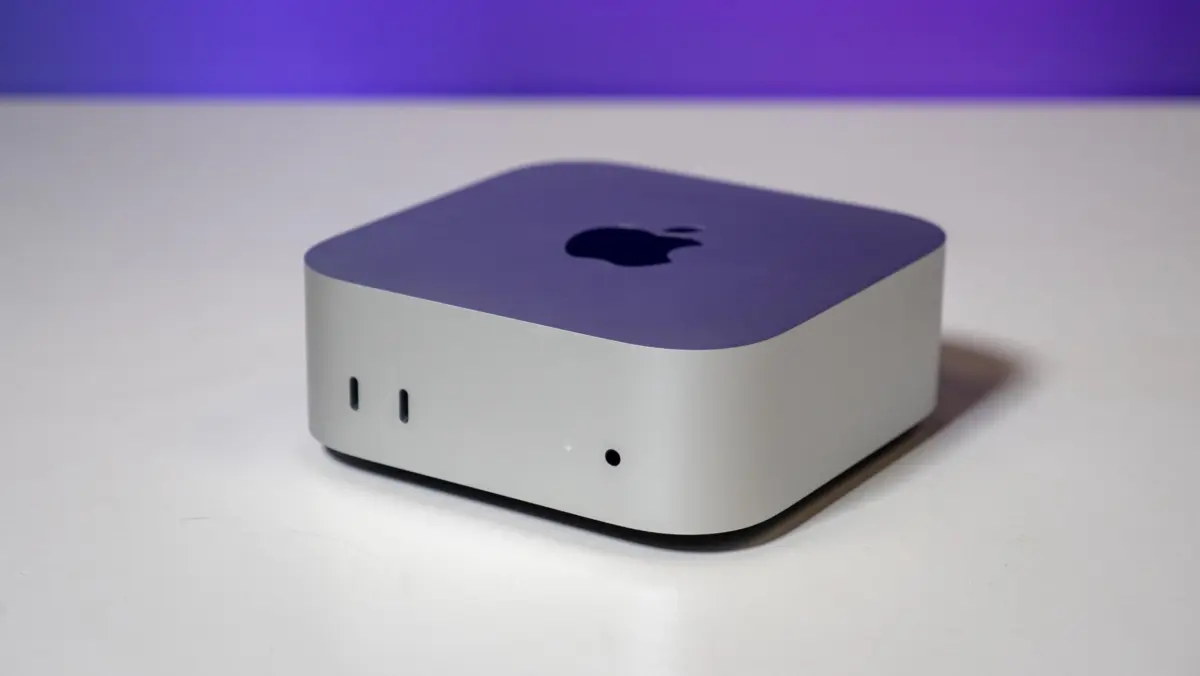
Externally, the M6 Mac Mini retains the exact same chassis introduced with the M4 generation—a compact 5-by-5-inch square standing 2 inches tall. While this small footprint is ideal for space-constrained desks and server racks, it retains frustrating design choices. Notably, the power button remains located on the bottom panel, requiring users to physically lift the device to turn it on or off. Additionally, the complete absence of legacy USB-A ports means users must rely on adapters or dongles for older peripheral devices.
Final Outlook
The M6 Mac Mini is a technological triumph that successfully showcases the efficiencies of a 2-nanometer manufacturing process. It delivers blistering single-core speeds, vastly superior AI processing capabilities, and future-proof networking in a package that easily fits in the palm of a hand.

Yet, potential buyers must navigate Apple’s notoriously aggressive upgrade pricing. While the base $899 model serves as an exceptionally capable entry point for AI hobbyists and minimalists, configuring a machine with adequate storage and memory quickly balloons the cost into professional workstation territory. Full reviews and extended real-world stress tests will determine whether the performance leap justifies the steep investment required for maxed-out configurations.
