

By Anthony Capkun
Published August 7, 2026
Main Facts
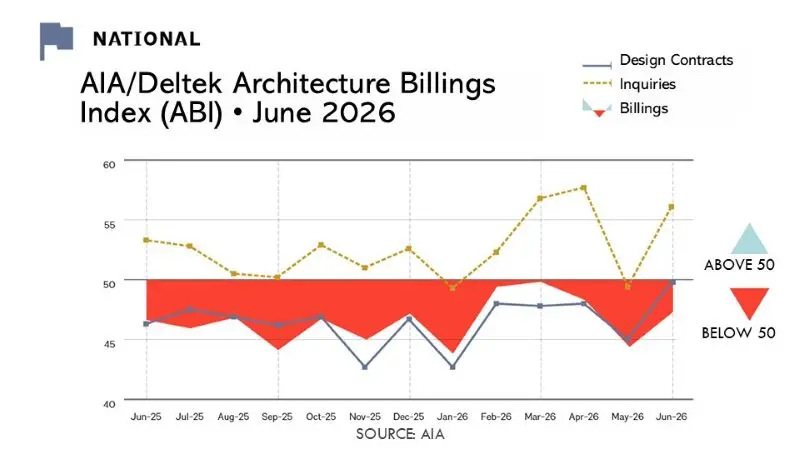
The latest economic data from the American Institute of Architects (AIA) and Deltek reveals a modest recovery in business conditions for U.S. architecture firms, though the sector remains trapped in a historically prolonged downturn. According to the AIA/Deltek Architecture Billings Index (ABI), the June 2026 score climbed to 47.3.
While this figure represents a noticeable improvement of nearly three points compared to May’s reading—which represented the lowest point for the index since January—it still falls below the crucial 50-point threshold. In the mechanics of the ABI, any score over 50 signals an increase in billings from the previous month, while anything under 50 indicates contraction. Therefore, the June data confirms that a majority of architecture firms across the United States continue to experience falling billings, even if the overall pace of decline has slowed.
As a widely trusted leading economic indicator, the ABI uses proprietary monthly data from architecture firms to forecast nonresidential construction activity roughly 9 to 12 months into the future. The persistent sub-50 readings point toward continued sluggishness and cautious spending across the broader commercial and institutional real estate development pipelines.
Beneath the headline billing index, other key metrics presented a mixed picture for the sector. Newly signed design contracts hovered just beneath the 50-mark, registering as essentially flat. This indicates that an equal number of firms experienced an uptick in new agreements as those reporting a drop-off. Meanwhile, project inquiries showed encouraging signs of life, ticking upward during the month and suggesting that prospective clients are still actively evaluating and planning future projects, even if they remain hesitant to ink formal contracts.
Chronology of the Downturn
To understand the weight of the June 2026 report, industry analysts must view it within the broader historical trajectory of the index. The architecture and commercial design sectors are currently navigating one of the most stubborn and extended slumps in the 30-plus-year history of the ABI.
According to data compiled by the AIA, the architectural sector has now endured 41 consecutive months without a majority of firms reporting billings growth. This multi-year contraction has fundamentally reshaped strategic planning for design practices of all sizes:
- Late 2025: The Midwest region of the United States experienced a brief, modest glimmer of hope, registering slight growth in billings during the fourth quarter. However, this momentum proved ephemeral.
- Early 2026: Architectural services employment managed to reach a seasonal peak in February 2026, supported by carryover projects from prior years. However, high financing costs, tighter lending standards, and macroeconomic uncertainty began to take a heavier toll as the quarter progressed.
- May 2026: Business conditions suffered a sharp setback, driving the ABI down to its lowest level since January. Architectural services employment contracted accordingly, shedding 300 jobs in May alone. This brought total industry job losses to 1,100 positions since the February peak.
- June 2026: The ABI rebounded slightly to 47.3, offering a slight reprieve from May’s severe contraction, but leaving the underlying structural challenges of the market unresolved.
Supporting Data and Regional Metrics
A granular analysis of the June 2026 report reveals deep disparities across firm sizes, geographic regions, and project specializations. The broad national average masks unique vulnerabilities hidden within specific segments of the market.
Project Backlogs Shrink in the Second Quarter
Average project backlogs across U.S. architecture firms edged downward during the second quarter of 2026, slipping to 6.3 months from 6.6 months in the first quarter. While a backlog of over six months would historically be considered healthy, the distribution of these remaining projects is unevenly distributed, heavily favoring larger, more diversified firms.
- Small Firms at Risk: The sharpest and most alarming decline in backlogs occurred at smaller practices—specifically those with annual billings under $250,000. For these boutique firms, average backlogs collapsed from 4.9 months in Q1 to just 3.1 months in Q2.
- Multifamily Residential Impact: Firms specializing in multifamily residential projects also absorbed heavy blows, watching their average backlogs shrink from 6.2 months down to 5.3 months.
The AIA notes that while large firms have successfully maintained relatively stable project pipelines, smaller operations are burning through their existing work much faster than they can secure replacements. This dynamic leaves micro-firms disproportionately vulnerable if macroeconomic conditions fail to stabilize soon.
Regional Breakdown
Geographically, billings contracted across nearly every part of the country in June, though the severity varied:
- The South: The South stood as the sole exception to widespread monthly declines, reporting essentially flat business conditions.
- The Midwest: The Midwest continued a steady softening trend, completely erasing the localized gains it posted in late 2025.
- The Northeast and West: Both regions continued to log sub-50 scores, reflecting cautious commercial real estate sentiment in major metropolitan hubs.
Sector Specializations
Across specialized practices, every major building sector reported declining billings for the second consecutive month. Multifamily residential practices experienced the steepest drop-offs, a dramatic reversal for a sector that had enjoyed relatively stable operating conditions earlier in the year. Commercial/industrial, institutional, and mixed-use practices also reported continued downward pressure on fee generation.
Official Responses and Expert Analysis
Leadership at the AIA and partner organizations have emphasized the need for pragmatism as the architectural community navigates this prolonged plateau.
"Architecture firms remain mired in one of the longest-running downturns in the 30-plus-year history of the ABI," AIA representatives stated in the June 2026 release. The persistence of the slump—now extending past three and a half years—defies typical cyclical recovery patterns, leading many economists to reevaluate how structural shifts in remote work, commercial office utilization, and high interest rates are permanently altering capital deployment.
Industry observers note that while project inquiries are rising—a sign that developers and corporate clients have not abandoned long-term visions—the translation from inquiry to signed contract remains heavily choked. Developers continue to struggle with pro forma feasibility. Even when clients are eager to build, elevated construction material costs, skilled labor shortages, and stringent commercial lending environments make it difficult for projects to clear internal hurdle rates.
Furthermore, labor market corrections within the architectural profession reflect these mounting pressures. The loss of 1,100 jobs since February 2026 indicates that firm leadership is increasingly turning to right-sizing staffing levels to match diminished forward-looking backlogs, prioritizing operational survival over speculative capacity building.
Broader Implications for the Construction and Real Estate Sector
Because the Architecture Billings Index acts as a reliable leading indicator for nonresidential construction expenditures over a 9- to 12-month horizon, the June 2026 data carries profound implications for the entire built environment ecosystem—including structural engineers, general contractors, specialty trade subcontractors, and building materials manufacturers.
1. A Softening Construction Pipeline in 2027
With billings remaining below the 50-point expansion threshold for 41 straight months, the volume of projects moving from the drawing board to the groundbreaking phase will likely remain depressed well into 2027. Contractors and construction managers should anticipate a fiercely competitive bidding environment as fewer new projects enter the market, putting downward pressure on contractor margins.
2. Supply Chain and Material Demand Adjustments
Manufacturers of steel, concrete, glass, and interior finishes must calibrate their production and inventory forecasts to match this prolonged lull. With multifamily and commercial sectors experiencing pronounced cooling, demand for specific types of building products—particularly those tied to new commercial office fit-outs and multi-family residential framing—may remain soft.
3. Consolidation Pressure on Boutique Firms
The dramatic shrinkage of backlogs among firms with billings under $250,000 highlights an impending existential crunch for independent architects and micro-firms. Without robust cash reserves or diversified project portfolios, many smaller practices may be forced to pursue mergers, joint ventures, or strategic partnerships with larger regional firms to weather the remaining duration of the downturn.
4. Adaptation Toward Adaptive Reuse and Sustainability
As new ground-up construction faces financing hurdles, many architecture firms are pivoting their business models toward adaptive reuse, commercial-to-residential conversions, and energy-retrofit projects mandated by tightening municipal carbon regulations. Firms that can successfully market these sustainable renovation services are proving better equipped to sustain inquiry-to-contract conversion rates than those solely dependent on traditional ground-up development.
As the industry looks toward the second half of 2026, stakeholders will monitor upcoming monetary policy decisions and localized economic indicators for any signal that the broader capital markets are ready to unlock pent-up development demand. Until then, architecture firms must continue navigating a tightrope of disciplined cost management and strategic market diversification.
