

By Corinne Reichert
Senior Editor
Main Facts: The Intersection of Real-Time Sports and Iconic Animation
When ESPN first floated the concept of producing animated alternative broadcasts, the primary objective was deceptively simple: to engineer "magical moments in sports." Instead of relying exclusively on traditional broadcasts showcasing human athletes sinking jump shots or powering into the end zone, viewers were suddenly presented with a whimsical alternative. Mickey Mouse, Buzz Lightyear, Lisa Simpson, and Mike Wazowski could be seen running plays, celebrating touchdowns, and interacting in real-time sports environments.
This intersection of sports broadcasting and beloved intellectual property is not merely a novelty; it represents a massive technological undertaking. Spearheaded by Michael “Spike” Szykowny, ESPN’s vice president of edit, animation, graphics innovation, and creative production, these animated "alt-casts" are designed to court entirely new demographics who might not otherwise tune into a standard game.
Behind the curtain, the broadcasts rely on a sophisticated synthesis of technologies. ESPN leverages live player-tracking systems—such as NFL Next Gen Stats and Sony’s Hawk-Eye Innovations optical tracking—combined with Sony’s Beyond Sports engine. These systems capture the movements of real athletes on the field, instantly translating that data to animate characters so that they mirror the exact throws, routes, blocks, kicks, and tackles happening on the gridiron, ice, or hardwood.
Furthermore, the announcers themselves have been integrated into the digital ecosystem. While ESPN studio host Drew Carter initially wore a full-body motion-capture suit for the debut broadcast, technological advancements have streamlined the process. Today, commentators simply wear virtual reality headsets, allowing their booth calls to sync seamlessly with their animated digital avatars in real time.
Chronology: A Timeline of ESPN’s Animated Alt-Casts
The evolution of ESPN’s animated alternative broadcasts has been rapid, expanding across multiple major sports leagues and iconic cinematic universes since its inception.
2023: The Toy Story Debut
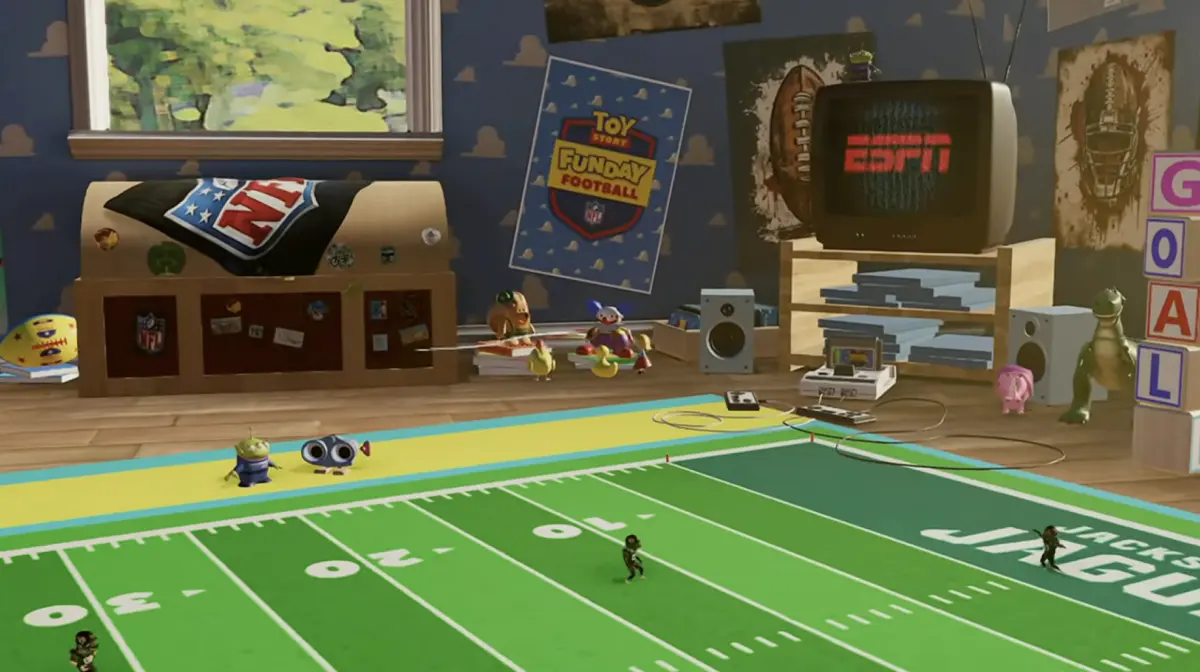
The experiment officially kicked off with the Toy Story version of Funday Football in late 2023. Set entirely inside Andy’s room, the broadcast featured toy-scale versions of real NFL players competing on a field constructed from household items. Goalposts were fashioned out of plastic blocks, the three-eyed aliens operated a claw machine to handle the kickoff ball, Slinky Dog served as the 1st-and-10 marker, and Duke Caboom delivered a memorable halftime show. Drew Carter appeared on-screen as a Pixar-ified digital counterpart of himself.
Expanding the Pixar Universe: Monsters, Inc.
Capitalizing on the success of the Toy Story broadcast, ESPN rolled out a second iteration of Funday Football themed around Monsters, Inc. Because the original film is now 25 years old, the digital environment had to be animated entirely from scratch. Randomly selected players were transformed into Mike Wazowski and James P. Sullivan (Sulley) on the field, while Roz served as a stern sideline reporter. Crucially, the production brought back the original voice actors from the classic Pixar film to aid in the alt-cast’s success.
December 2023: Dunk the Halls Hits the Hardwood
Shifting from football to basketball, ESPN debuted Dunk the Halls on Christmas Day, featuring Mickey Mouse and his closest friends squaring off in an NBA game. Set on a meticulously detailed replica of Main Street, U.S.A., at Walt Disney World, the production team enlisted animators directly from Walt Disney Studios to ensure absolute authenticity. Disney Legend and iconic animator Eric Goldberg personally drew hundreds of sketches outlining potential visual "bits" the characters could perform during the game.
March 2024: Taking to the Ice with Inside Out
In early 2024, ESPN targeted the National Hockey League (NHL), turning to Pixar’s Inside Out franchise—a natural thematic fit given the film’s hockey-centric plot points. The game was creatively designed to look as though it were unfolding inside the mind of the character Riley while she was sleeping. The ESPN Beyond Sports animation team built out "Hockey Island" in full three-dimensional space, utilizing official NHL positional data and Sony’s optical tracking to drive the action.
December 2024: Entering Springfield with The Simpsons
Most recently, ESPN launched a Simpsons-themed Funday Football alt-cast in December 2024. For this project, the network brought in the entire writing staff of The Simpsons to craft an overarching narrative that developed across eight minutes of original animation embedded throughout the game.

Supporting Data & Technological Architecture
The underlying mechanics required to pull off these live animated broadcasts are staggering. According to Disney and its production partners, the workflow bridges multiple complex data pipelines:
- Player Tracking Devices: Athletes wear specialized tracking hardware during games that continuously stream positional data.
- Data Ingestion: This data feeds directly into NFL Next Gen Stats (for football) or league-specific tracking databases (for the NHL and NBA).
- The Engine: Sony’s Beyond Sports engine and Hawk-Eye Innovations optical tracking process the raw data points.
- Real-Time Rendering: The system reconstructs every play in real time.
- The Delay Buffer: To allow for last-minute creative inserts and narrative adjustments, the broadcasts operate on a deliberate one-minute delay. This buffer gives producers just enough time to insert specific characters into key plays—such as rendering Bart Simpson as a quarterback or Lisa Simpson as a receiver immediately following a scoring play.
This architecture allows the production crew to pivot dynamically when anomalies occur. René Johnson, creative director of Disney Character Voices, recounted a moment during the Dunk the Halls broadcast when tracking glitches accidentally transformed a game referee into a player who subsequently sank a three-pointer. Quick thinking by the technical crew salvaged the error by instantly converting the errant referee model into the chaotic fan-favorite character, Stitch.
Official Responses and Creative Perspectives
Bringing together corporate giants like the NFL, Disney, Pixar, and The Simpsons required extensive collaboration, delicate negotiations, and a willingness to embrace uncertainty.
Jay Ward, creative director of franchise at Pixar, emphasized that the studio’s primary motivation for joining the project was its historic dedication to technology, creativity, and storytelling. Describing the real-time player tracking as an extraordinary technological feat, Ward noted that merging the rigid, data-driven world of professional sports with the expressive, fluid medium of animation was a natural evolution for modern media.
For the creative team behind The Simpsons, stepping into the live sports arena brought a unique blend of excitement and apprehension. Joel Cohen, writer and co-executive producer of The Simpsons, admitted that initial fears centered around whether these three colossal brands could coexist harmoniously.
"There was a little bit of fear because these are three giant iconic brands: NFL, The Simpsons and Disney — how will they work together?" Cohen reflected during the D23 panel. "We’re very particular about how we want our characters to be portrayed and what jokes we want them to tell."
Despite these initial anxieties, the partnership unlocked a style of production the veteran animation team had never previously experienced. Because television animation typically requires months or years of pre-production, the live, dynamic nature of an NFL broadcast offered a "super fun vibe" that even series creator Matt Groening turned out to experience firsthand.
However, the collaboration was not without its creative friction. Cohen noted that the NFL vetoed several jokes pitched by the writing staff, proving that even in a fictionalized universe where animated characters roam the gridiron, professional sports leagues maintain strict oversight over their product.
Implications: The Future of Sports Broadcasting
The ongoing success of ESPN’s animated alternative broadcasts signals a fundamental shift in how media companies package live events. By transforming standard sports into immersive, narrative-driven spectacles, Disney and ESPN are successfully bridging the gap between traditional sports fandom and family-friendly entertainment.
While traditionalists may still prefer the conventional broadcast booth and standard camera angles, the data points toward undeniable audience expansion. These alt-casts lower the barrier to entry for younger viewers, introducing children and families to sports leagues through characters and stories they already love.
ESPN has yet to officially announce which franchise or league will receive the animated alt-cast treatment next, but the initiative shows no signs of slowing down. Fans looking to revisit these technological milestones can stream past broadcasts on platforms like YouTube, Disney Plus, and ESPN Plus. Yet, as the production teams continually prove, the true magic lies in experiencing these digital marvels live—at the exact moment data, technology, and pure imagination collide on the screen.
