

SACRAMENTO — For decades, California’s premier environmental protection statute has served as both a shield for natural resources and the single most formidable weapon wielded against new residential construction. The California Environmental Quality Act (CEQA)—enacted in 1970—has long been utilized by neighborhood groups, environmental watchdogs, and project opponents to stall, downsize, or outright kill ground-up housing developments through protracted, expensive litigation.
Overriding fierce objections from project opponents who lobbied heavily for a gubernatorial veto, Governor Gavin Newsom signed a sweeping new package of housing legislation on Tuesday. The package is designed to systematically dismantle regulatory bottlenecks and drastically accelerate residential construction across a state grappling with a severe and enduring affordability crisis.
At the center of this legislative maneuver are Senate Bills 344 and 958, statutes explicitly engineered to blunt the efficacy of CEQA-based lawsuits. Notably, SB 344 targets a single, highly contentious enterprise: the multi-billion-dollar Midway Rising redevelopment in San Diego. In doing so, the bill establishes a groundbreaking precedent as the first state-level statute of its kind crafted to insulate a specific urban development from endless environmental challenges.
Main Facts: The Anatomy of the New Legislation
The newly signed housing package represents a decisive intervention by state lawmakers into local land-use disputes, prioritizing regional density and affordable housing production over localized environmental litigation.
The legislative framework centers on two primary bills authored by San Diego-area Senator Akilah Weber Pierson and sponsored by San Diego Mayor Todd Gloria, both of which sailed through the state Senate with unanimous approval:
- Senate Bill 344 (SB 344): This legislation pulls the rug out from under ongoing and future CEQA challenges directed at the environmental impact report (EIR) for the Midway Rising project. Once the City of San Diego certifies the project’s environmental review, SB 344 legally bars any further CEQA-based litigation, effectively ending a years-long courtroom chess match.
- Senate Bill 958 (SB 958): Extending its reach statewide, SB 958 permanently prevents local jurisdictions from using increased building height as a determining environmental impact factor for qualifying infill housing developments. By removing height as a valid basis for a CEQA challenge, the law eliminates a principal line of attack utilized by anti-density litigants.
These statutes do not exist in a vacuum. They are anchored by a broader legislative offensive aimed at standardizing and expediting housing production statewide:
- Senate Bill 1116 (SB 1116): Expands the state’s starter home regulations by eliminating a restrictive five-acre cap on qualifying projects while simultaneously curtailing local zoning standards that artificially deflate housing yields.
- Assembly Bill 1294 (AB 1294): Establishes a targeted pilot property-tax incentive program specifically designed to encourage the development of low- and moderate-income apartment rentals across Alameda, San Francisco, and Sacramento counties.
- Senate Bill 328 (SB 328): Streamlines and accelerates the environmental review process for the large-scale redevelopment of the former Concord Naval Weapons Station in Contra Costa County, where planners envision at least 10,000 new residential units.
- Assembly Bill 1815 (AB 1815): Prohibits municipal governments from imposing arbitrary, localized building standards on factory-built or modular housing that exceed baseline state building codes.
Chronology of Conflict: The Road to Midway Rising
To understand the immense political and legal friction that birthed SB 344 and SB 958, one must examine the turbulent history of the Midway Rising project—a textbook illustration of how CEQA can be leveraged to paralyze urban planning.
The Genesis of Midway Rising
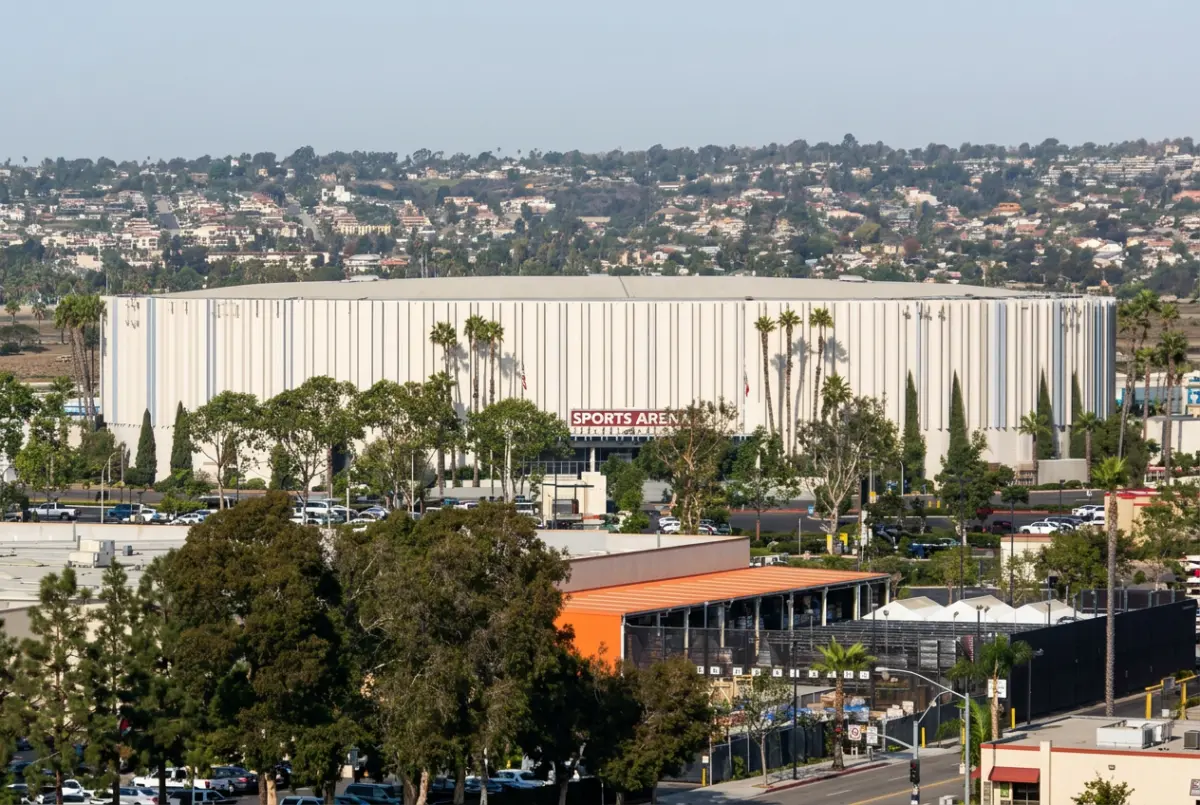
The Midway Rising initiative is a massive $3.9 billion redevelopment proposal centered on San Diego’s aging 49.2-acre Sports Arena site in the Midway District. Conceived as a transformative mixed-use urban village, the project promises to deliver more than 4,000 new residential units—half of which are designated as deed-restricted affordable housing—alongside expansive new park space and a state-of-the-art sports and entertainment arena.
In September 2022, the San Diego City Council officially selected the Midway Rising development team to spearhead the project. By 2023, the venture secured a heavyweight financial backer: billionaire sports mogul Stan Kroenke, owner of the NFL’s Los Angeles Rams, the NBA’s Denver Nuggets, and an incoming stakeholder in Major League Baseball’s Los Angeles Angels.
The Legal Quagmire
Despite the city’s enthusiastic backing, the project immediately collided with local opposition groups, most notably the coastal advocacy nonprofit Save Our Access.
The core of the dispute involved local voter-approved ballot measures designed to lift the Midway District’s long-standing 30-foot height limit, a restriction originally enacted to protect coastal views and community character. Once voters elected to raise the height cap to accommodate higher-density residential towers, Save Our Access filed a pair of high-profile lawsuits against the city.
The plaintiffs argued that San Diego officials flagrantly violated CEQA by failing to adequately study, disclose, and mitigate how taller buildings would negatively impact local airflow, traffic congestion, and wildlife habitats.
The litigation succeeded in systematically dismantling the city’s legal framework:
- October 2025: A California appellate court officially invalidated the second of the city’s ballot measures, ruling the environmental review legally deficient.
- December 2025: The California Supreme Court declined to hear the city’s appeal, letting the appellate decision stand.
This string of judicial defeats effectively reinstated the rigid 30-foot height cap, throwing the entire multi-billion-dollar master plan into structural jeopardy and threatening to derail the construction of its taller residential towers.
Legislative Intervention
Faced with the permanent paralysis of a project central to the city’s housing goals, local leaders pivoted from the courtroom to the statehouse. Mayor Todd Gloria championed the creation of SB 344 and SB 958 to legislative allies, securing a statutory workaround to neuter the legal arguments that had successfully grounded Midway Rising. Governor Newsom’s signature on Tuesday formally codified this legislative rescue mission.
Supporting Data: San Diego’s Aggressive Housing Push
The legislative battle over Midway Rising unfolds against the backdrop of San Diego’s aggressive push to position itself as a vanguard for municipal housing production in California, a state historically plagued by under-building.
According to the city’s 2025 annual housing report, San Diego permitted nearly 8,800 new residential units in 2024 alone. This statistical surge is the direct result of deliberate municipal policy changes. In tandem with the city’s robust zoning adjustments, Mayor Gloria issued an executive mandate ordering city departments to process qualifying residential permit applications within an accelerated 30-day window.
Yet, this rapid growth strategy has made San Diego a lightning rod for broader debates over local control, neighborhood character, and environmental oversight. The Midway Rising project, slated to span an estimated 14 years from conception to final buildout, has become the ultimate test case for whether California’s urban centers can override localized opposition in the name of mass housing delivery.
Official Responses: A Divide Between Relief and Resentment
The enactment of the new housing package has elicited sharp, polarized reactions from public officials, housing advocates, and legal representatives for neighborhood coalitions.
Proponents Celebrate Regulatory Certainty
For municipal leaders and state lawmakers, the new laws represent a long-overdue triumph of pragmatism over procedural obstruction. Proponents argue that protracted CEQA lawsuits are rarely about genuine environmentalism; instead, they are frequently weaponized as "NIMBY" (Not In My Back Yard) tactics designed to preserve exclusionary zoning and inflate property values at the expense of working-class families.
In an official statement released following the bill signings, Mayor Gloria emphasized the transformative nature of the legislation:
"San Diegans have waited decades to see the Midway District transformed. We now have greater certainty to move this long-awaited vision forward that will deliver over 4,000 new homes, including 2,000 deed-restricted affordable homes, along with new park space and a new world-class arena."
Senator Akilah Weber Pierson, author of both SB 344 and SB 958, echoed these sentiments, framing the bills as essential tools to protect regional housing investments from endless legal attrition and ensure that state housing goals are met on the ground.
Opponents Decry Legislative Overreach and Legislative Irony
Conversely, project opponents and legal watchdogs view the new laws as an authoritarian overreach by Sacramento legislators acting in concert with deep-pocketed developers. Critics argue that bypassing CEQA review sets a dangerous precedent, stripping communities of their legal mechanisms to demand proper environmental mitigation.
Everett DeLano, the attorney representing the coastal advocacy nonprofit Save Our Access, voiced disbelief regarding the political maneuvering used to pass the legislation. Speaking to the Peninsula Beacon, DeLano remarked:
"Is it just me, or does anyone else see an irony in taking a bill that was supposed to be about the disposal of human remains and turning it into Midway Rising ‘fast track’ legislation?"
Beyond procedural complaints, local residents in nearby Point Loma continue to argue that the project’s environmental impact report remains fundamentally flawed. Critics maintain that the development will inevitably trigger severe regional traffic gridlock, strain municipal infrastructure, and degrade access to California’s precious coastal corridors.
Implications: What Lies Ahead for California Land Use
Governor Newsom’s signing of SB 344 and SB 958 marks a watershed moment in California’s protracted housing war, carrying profound implications for future real estate development across the state.
1. The Erosion of CEQA as a Veto Tool
For half a century, CEQA litigation has been the definitive graveyard for ambitious urban housing projects. By carving out specific statutory exemptions—such as SB 344’s blockade against Midway Rising challenges and SB 958’s statewide elimination of height-based environmental reviews—the state legislature has signaled that the existential housing crisis now supersedes traditional environmental review protocols. Legal experts anticipate that developers of large-scale urban infill projects will increasingly lobby Sacramento for similar legislative carve-outs to insulate their ventures from litigation.
2. The Fight is Far From Over
Despite the governor’s signature, the war over Midway Rising is far from finished. Leaders of Save Our Access have made it clear they intend to continue their campaign against the development, focusing their next political and legal offensive on the upcoming real estate negotiations.
The conflict shifts immediately to local committees: the real estate terms of the Midway Rising ground lease are scheduled to appear before a city council committee on October 8. Following that committee review, the full San Diego City Council must formally certify the environmental review and grant final project approvals, providing opponents with another public forum to voice their grievances.
3. A Shifting Balance of Power
Ultimately, the legislative package underscores a seismic shift in California politics: power is actively migrating away from municipal entities and local neighborhood associations toward state authorities determined to force local compliance with housing quotas. Whether these reforms successfully translate into hundreds of thousands of affordable homes—or simply trigger a new era of bitter, high-stakes litigation between developers and local communities—will define the architectural and social landscape of California for generations to come.
