

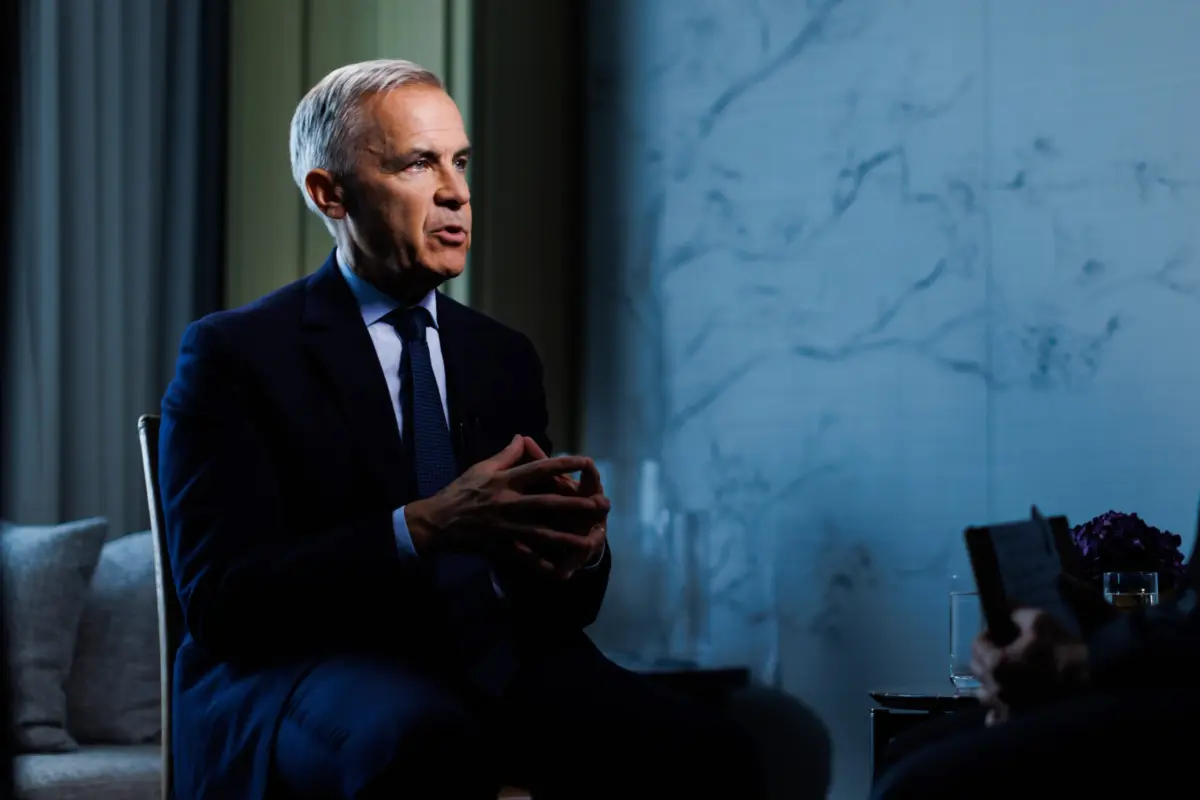
TORONTO — Prime Minister Mark Carney has proposed the establishment of a global "technology stability board" to oversee artificial intelligence and ensure its safe deployment worldwide. Drawing parallels to the Financial Stability Board, Carney argued that international coordination is essential to manage the rapid ascent of advanced technologies, maximize value creation, and mitigate existential risks.
The proposal comes amid a shifting global landscape marked by starkly contrasting views on artificial intelligence safety regulation among world leaders and tech executives, even as Canada grapples with heightened trade tensions with the United States and works aggressively to court international capital.
Main Facts
- Global AI Oversight: Prime Minister Mark Carney has called for a "technology stability board" modeled on the Financial Stability Board to ensure international coordination and safety in artificial intelligence development.
- Divergent Safety Views: While leaders of major AI labs like Anthropic’s Dario Amodei warn that advanced systems must be slowed down to prevent catastrophic harm, U.S. President Donald Trump has dismissed calls for AI guardrails.
- Industry Skepticism: Aidan Gomez, CEO of Canadian AI firm Cohere, voiced concerns over antitrust waivers proposed for safety discussions, warning they could facilitate cartel formation. Meanwhile, RBC CEO Dave McKay stressed the need for uniform access to powerful tools to maintain cybersecurity.
- Economic Reforms & Investment Summit: In a bid to attract underallocated foreign capital, Carney’s government is introducing competitive tax reforms and fast-tracking federal project approvals to a one-year timeline. Canada is hosting top global investors in Toronto with a prospectus featuring over 160 projects, including pipelines, LNG facilities, and massive data centers.
- U.S.-Canada Trade Strife: The diplomatic push occurs against a backdrop of severe trade friction with the U.S., including 50% tariffs imposed by Trump, retaliatory measures by Ottawa, trade negotiation breakdowns, and strategic efforts by Carney to diversify Canada’s economic partnerships toward Europe, Asia, and other global allies.
Chronology of Events
The Lead-Up to the AI and Trade Debates
Throughout 2025 and into 2026, the global conversation surrounding artificial intelligence transitioned from conceptual enthusiasm to intense scrutiny regarding safety, alignment, and geopolitical dominance. As foundational models grew exponentially more potent, top-tier AI researchers and lab executives began sounding alarms over the potential for systems to slip beyond human control.
August 2026: Trade Breakdown and Tariffs
Relations between Canada and its largest trading partner, the United States, deteriorated significantly following the collapse of trade negotiations on August 21, 2026. Shortly after talks broke down, U.S. President Donald Trump levied 50% tariffs on $20 billion worth of Canadian imports. In response, the Canadian government enacted swift retaliatory tariffs on an equivalent volume of U.S.-manufactured goods.
Over the subsequent weeks, diplomatic rhetoric intensified. U.S. officials enacted measures to block specific Canadian imports—such as alcohol and select dairy products—and restricted Canadian enterprises from securing U.S. government contracts. In an unprecedented symbolic move, President Trump ordered the renaming of Lake Ontario to "Lake America."
Mid-September 2026: The Bloomberg Interview and Industry Panels
In mid-September 2026, Prime Minister Carney sat down with Bloomberg News to outline his vision for global AI governance, economic liberalization, and foreign investment attraction. Concurrently, industry leaders gathered at events such as the Milken Institute conference in Toronto to debate the practicalities of AI regulation, antitrust laws, and infrastructure access.
Upcoming Diplomatic Mission to Europe
Following the high-stakes investment summit in Toronto, Prime Minister Carney is scheduled to fly to Strasbourg, France. There, he and European Commission President Ursula von der Leyen are slated to unveil plans for an expanded bilateral partnership encompassing trade, security, supply chain resilience, and raw material access.
Supporting Data and Economic Infrastructure
Canada’s renewed economic strategy is rooted in an aggressive campaign to capture foreign capital currently underallocated within its borders. To bridge this gap, the federal government has assembled a comprehensive prospectus comprising over 160 projects requiring hundreds of billions of dollars in funding.
Key Investment Projects Featured in the Prospectus:
- Energy Infrastructure: Proposed crude-oil pipelines routing to Canada’s west coast and the Ksi Lisims liquefied natural gas (LNG) export facility in British Columbia.
- Digital Infrastructure: A massive C$14.5 billion ($10.4 billion) data-center campus located in Alberta.
- Provincial Contributions: Specialized pitchbooks prepared independently by the provincial governments of Ontario and Alberta to highlight regional growth vectors.
Investor Delegation
The Toronto summit has drawn over 100 high-profile global investment entities to the Four Seasons hotel and a formal gala dinner. Key participants include representatives from:
- Blackstone Inc.
- Temasek Holdings Pte (Singapore)
- Apollo Global Management
Official Responses and Stakeholder Perspectives
Prime Minister Mark Carney on Governance and Competitiveness
Carney emphasized that the rapid advancement of artificial intelligence necessitates multilateral cooperation rather than fragmented, nationalistic policy responses.
"There’s a need for coordination," Carney told Bloomberg News. "Ultimately, a technology stability board, in our view, along the lines of the Financial Stability Board would make sense. It’s an opportunity — and I think ultimately what it’s going to mean is greater value creation and greater value delivery to people."
Addressing Canada’s domestic economy, Carney underscored upcoming structural adjustments designed to streamline capital inflows. "Foreign capital is underallocated to Canada," he stated, noting that his administration will soon roll out tax system overhauls and compress major project federal approval windows to a single year.
Divergent Views on AI Safety: Washington vs. Silicon Valley
The debate over artificial intelligence guardrails has created a deep ideological fissure. Dario Amodei, Chief Executive Officer of Anthropic, has publicly advocated for slowing down the development of cutting-edge systems to prevent catastrophic societal risks.
Conversely, U.S. President Donald Trump has strongly rejected artificial intelligence guardrails, publicly rebuking Amodei for urging deceleration in the sector.
Industry Leaders Weigh In: Cohere and RBC
Aidan Gomez, CEO of Canadian AI pioneer Cohere Inc., expressed apprehension regarding Amodei’s calls for temporary antitrust waivers that would permit safety-centric discussions among direct competitors. Speaking at a Milken Institute panel in Toronto, Gomez contextualized the warning:
"Those [antitrust laws] were set up to prevent the formation of cartels. That should raise a huge red flag in terms of what some of the incentives behind this might be… What we need is a process by which to come up with the right regulation, and that should include things like testing of these models in advance and an independent third party that isn’t isolated to any one country and isn’t dominated by any one industry player."
Royal Bank of Canada (RBC) CEO Dave McKay, appearing alongside Gomez, highlighted that true technological safety must be coupled with democratization of access. McKay argued that advanced tools must be distributed beyond exclusive U.S. markets to ensure broader cyber-resiliency:
"You need access to the most advanced tools to not only build product, but also make sure you’re cyber safe as a society and as an economy."
Implications
Geopolitical and Economic Realignments
The convergence of AI governance debates and severe U.S.–Canada trade friction highlights a fundamental pivot in Canadian foreign and economic policy. Facing hostile trade policies from Washington—including steep tariffs and targeted import bans—Prime Minister Carney is leveraging high domestic political popularity to diversify Canada’s international partnerships.
By actively courting sovereign wealth funds and institutional investors from Asia, Europe, and the Middle East, Canada is attempting to insulate its economy from North American bilateral volatility. The impending framework agreement with the European Union further illustrates Ottawa’s determination to anchor its economic future within a broader coalition of middle powers and global allies.
The Future of AI Regulation
Carney’s proposal for a global Technology Stability Board signals an ambitious effort to bring order to an anarchic technological frontier. While tech giants and regional superpowers remain divided over whether to accelerate or restrict AI development, the call for an independent, third-party testing regime—free from the capture of a single nation or corporate monopoly—addresses core anxieties about accountability.
However, translating a conceptual "stability board" into operational international law will require overcoming deep-seated geopolitical rivalries, particularly given the Trump administration’s outright rejection of domestic regulatory guardrails. Whether Canada’s coalition-building approach can successfully bridge these divides will profoundly shape the trajectory of both global technology governance and national economic sovereignty in the years ahead.
