

For decades, the silhouette of a commercial building’s exterior access ladder was instantly recognizable by its steel safety cage. To building owners, architects, and roofing contractors, these cages represented the gold standard in vertical fall protection. However, a profound regulatory shift by the Occupational Safety and Health Administration (OSHA) is systematically dismantling this conventional wisdom.
Under updated standards, steel cages are no longer recognized as compliant fall protection for high fixed ladders. This regulatory transition represents one of the most significant changes to commercial facility safety in a generation. It presents building owners and roofing contractors with a complex path toward compliance, substantial liability risks, and a pressing need for technical education.
With the regulatory landscape shifting beneath their feet, industry professionals must understand the mechanics of OSHA 1910.28(b)(9), the physics of fall dynamics, and the practical steps required to upgrade both internal roof hatches and external access points before enforcement actions and liabilities mount.
Main Facts: The End of the Ladder Cage Era
The central catalyst for this industry-wide transformation is the amendment of OSHA Standard 1910.28(b)(9), which governs fall protection systems on fixed ladders. Historically, any fixed ladder exceeding 20 feet in height required a cage or well to protect workers from falling to the ground. Today, OSHA has officially declared that cages and wells are no longer acceptable primary fall protection systems on fixed ladders that extend more than 24 feet above a lower level.
+-----------------------------------------------------------------------------+
|                         THE FALL PROTECTION SHIFT                           |
|                                                                             |
|   OLD PARADIGM (Pre-2018)                     NEW PARADIGM (Post-2018)      |
|   +---------------------+                     +---------------------+       |
|   |  [ Ladder Cage ]    |  =================> | [Ladder Safety Sys] |       |
|   |  Passive containment|  Cages phased out   | Active arrestment   |       |
|   |  High injury risk   |  as primary safety  | Immediate arrest    |       |
|   +---------------------+                     +---------------------+       |
+-----------------------------------------------------------------------------+
Instead, OSHA mandates the use of either a Personal Fall Arrest System (PFAS) or a dedicated Ladder Safety System (LSS). This rule applies to both:
- External Roof Access Ladders: Exposed to the elements, used to scale exterior facades.
- Internal Hatch Ladders: Used to access the roof deck from interior mechanical rooms or corridors.
The distinction between passive containment (cages) and active fall arrest (cable or rigid rail systems) is critical. While a cage merely encloses the climber, a ladder safety system actively arrests a fall, stopping a descent within inches.
For contractors and facility managers, this change introduces immediate compliance requirements. Every time a roofing crew prepares to climb an existing ladder, they must evaluate whether the access point complies with modern federal standards. If it does not, both the building owner and the contractor risk severe regulatory penalties and catastrophic civil liability in the event of an accident.
Chronology: The Multi-Decade Regulatory Timeline
The transition away from ladder cages is not happening overnight; instead, OSHA has structured a multi-phase, 18-year implementation timeline designed to allow building owners to systematically budget for and execute safety upgrades. However, this long timeline contains critical triggers that mandate immediate action today.
  Nov 19, 2018               Current Transition Period (2018-2036)               Nov 18, 2036
-------|---------------------------------------|---------------------------------------|--------
       |                                       |                                       |
  New Installations                      Any Repair/Replacement                   Universal Deadline
  Must feature PFAS                      Triggers immediate upgrade               ALL ladders >24'
  or Ladder Safety                       to full compliance across                must have PFAS/LSS
  Systems (No cages).                    the entire ladder system.                (Cages fully defunct).
Phase 1: November 19, 2018 (The Starting Line)
On this date, the amended OSHA Subpart D (Walking-Working Surfaces) standard took effect. From this point forward:
- All newly installed fixed ladders over 24 feet high must be equipped with an approved ladder safety system or a personal fall arrest system.
- The installation of new cages as a sole source of fall protection became legally obsolete.
- Existing ladders installed prior to this date were temporarily grandfathered in, allowing them to retain cages or wells as compliance measures, provided no modifications were made.
Phase 2: The Ongoing Maintenance Trigger (Current Phase)
We are currently in a highly critical transition window. Under standard 1910.28(b)(9)(i)(C), if any section of an existing grandfathered fixed ladder, cage, or well is replaced or repaired, the entire ladder system must be upgraded with a personal fall arrest system or a ladder safety system.
This means routine maintenance can instantly strip a building of its grandfathered status. If a storm damages a portion of an old external ladder cage, or if a building owner seeks to repair rusted rungs, they cannot simply repair the cage. They must install an active fall arrest system.
Phase 3: November 18, 2036 (The Absolute Deadline)
This date represents the final sunset clause. On and after November 18, 2036, all fixed ladders over 24 feet in height, regardless of their installation date, must be equipped with a personal fall arrest system or a ladder safety system.
By this deadline, the grandfathering of legacy cages will end entirely. Every commercial facility in the United States must have completed its retrofits by this date, making proactive planning essential for property portfolios.
Supporting Data: Why Cages Failed and the Physics of the New Standards
To understand why OSHA took the drastic step of phasing out a safety mechanism used for nearly a century, one must look at the empirical data surrounding fall protection physics and occupational accident reports.
The Myth of the Cage: The "Chimney Effect"
For decades, safety cages provided a false sense of security. Biomechanical engineering studies and accident investigations revealed that cages did not reliably prevent climbers from falling to the ground. In many cases, a falling worker would slip down the "chimney" of the cage, bouncing off the steel hoops on the way down.
This "chimney effect" often resulted in:
- Severe compound fractures and lacerations from striking the cage structure during descent.
- Deflection of the worker’s body, which could cause them to fall backward out of the bottom of the cage.
- Entanglement within the cage, severely complicating rescue efforts for emergency services.
According to data from the Bureau of Labor Statistics (BLS), falls remain the leading cause of death in the construction industry, accounting for over one-third of all on-site fatalities. By eliminating cages and mandating active systems, OSHA aims to reduce the fall-clearance distance to near zero.
Technical Anatomy of Compliant Systems
To replace cages, OSHA recognizes two primary active solutions:
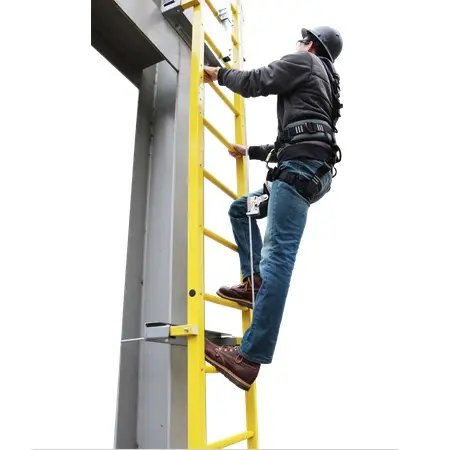
- Ladder Safety Systems (LSS): These are integrated, hardware-based solutions permanently attached to the ladder. The most common configuration is a cable-based vertical lifeline (such as a galvanized or stainless steel cable run vertically down the center of the rungs) or a rigid rail system. The climber connects their safety harness to this system using a specialized mobile sleeve (or cable grab) that slides freely as they climb but locks instantly in the event of a slip.
- Personal Fall Arrest Systems (PFAS): These systems are anchored to the ladder or building structure and rely on a full-body harness, a lanyard, and an energy-absorbing device to arrest a fall before the worker strikes a lower level.
+------------------------------------------------------------------------+
|                 LADDER SAFETY SYSTEM (LSS) COMPONENTS                 |
|                                                                        |
|    [Top Bracket Anchor]                                                |
|            ||                                                          |
|            || <=== Vertical Cable Lifeline                             |
|            ||                                                          |
|         [Sleeve] <--- Mobile Cable Grab (Locks instantly on fall)      |
|            |                                                           |
|        [Connector] <--- Carabiner/Lanyard                              |
|            |                                                           |
|     [Sternal D-Ring] <--- Harness Attachment Point                     |
|         ( /  )                                                        |
|        /  X   <--- Full Body Harness (Sustains worker safely)         |
|                                                                        |
|            ||                                                          |
|    [Bottom Tensioner]                                                  |
+------------------------------------------------------------------------+
The Critical Harness Distinction: OSHA 1910.140(d)(1)(iv)
A common point of confusion for contractors is the type of harness required for these systems. Many roofing crews carry standard construction harnesses designed for horizontal fall arrest (such as working on a flat roof deck). These harnesses typically feature a single dorsal (back) D-ring.
However, when climbing a vertical fixed ladder equipped with a ladder safety system, a dorsal D-ring can be highly dangerous. If a worker falls backward, a dorsal attachment can cause their body to hang horizontally or fold in a way that allows the system to strike their neck and chin.
To prevent this, OSHA standard 1910.140(d)(1)(iv) mandates that the fall arrest system must:
"…sustain the employee within the system/strap configuration without making contact with the employee’s neck and chin area."
To comply with this performance standard, workers climbing fixed vertical ladders must use harnesses equipped with a sternal (chest) D-ring or a waist-mounted D-ring specifically rated for vertical climbing. This configuration keeps the worker suspended in an upright, seated position post-fall, protecting the cervical spine and keeping the airway clear.
Official Responses and Industry Perspectives
The enforcement of these standards has sparked a wide range of responses from safety advocates, regulatory bodies, and industry suppliers.
The Regulatory Position
OSHA’s stance is clear: the 2018 Walking-Working Surfaces rule update was designed to align federal standards with consensus standards from the American National Standards Institute (ANSI), specifically ANSI A14.3 (Standard for Ladders – Fixed – Safety Requirements). OSHA officials emphasize that the cost of retrofitting ladders is far outweighed by the reduction in workers’ compensation claims, civil litigation, and, most importantly, lost lives.
The Contractor’s Dilemma
Many roofing contractors express frustration over the practical execution of these rules. "When we arrive at a commercial job site, we are often forced to use whatever access ladder is on the building," says one veteran commercial roofing foreman. "If that ladder has an old cage and no cable system, we technically face a compliance violation the moment we step onto it. But building owners are often reluctant to pay for a ladder retrofit just so we can service their roof."
This conflict highlights the need for proactive communication. Contractors must act as educators, helping building owners understand that upgrading their fixed ladders is not an optional luxury, but a pressing legal necessity.
The Manufacturer’s Solution
Industrial supply companies have stepped forward to bridge the gap between regulation and reality. Specialists like Roofmaster, a safety and equipment supplier with over 70 years of experience and five nationwide locations, have developed targeted product lines to help contractors navigate these requirements.
By providing pre-engineered external access ladders, specialized internal hatch ladders, and complete ladder fall arrest cable systems, manufacturers allow contractors to source turnkey, fully compliant systems. These systems can be retrofitted onto existing structures without requiring complete architectural redesigns.
Implications: Liability, Asset Management, and the Path Forward
The business implications of OSHA’s fixed ladder standards stretch far beyond the safety department. They directly impact asset valuation, risk management, and corporate liability.
Property Owner Liability and the "General Duty Clause"
Building owners who delay retrofitting their fixed ladders until the 2036 deadline are exposed to significant legal risk. If an independent contractor, utility worker, or municipal inspector falls from an unretrofitted ladder over 24 feet high, the property owner can face catastrophic civil lawsuits.
Plaintiffs’ attorneys routinely cite OSHA standards as the baseline definition of a safe property. Even if a ladder is technically grandfathered under the 2036 timeline, a property owner can still be held liable under OSHA’s General Duty Clause (Section 5(a)(1)), which requires employers and property controllers to provide a place of employment free from recognized hazards that are causing or are likely to cause death or serious physical harm. A legacy cage, now recognized by safety science as a hazard, represents a significant liability.
+--------------------------------------------------------------------------+
|                     BUILDING OWNER RISK EXPOSURE                         |
|                                                                          |
|   Regulatory Risks                      Civil Liability Risks            |
|   +---------------------------------+   +----------------------------+   |
|   | * OSHA Citations & Fines        |   | * Negligence Lawsuits      |   |
|   | * Loss of Grandfathered Status  |   | * Third-Party Injury Claims|   |
|   | * Stop-Work Orders on Roofs     |   | * Insurance Premium Hikes  |   |
|   +---------------------------------+   +----------------------------+   |
+--------------------------------------------------------------------------+
The Financial Cost of Non-Compliance
The financial penalties for non-compliance are steep. As of 2024, OSHA’s maximum penalty for a "Serious" violation exceeds $16,000, while a "Willful or Repeated" violation can top $161,000 per instance. If a building has multiple non-compliant ladders, these fines can quickly escalate.
Conversely, the cost of installing a cable-based ladder safety system is remarkably modest, often representing a fraction of the cost of a single regulatory fine or the legal fees associated with a minor slip-and-fall claim.
Strategic Roadmap for Building Owners and Contractors
To mitigate risk and ensure compliance, commercial property owners and roofing contractors should implement a systematic compliance program:
| Step | Action Item | Technical Focus |
|---|---|---|
| 1 | Facility Audit | Identify every fixed ladder over 24 feet (internal and external). Document their installation dates, current physical condition, and existing fall protection. |
| 2 | Assess Maintenance Status | Determine if any planned roofing work or building maintenance will require repairs to these ladders, which would immediately trigger the requirement for a full upgrade. |
| 3 | Procure Standardized Hardware | Source compliant systems, such as ladder fall arrest cable systems and compatible harnesses, from reputable manufacturers like Roofmaster. |
| 4 | Train the Workforce | Ensure all climbing personnel are trained on how to inspect, connect to, and climb using active ladder safety systems, emphasizing the use of sternal D-ring configurations. |
| 5 | Document Compliance | Maintain clear engineering records of all ladder installations, retrofits, and safety inspections to present to OSHA inspectors or insurance underwriters. |
Conclusion
The transition from passive ladder cages to active ladder safety systems represents a major step forward in protecting vertical climbers. While the 2036 deadline may seem distant, the legal, financial, and regulatory triggers in place today mean that commercial building owners and contractors cannot afford to wait. By taking action to audit, upgrade, and standardize their fixed ladder safety systems, building owners can protect their workers, secure their properties, and confidently navigate the regulatory path ahead.
