

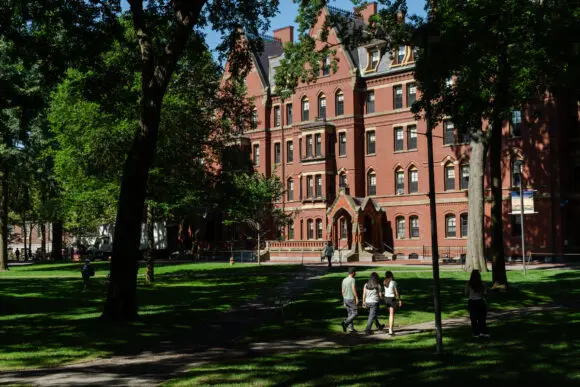
BOSTON — In a significant legal defeat for the federal government, a U.S. district judge has dismissed a high-profile lawsuit brought by the Justice Department against Harvard University. The government had alleged that the Ivy League institution turned a blind eye to antisemitism and discrimination against Jewish and Israeli students. The ruling represents the latest flashpoint in an aggressive, multi-pronged campaign by the Trump administration aimed at reshaping American higher education, exerting federal oversight over elite universities, and penalizing institutions over their handling of campus climate issues following the outbreak of the Israel-Hamas war.
U.S. District Judge Richard Stearns, presiding in Boston, ruled on Thursday that the Justice Department failed to sustain its legal claims that Harvard violated Title VI of the Civil Rights Act. The federal government’s complaint argued that the university neglected its legal obligations to protect Jewish and Israeli students from a hostile environment in the wake of Hamas’s October 7, 2023, attack on Israel and the subsequent military conflict in Gaza.
However, in a concise four-page opinion, Judge Stearns dismantled the government’s evidentiary foundation, concluding that federal prosecutors relied too heavily on a narrow timeframe and insufficient incidents to prove systemic, institutionalized noncompliance.
The dismissal is a major win for Harvard, which has aggressively fought back against various administration pressures, distinguishing itself from other elite universities that chose to settle similar federal inquiries rather than engage in protracted courtroom battles.
Main Facts of the Ruling
At the core of Judge Stearns’s decision was an evaluation of whether the Justice Department provided enough evidence to prove that Harvard maintained a persistent, institutionalized violation of civil rights law.
According to the ruling, the federal government focused "almost entirely" on the 2023–2024 academic year. Prosecutors cited a limited number of specific occurrences—notably highlighting only three incidents taking place after that initial academic year—to substantiate claims that Harvard was in ongoing breach of Title VI. Under federal law, Title VI bars discrimination based on race, color, and national origin by any institution receiving federal financial assistance.
Judge Stearns acknowledged the gravity of the allegations but ruled that the isolated nature of the cited events fell short of the legal threshold required to maintain a systemic enforcement action.
"Without diminishing any concern arising from these occurrences, the court finds them, singly and collectively, to be too isolated and episodic to support a plausible inference that any institutionalized noncompliance with Title VI persists at Harvard to this day," Stearns wrote.
Furthermore, the judge criticized the government’s fundamental interpretation of Title VI enforcement mechanisms. Stearns pointed out that federal prosecutors misconstrued the legislative intent behind the statute, which was designed to correct behavior rather than serve as a blunt punitive instrument.
"Congress’s intent was not to penalize a wayward funding recipient but instead to incentivize it to bring itself into compliance with Title VI," the judge wrote. He added that even within the government’s worst-case warnings regarding campus climate, federal attorneys conceded that the ultimate goal of compliance could be achieved through corrective channels rather than scorched-earth litigation.
Chronology of the Conflict: From Campus Protests to Federal Court
To understand the weight of Thursday’s ruling, it is necessary to trace the rapid escalation of tensions between Harvard University and the federal government over the last several years.
October 2023 – May 2024: The Crisis Unfolds
- October 7, 2023: Hamas launches a massive terror attack against Israel, killing roughly 1,200 people and taking hundreds of hostages. The attack sparks an immediate military response by Israel in the Gaza Strip.
- Fall 2023 – Spring 2024: College campuses across the United States, including Harvard, become epicenters of intense geopolitical debate, protests, counter-protests, and encampments. Jewish and Israeli students, as well as pro-Palestinian activists, report rising tensions, harassment, and safety concerns.
- December 2023: Harvard President Claudine Gay testifies before a congressional committee regarding campus antisemitism, facing fierce backlash over her answers regarding whether calls for the genocide of Jews violate university codes of conduct. Gay ultimately resigns under mounting pressure, though the campus climate controversies continue to simmer.
Late 2024 – 2025: The Administration’s Broadening Campaign
- The Shift in Federal Focus: What initially began as targeted congressional and executive branch criticism regarding campus speech policies and safety protocols soon metastasized into a broader strategic campaign. The Trump administration pivots from investigating specific disciplinary responses to demanding overarching structural changes at Harvard.
- Demands for Oversight: Federal pressure expands to encompass federal oversight and direct intervention in Harvard’s internal governance, faculty hiring practices, and student admissions criteria.
- Civil Rights Probes: Multiple federal agencies launch an array of civil rights investigations into the university, scrutinizing everything from disciplinary procedures to foreign funding and diversity, equity, and inclusion (DEI) initiatives.
2026: Legal Showdowns in Federal Court
- The Lawsuit Filed: The Justice Department formally files its federal lawsuit against Harvard (United States of America v. Harvard, 26-11352) in the U.S. District Court for the District of Massachusetts, accusing the university of turning a blind eye to systemic antisemitism.
- Funding and Visa Battles: Beyond the Title VI lawsuit, the administration attempts to freeze federal research grants to Harvard and restrict international student enrollment. While Harvard successfully challenges these funding freezes and visa restrictions in court, the administration initiates appeals.
- The Dismissal (February/March 2026): Judge Stearns issues his ruling dismissing the Justice Department’s Title VI lawsuit, citing a lack of sustained, systemic evidence.
Supporting Data and Broader Higher Education Landscape
The conflict between Harvard and the federal government does not exist in a vacuum; it is part of a coordinated campaign targeting some of the nation’s wealthiest and most prestigious institutions. However, Harvard’s legal strategy stands in stark contrast to the approaches taken by its peers.
Other prominent universities facing similar federal scrutiny chose the path of conciliation. For instance:
- Columbia University: Faced with intense congressional scrutiny, campus occupations, and federal civil rights investigations, Columbia reached a formal settlement agreement with the administration regarding campus safety protocols and Title VI compliance.
- Brown University: Similarly negotiated a settlement with federal authorities to resolve allegations of inadequate responses to campus antisemitism, agreeing to external reporting mechanisms and policy adjustments.
Harvard, by contrast, has largely refused to enter into sweeping settlement agreements that would grant the federal government structural oversight over its academic admissions and internal governance. Instead, the university has fought the administration on multiple fronts.
While the Justice Department’s Title VI lawsuit has now been thrown out, the legal war is far from over. Harvard has successfully won prior court battles blocking executive attempts to slash its federal research funding and interrupt international student pipelines. The Trump administration has signaled that it will appeal those funding-related rulings, ensuring that the legal battle between Cambridge and Washington will continue for months, if not years.
Official Responses and Reactions
The dismissal of the lawsuit drew swift and sharp reactions from federal officials, while university representatives remained measured.
Harmeet Dhillon, the assistant attorney general for civil rights at the Justice Department, issued a strongly worded statement expressing profound disagreement with Judge Stearns’s conclusions and outlining the administration’s unwavering commitment to the issue.
"We disagree with the ruling and are assessing next steps," Dhillon said. "The Justice Department’s Civil Rights Division is actively investigating antisemitism nationwide. The Civil Rights Division has an extensive and active portfolio of antisemitism enforcement, including indictments, prosecutions, settlements, and investigations across the country."
Dhillon’s comments underscore that despite the setback in Boston, the Justice Department views campus antisemitism enforcement as a core pillar of its civil rights mandate and is evaluating whether to appeal Judge Stearns’s dismissal or pursue alternative legal avenues.
Meanwhile, spokespeople for Harvard University did not immediately respond to requests for comment following the release of the four-page opinion. Historically, Harvard leadership has maintained that it takes all forms of discrimination and harassment seriously while simultaneously guarding its institutional independence against federal overreach.
Broader Implications for Higher Education and Civil Rights Law
The outcome of United States of America v. Harvard carries profound implications that extend far beyond the red-brick pathways of Cambridge, Massachusetts.
1. The Legal Standard for Title VI Systemic Claims
Judge Stearns’s ruling establishes a high evidentiary bar for the federal government when utilizing Title VI to target universities over campus climate issues. By ruling that a handful of "isolated and episodic" incidents are insufficient to prove a pervasive, institutionalized practice of discrimination, the decision sets a precedent protecting universities from sweeping federal interventions based on limited temporal samples or high-profile localized events.
2. Executive Overreach vs. Institutional Autonomy
The case represents a critical test of the boundaries of executive power over higher education. Elite universities have historically enjoyed broad autonomy regarding admissions, hiring, curriculum, and internal governance under principles of academic freedom. The Trump administration’s strategy of leveraging civil rights enforcement to force systemic structural overhauls has alarmed many in the academic community. Thursday’s ruling provides a legal speed bump—and potentially a roadblock—to using civil rights laws as a backdoor for broad federal administrative control over private and semi-private universities.
3. The Ongoing Fight Over Federal Funding
Because the Justice Department is already appealing separate rulings regarding federal research funding freezes, the broader war over Harvard’s multi-billion-dollar federal lifeline continues. Research universities rely heavily on federal grants from agencies like the National Institutes of Health (NIH) and the National Science Foundation (NSF). Allowing the executive branch to withhold these funds as leverage in cultural and political disputes could fundamentally alter the financial and operational model of American scientific research.
As legal teams on both sides review the text of Judge Stearns’s opinion, the battle lines are firmly drawn. Whether the Justice Department chooses to recast its legal arguments or pivot to other regulatory pressure points, the clash between Washington and Harvard remains one of the defining legal struggles of modern American higher education.
