

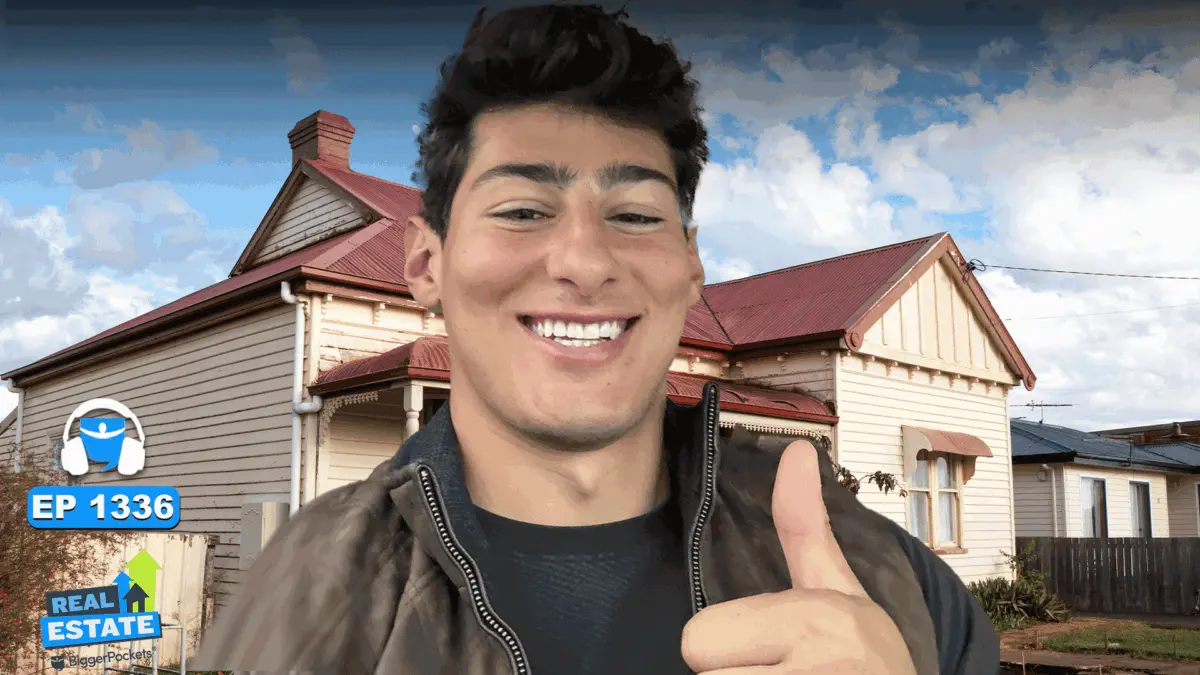
The path to financial independence is rarely a straight line, but for Lawrence “Larry” Guerguis—widely known across digital platforms as "Landlord Larry"—the detour began over a casual slice of pizza.
Destined by college curriculum and societal expectation to spend the next four decades of his life climbing the corporate ladder in investment banking, Guerguis’s trajectory shifted overnight. Today, just three years after that fateful conversation, the young entrepreneur owns 40 rental properties generating thousands of dollars in monthly cash flow. His story is a masterclass in calculated risk, alternative financing, and leveraging government-backed programs to achieve rapid real estate scale.
The Catalyst: A Chance Encounter in San Diego
Before pivoting to real estate, Guerguis was a typical finance major at San Diego State University. He envisioned a future living in New York City, grinding through 80-hour workweeks, and collecting a hefty Wall Street paycheck. That all changed during the first semester of his junior year.
Out at a local bar with friends, Guerguis noticed a lone man sitting nearby who appeared visibly exhausted and dejected. Seized by curiosity, Guerguis struck up a conversation.
"I was like, ‘Hey bro, everything all right?’" Guerguis recalled during an appearance on the BiggerPockets Podcast.
The stranger’s response stopped him in his tracks: "Don’t talk to me. I only get two weeks out of the year off."
When Guerguis asked what he did for a living, the man replied that he was an investment banker. Intrigued, Guerguis spent the next hour and a half picking his brain. The banker asked Guerguis a defining question: "Do you love money?"—not just enjoy spending it, but genuinely love it.
Guerguis realized he didn’t. The banker’s final piece of advice was blunt: forget investment banking, and forget traditional finance, unless he was willing to sacrifice his entire life for a bank account he’d never have time to enjoy.
"After that day, I was like, ‘We’re going to figure out this real estate stuff before we graduate so that we have some sort of path coming coming out of college,’" Guerguis said.
Overcoming the W-2 Barrier: The First Deal
Transitioning from a college dorm room to property ownership presented an immediate hurdle: Guerguis had no W-2 income, no tax returns to show, and zero capital in the bank. Traditional bank financing was entirely off the table.
Refusing to accept defeat, Guerguis took extreme measures. He sold his car—his primary mode of transportation—for roughly $16,000, choosing instead to rely on a family hand-me-down vehicle from 2008.
Realizing that high-cost markets like Southern California were completely out of his budget, Guerguis turned to online real estate platforms. He filtered properties with a maximum purchase price of $70,000, guiding him straight to the Midwest and South—regions like Ohio, Illinois, and Missouri.
Without visiting the property in person, Guerguis found a handyman via a local Facebook group in Peoria, Illinois, paid him to look over the house, and secured his first investment: a single-family home priced at $65,000. Lacking a standard W-2, he secured a Debt-Service Coverage Ratio (DSCR) loan, putting down roughly $15,300.
To mitigate his fear of failure, Guerguis ran a worst-case scenario analysis: "What’s the worst-case scenario? I buy a house, and my mortgage payment is $300… I can figure that out."
Finding Stability Through Section 8
Guerguis soon realized that as an investor with tight margins, he could not afford a tenant default. His solution? The Section 8 housing voucher program.
"The government never misses a payment," Guerguis noted.
By listing his Peoria property through affordable housing channels, he secured a tenant whose rent was 100% covered by the government. With a monthly mortgage of roughly $480 and rental income of $1,400, the property immediately generated healthy cash flow. The proof of concept was secured.
Scaling Rapidly: Moving to Cleveland and Crowdsourcing Capital
With his proof of concept validated, Guerguis faced a new problem: his newfound passion for real estate was going to extend his college career. To graduate on time, he went to his academic advisor and orchestrated a grueling schedule, packing in 18 credits one semester, summer classes, winter classes, and a massive 23-credit load during his senior year, supplemented by community college courses.
Concurrently, he began laying the groundwork for his post-graduation move. He spent months cold-calling real estate agents in prospective markets, asking them to send video tours of properties so he could learn the fundamentals of home mechanics—identifying outdated electrical panels, aging water heaters, and structural roof damage.
Tapping the Crypto Community for Private Equity
Needing capital to scale outside of traditional banking, Guerguis turned an unlikely place: Discord. Active in various cryptocurrency channels, he began engaging members by warning them about the volatility of digital assets and advocating for tangible investments like real estate.
His persistence paid off when a young crypto investor reached out, agreeing to take a portion of his digital gains and invest them into tangible brick-and-mortar assets. After crafting a basic pitch deck on Canva, Guerguis met the investor in San Diego, secured a partnership, and set his sights on his next target market: Cleveland, Ohio.
Moving to Cleveland immediately after graduation in July 2024, Guerguis hit the ground running. Working alongside a knowledgeable local agent, he toured dozens of properties within his first week.
Portfolio Growth and Strategic Evolution
Guerguis’s aggressive acquisition strategy resulted in him buying six properties in his first six months in Cleveland. His strategy focused primarily on single-family homes (with a mix of 3-bedroom, 1-bathroom or 3-bedroom, 2-bathroom layouts) and strategically capitalizing on undervalued Section 8 properties.
In many cases, out-of-state landlords had neglected to submit annual rent increases to the local housing authority. Guerguis stepped in, evaluated the compliance of the turnkey properties, and successfully pushed rents up to contemporary fair market value without needing to perform major renovations.
Within three years, his portfolio expanded to 40 rental properties, spread primarily across Cleveland, Ohio, and St. Louis, Missouri (where he partnered with a college friend to establish a secondary market footprint).
Building a Digital Brand: "Landlord Larry"
As his portfolio grew, Guerguis began documenting his journey on social media platforms like Instagram and TikTok under the handle @landlord.larry. Initially struggling to gain traction with early videos, he pivoted in January to a consistent strategy of high-value, transparent content—sharing actual numbers, rent rolls, and banking statements to demystify real estate investing for younger generations.
While social media has not been his primary driver for property acquisitions, Guerguis notes that building an online brand has opened doors to private lenders, valuable industry connections, and an expansive network of wholesalers.
Key Takeaways for Aspiring Investors
Guerguis’s journey from a hesitant college student to a 40-property owner offers several vital lessons for the next generation of real estate entrepreneurs:
- Conduct a Worst-Case Analysis: Break down your fears logically. If the worst-case scenario involves a manageable financial setback rather than total ruin, calculated risks are often worth taking.
- Prioritize Education: Real estate is a high-stakes industry. Aspiring investors must invest time—and sometimes money—into books, mentorship, and podcasts to understand the mechanics of financing and property management before diving in.
- Leverage Government Programs Wisely: Section 8 and similar voucher programs, when navigated correctly, can provide unmatched tenant reliability and consistent cash flow, particularly in affordable Midwest markets.
- Don’t Let Analysis Paralysis Win: Guerguis’s biggest early regret was penny-pinching over minor negotiation gaps. Securing a cash-flowing asset often outweighs trying to squeeze out every last dollar on the purchase price.
For young investors wondering if financial freedom is possible without a massive corporate salary, "Landlord Larry" stands as living proof that with education, hustle, and a willingness to step outside comfort zones, the door to real estate is wide open.
