

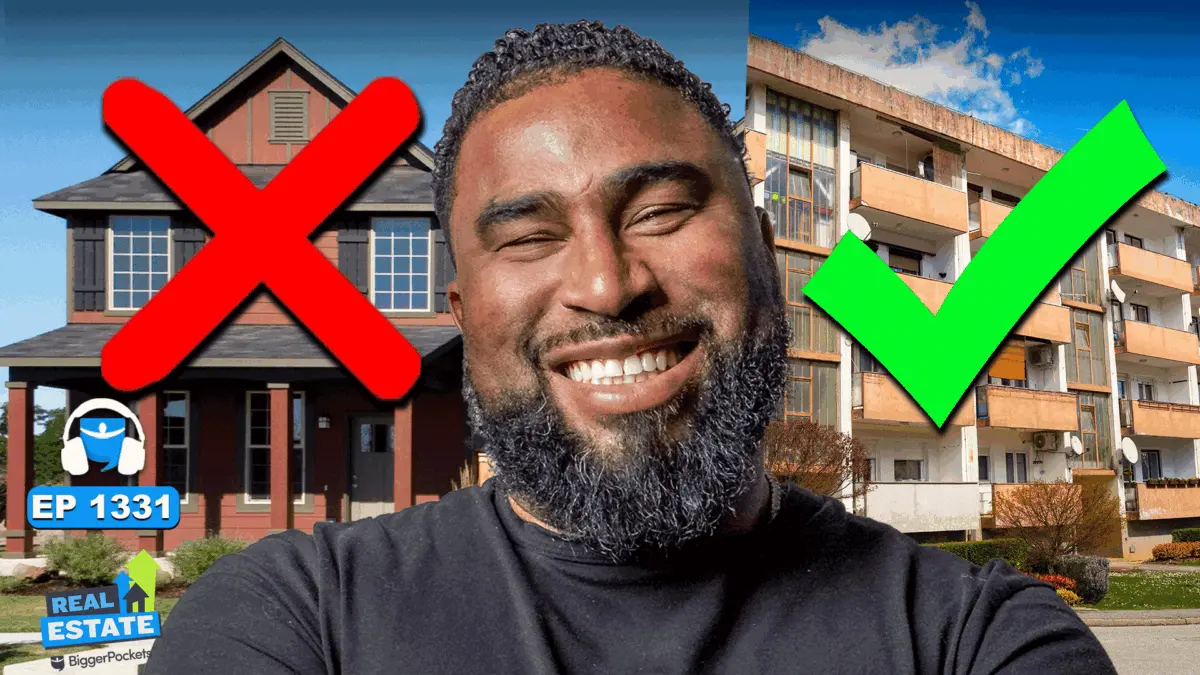
In the world of real estate investing, few dogmas are as deeply entrenched as the traditional "crawl, walk, run" methodology. For decades, conventional wisdom has dictated that beginners enter the market through single-family rentals (SFRs) or small duplexes, learning the operational ropes on a micro-scale before slowly compounding their capital into larger multifamily assets.
But what if you could bypass the single-family grind entirely? What if Deal Number One was a sprawling 16-unit apartment complex?
Recently, on a special episode of the BiggerPockets Podcast, host Henry Washington sat down with veteran investor, broker, and six-figure-per-deal construction operator Chauncey Pham to tackle real questions straight from the BiggerPockets Forums. The dynamic discussion laid bare a fundamental divide in modern real estate strategy: Is jumping straight into big commercial assets a wealth-accelerating masterclass or a high-stakes recipe for total financial ruin?
Main Facts: The Core Debates of Modern Real Estate Investing
The conversation centered on four critical dilemmas faced by modern real estate entrepreneurs navigating today’s complex macroeconomic landscape:
- The Leap to Multifamily: Should an investor with adequate capital skip single-family homes and acquire a mid-sized multifamily asset (such as a 16-unit building) right out of the gate?
- The Young Investor Dilemma: How should a 19-year-old with limited capital ($20,000), a construction background, and a desire to build generational wealth approach their first deal without getting wiped out?
- The Contractor Estimation Trap: Should investors disclose their exact renovation budget to contractors upfront, or does showing your hand invite inflated bids that magically match your maximum limit?
- The Brokerage Illusion: Why do newly licensed real estate agents often experience severe disillusionment regarding mentorship, and what is the true nature of the agent-brokerage relationship?
Chronology: A Deep Dive into the Forum Questions
Phase 1: The 16-Unit Quandary (Slow & Steady vs. All-In)
The session kicked off with a dilemma posed by Nekesh from Charlotte, North Carolina. Nekesh observed the standard industry trend of starting small, but noted that he possessed enough capital to acquire a quadplex—or even a 16-unit property. Fearing he was taking an unearned shortcut, he asked if targeting a large property immediately was a terrible idea.
Pham dismissed the traditional "crawl before you walk" mantra as "groupthink" perpetuated by individuals who lack the capacity to scale quickly.
"If you have the opportunity, the funds, and you understand the risk involved with the acquisition of a 16-unit, then do it," Pham argued. "You’re able to acquire 16 doors in one shot, complete one inspection, gain immediate exposure to a commercial loan product, and bypass buying 16 separate single-family homes."
Washington countered with a more conservative, risk-managed perspective. While acknowledging that wealth can be built through various avenues, he warned that stepping into a 16-unit building cold—without prior execution experience or a supportive ecosystem—multiplies potential mistakes.
"If you blow your budget on a single-family home, you aren’t going to lose your shirt," Washington explained. "A bad deal on a 16-unit property can totally wipe you out. If you’re going to jump straight into a large asset, you need a partner, a mentor, or someone with specialized experience guiding your decisions."
Phase 2: The 19-Year-Old Constructor’s Crossroads
Next up was Jackson from Columbus, Ohio. At 19 years old, Jackson boasted a steady W-2 income, good credit, $20,000 in liquid capital, and a background in construction backed by contractor connections. Eager to achieve financial freedom and build a legacy for his infant son, Jackson wanted to move quickly while managing risk.
Washington advised Jackson to temper his desire for rapid scaling. "You’re 19; you have all the time in the world," Washington noted, advocating strongly for house-hacking as a low-cost entry point to eliminate personal living expenses while learning the operational ropes.
Pham, however, introduced a sophisticated alternative strategy leveraging Jackson’s unique blue-collar skill set. Pointing out that failure at age 19 is financially cheapest, Pham suggested Jackson skip traditional house-hacking initially and instead enter the market via wholesaling—with a twist.
"He has a unique opportunity to market deals that not only generate assignment fees for quick capital, but also feed his construction business," Pham explained. By providing accurate scopes of work and realistic bids to other investors, Jackson could secure backend construction contracts, stack his capital from $20,000 to $75,000 or $100,000 over a year, and enter the long-term investment arena from a position of absolute strength.
Supporting Data & Industry Insights: Managing Renovations and Professionals
As the discussion progressed, the hosts addressed tactical execution—specifically, how to manage contractor relationships and build an elite professional network.
The Renovation Budget Debate
Ali from Houston raised a classic real estate conundrum: Should you tell contractors your exact maximum rehab budget (e.g., $70,000) before they bid, or keep it private to force independent pricing?
Pham emphasized that the budget discussion is secondary to a more foundational failure point among investors: the lack of a concrete design plan.
- "Investors come in, give a number, and get angry when costs double, but they never specified design details—like whether faucets wall-mount or sit on countertops," Pham stated. "Tell them your budget, but more importantly, nail down your design and scope so they can accurately evaluate if the budget matches reality."
Washington agreed on the primacy of scope, noting that honesty breeds honesty, but stressed that possessing $70,000 does not automatically mean a house can be renovated for that amount. "Don’t bring wine taste to a project with a beer budget," Washington cautioned.
The Ultimate Professional Network
When Amber from Tampa asked which single professional they would keep if restricted to only one, the hosts highlighted distinct operational philosophies:
- Pham’s Choice: The Project Manager (ideally cross-trained as a real estate agent), who directly influences acquisition speed, material costs, subcontractor performance, and adherence to budgetary limits through financial incentives.
- Washington’s Choice: The Investor-Friendly Real Estate Agent, who serves as a master key unlocking other essential industry relationships, complemented closely by a CPA/Bookkeeper to track asset-level profitability.
Official Perspectives: Demystifying the Real Estate License
A passionate highlight of the episode centered on whether aspiring investors should obtain their real estate licenses. Pham argued strongly in the affirmative, not necessarily to list properties, but to deeply understand consumer psychology.
"We get lost looking at spreadsheets and pencil-whipping numbers, forgetting that a real consumer is going to consume the product we create," Pham noted. "Understanding retail real estate sales teaches you what the market actually demands."
Washington offered a counter-perspective, warning that studying for a license can sometimes serve as an avoidance mechanism for new investors delaying their first live deal. However, he conceded that dual execution—pursuing education while actively analyzing deals—remains a viable path.
The conversation concluded with a sobering reality check regarding real estate brokerages, sparked by a forum user named Sophia who felt unsupported by her brokerage mentor.
Pham delivered a sharp, memorable industry truth:
"A real estate brokerage is nothing more than the strip center housing your retail store. Brokerages sell agents; agents sell houses. You cannot expect a brokerage to teach you business acumen or marketing when other agents are fundamentally your competition. Entrepreneurship means you are entirely on your own."
Implications for Future Investors
The insights shared by Washington and Pham carry profound implications for the broader real estate market:
- The Death of Cookie-Cutter Paths: The debate over skipping single-family homes proves that modern wealth-building is not one-size-fits-all. Risk tolerance, liquid capital reserves, and strategic partnerships dictate optimal entry points far more than arbitrary industry traditions.
- The Rise of Vertical Integration: Skilled tradespeople entering real estate—like young Jackson—possess asymmetric advantages. Combining marketing, wholesaling, and in-house contracting creates a self-funding engine that dramatically accelerates portfolio growth.
- The Shift Toward Radical Accountability: As real estate education modernizes through platforms like BiggerPockets, the illusion of the "hand-held employee mindset" in brokerage and investing is rapidly dissolving. Success in modern property markets requires treating real estate ventures as rigorous, independent business enterprises from Day One.
