

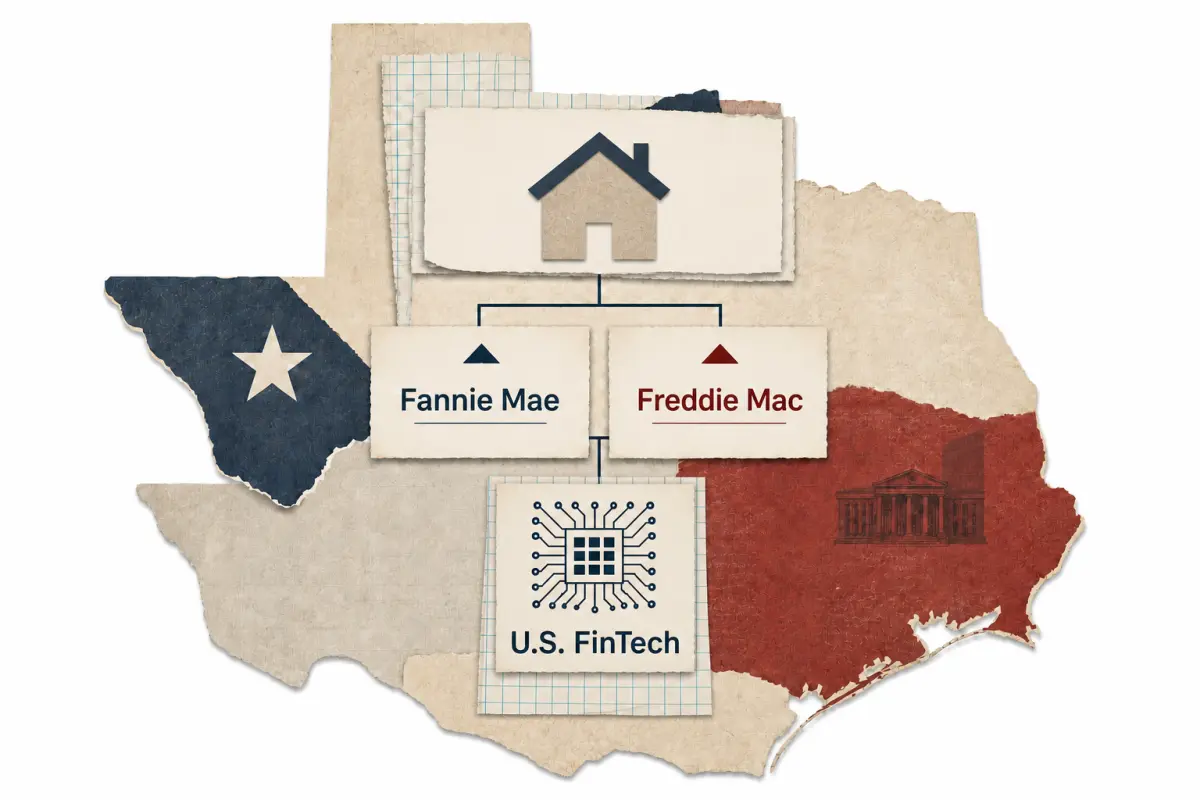
WASHINGTON — As the multi-decade debate over how to successfully release government-sponsored enterprises (GSEs) Fannie Mae and Freddie Mac from federal conservatorship drags on, a fresh and unconventional proposal has entered the policy arena. Jon Oksenholt, managing partner of Oksenholt Capital Management, has formally introduced a comprehensive corporate restructuring plan that would house both housing finance giants under a newly minted Texas-based holding company.
The strategy—designed to sidestep the traditional, friction-heavy pathways previously floated by Wall Street and Washington insiders—aims to preserve the operational integrity of the two mortgage powerhouses while unlocking unprecedented value for institutional and retail investors alike. Against the backdrop of evolving political leadership and ongoing discussions within the Trump administration regarding a potential public offering, Oksenholt’s blueprint introduces an entirely new paradigm for the future of American housing finance.
Main Facts of the Oksenholt Proposal
At the core of Oksenholt’s proposal is the creation of a single publicly traded security, tentatively named U.S. Financial Technology and Mortgage Corp. (USFTMC), domiciled in Texas. Rather than merging Fannie Mae and Freddie Mac—a move that legal experts warn would face steep hurdles given their distinct, congressional charters—or forcing them out into the public markets as entirely separate, competing equities, the USFTMC framework introduces a centralized holding structure at the top.
Under this proposed corporate architecture:
- The Holding Company: USFTMC would sit directly above two separately chartered mortgage guarantors (Fannie Mae and Freddie Mac) and a shared financial technology infrastructure.
- Preservation of Operations: Both Fannie Mae and Freddie Mac would remain completely intact as separately capitalized subsidiaries. They would retain their current legislative charters, robust guaranty businesses, and vital affordable housing missions.
- The Technology Core: Their existing joint venture, U.S. Financial Technology LLC (U.S. FinTech)—which currently operates the critical Common Securitization Platform (CSP)—would remain jointly owned. However, it would be elevated to serve as the core of a governed, highly commercialized data and technology platform.
"I believe this structure would create more value without dismantling what already works," Oksenholt stated in a release detailing the strategy. "Fannie and Freddie keep their charters, their capital, and their competitive roles. U.S. FinTech gets room to become a much more valuable commercial business, and investors get one security that reflects the value of the whole platform."
The proposal fundamentally challenges conventional wisdom by importing the structural logic of the CSP and the Uniform Mortgage-Backed Security (UMBS)—namely, shared market infrastructure paired with separate competitive guarantors—and extending that philosophy directly into the ownership layer.
Chronology of the GSE Conservatorships and Recent Developments
To understand the weight of Oksenholt’s proposal, it is necessary to examine the long and complex timeline governing Fannie Mae and Freddie Mac since the 2008 financial crisis.
- September 2008: In the throes of the subprime mortgage meltdown, the Federal Housing Finance Agency (FHFA) placed Fannie Mae and Freddie Mac into conservatorship. The U.S. Department of the Treasury stepped in with senior Preferred Stock Purchase Agreements (PSPAs), injecting billions of dollars of taxpayer funds to stabilize the institutions in exchange for senior preferred stock and warrants.
- 2008–2019: Through various economic cycles, the GSEs returned hundreds of billions of dollars in dividends to the federal government under successive amendments to the PSPAs, fueling a continuous, litigious, and high-stakes policy debate over their eventual privatization.
- The PSPA Amendments: Over successive years, Treasury and FHFA leadership altered sweep mechanisms, allowed the GSEs to begin retaining capital, and laid groundwork for an eventual exit, though political gridlock repeatedly stalled execution.
- Early 2024: Prominent hedge fund manager Bill Ackman of Pershing Square Capital Management advanced a high-profile "three-step plan" aimed at unlocking value and returning the GSEs to the public markets, which generated substantial discussion among market stakeholders.
- Mid-2024: Jon Oksenholt publicly challenged Ackman’s analytical framework, taking specific issue with a "three-turn" multiple discount applied to Freddie Mac relative to Fannie Mae, arguing that both entities share identical regulatory oversight, business profiles, and housing missions.
- June 2025: Amid shifting political dynamics—including the temporary appointment of FHFA Director Bill Pulte to lead national intelligence agencies—President Donald Trump reaffirmed that his administration was actively evaluating paths toward a public stock offering (IPO) for Fannie Mae and Freddie Mac.
- Present Day: Oksenholt Capital Management formally releases its USFTMC proposal as a sophisticated alternative to both standard IPO paths and complete corporate consolidation.
Supporting Data and Financial Projections
Oksenholt Capital Management—which commands more than $1.3 billion in assets under management—has put its financial weight behind its thesis. The firm has publicly disclosed ownership of over 1 million shares across Fannie Mae and Freddie Mac, including roughly 700,000 common shares of Freddie Mac alongside various other junior preferred and common equity positions.
The financial projections outlined in the USFTMC whitepaper are remarkably ambitious:
- Upfront Equity Value: The plan estimates an initial combined platform equity valuation of approximately $500 billion.
- The Path to $1 Trillion: The framework outlines a clear trajectory toward a $1 trillion valuation, driven by higher normalized earnings across the housing cycle, successfully realized operational synergies, the expanded commercialization and monetization of U.S. FinTech’s technology ecosystem, and a higher consolidated valuation multiple enjoyed by integrated financial holding companies.
- The "Capital Reset": Execution of the model relies on a successful "capital reset" to legally and financially resolve the legacy senior PSPAs, government warrants, and junior preferred stock claims held by the Treasury and FHFA.
- Primary Capital Raise: The Texas-based holding company would orchestrate a primary capital raise. The generated proceeds would be earmarked specifically to satisfy stringent post-conservatorship regulatory capital requirements, ensuring a clean, fully compliant release from federal oversight.
Official Responses and Market Reactions
Reaction across the mortgage finance ecosystem has been mixed as analysts, legal experts, and investor blocs dissect the feasibility of the Texas holding company model.
Proponents of the plan praise its pragmatic approach to the legal architecture. Because Fannie Mae and Freddie Mac were established via distinct acts of Congress, a full statutory merger would face monumental legislative challenges and protracted court battles from dissenting shareholders. By maintaining the separate charters and guaranty subsidiaries underneath the USFTMC umbrella, Oksenholt’s model successfully bypasses these statutory roadblocks while capturing the enterprise valuation benefits of a unified public equity.
Conversely, skeptics note that orchestrating a complex capital reset involving the U.S. Treasury requires deep political alignment and intricate negotiations with federal regulators. The federal government still holds massive economic stakes via senior preferred shares and warrants, meaning any exit strategy requires the explicit sign-off of both the Treasury Department and the FHFA.
Furthermore, rival investors who have spent years building investment theses around standalone GSE equities—such as Ackman’s Pershing Square—may push back against a unified security model that forces both enterprises into a single traded vehicle, potentially altering liquidity dynamics for legacy common and preferred stockholders.
Implications for the Housing Market and the Broader Economy
The introduction of the USFTMC proposal carries profound implications for the future of the American housing finance system, taxpayers, and mortgage borrowers.
1. Taxpayer Protection and Systemic Stability
For decades, policymakers have obsessed over the "housing finance triad": ensuring robust access to mortgage credit, protecting taxpayers from future bailouts, and maintaining a liquid, stable secondary mortgage market through the 30-year fixed-rate mortgage. By demanding a rigorous primary capital raise and satisfying all PSPA conditions prior to a formal release from conservatorship, the USFTMC model seeks to institutionalize a permanent buffer against systemic shocks.
2. Modernizing Mortgage Technology
Perhaps the most overlooked element of the GSE conservatorship has been the modernization of market infrastructure. Through the Common Securitization Platform, Fannie Mae and Freddie Mac have steadily harmonized their operational back-ends. Elevating U.S. FinTech into a core commercial data and technology platform under the USFTMC banner could unlock massive efficiencies, reduce operational costs for originators, and foster a more competitive, technology-driven housing market.
3. The Political Calculus
As the Trump administration weighs its next steps regarding a potential Fannie and Freddie IPO, policymakers face immense pressure to deliver a solution that satisfies market demands without risking market disruption or driving up mortgage rates. While traditionalists advocate for simple public offerings of the separate GSE entities, Oksenholt’s Texas holding company model offers a compelling third option—one that blends structural continuity with modern corporate finance.
Whether the federal government embraces the USFTMC framework or sticks to more conventional privatization paths remains to be seen. However, by shifting the conversation toward integrated platform economics and pragmatic corporate restructuring, Oksenholt Capital Management has fundamentally altered the debate over how to finally close the chapter on the longest conservatorship in American financial history.
