

WASHINGTON — The U.S. mortgage industry is hurtling toward a generational transformation in credit scoring. With the regulatory approval of FICO 10T and VantageScore 4.0, lenders are no longer restricted to the decades-old, point-in-time "Classic FICO" snapshot. Instead, they stand on the precipice of a broader, more dynamic credit scoring regime powered by trended data, consumer-permissioned cash-flow analytics, and alternative financial metrics.
Yet, as mortgage lenders push aggressively toward digital transformation, operational efficiency, and broader market reach, they are confronting a sobering, high-stakes question: How far is too far when it comes to adopting new data?
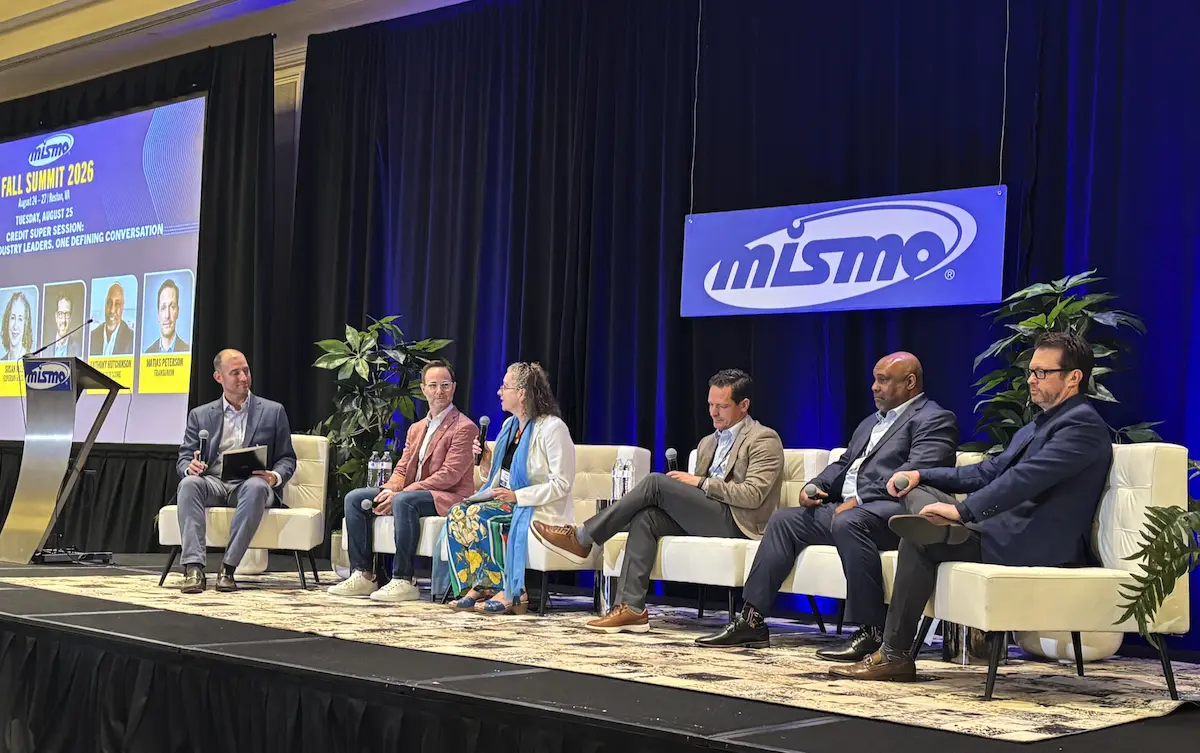
That tension served as the defining theme of the Credit Super Session at the Mortgage Industry Standards Maintenance Organization (MISMO) Fall Summit. Moderated by HousingWire CEO Clayton Collins, the panel featured executive heavyweights from the nation’s leading credit and scoring powerhouses: FICO, VantageScore, Experian, Equifax, and TransUnion.
The resulting discussion unpacked a complex ecosystem caught between the promise of technological modernization and the pragmatic realities of cost, compliance, and capital markets alignment.
1. Main Facts: The Shift to Modern Credit Scoring
The mortgage landscape is undergoing its most radical structural evolution in a generation, driven by several core shifts:
- The Scoring Models: The Federal Housing Finance Agency (FHFA) mandated the transition to a bi-merge credit report system using FICO 10T and VantageScore 4.0, replacing the long-standing tri-merge Classic FICO requirement.
- Trended Data Adoption: Both FICO 10T and VantageScore 4.0 incorporate trended credit data, which observes consumer financial behavior over time—such as whether revolving balances are paid off monthly or merely carried—rather than capturing a single moment in time.
- The Core Debate: While the industry accepts that it can use more data, executives at the MISMO summit stressed that consensus breaks down rapidly around how and to what extent lenders should integrate alternative data streams, artificial intelligence, and dual-scoring models into legacy workflows.
- The Operational Burden: Lenders accustomed to decades of reliance on a single, dominant credit score model must now re-engineer their internal tech stacks to ingest, process, and analyze multiple competing scores simultaneously.
2. Chronology: The Road to the MISMO Fall Summit
The path to the current credit modernization debate has been years in the making, marked by regulatory pushes, technological advancements, and shifting macroeconomic pressures.
- Late 2010s to 2020: As fintech lenders began leveraging alternative data and cash-flow underwriting to capture market share, traditional mortgage players faced mounting pressure to modernize. Concurrently, government-sponsored enterprises (GSEs) Fannie Mae and Freddie Mac began exploring alternatives to legacy credit scoring models.
- October 2022: The FHFA officially announced a timeline for the transition to bi-merge credit reporting and the implementation of FICO 10T and VantageScore 4.0 for enterprises, setting off a multi-year software and operational overhaul across the housing finance chain.
- 2023–2024: Lenders, credit bureaus, and software vendors grappled with the massive technical debt required to update loan origination systems (LOS) to handle new data structures. Industry trade groups pushed back on timelines, citing the immense cost and compliance hurdles of adopting two distinct credit scoring models concurrently.
- The MISMO Fall Summit (Tuesday): Against this backdrop, the Credit Super Session brought together the primary stakeholders of the credit ecosystem. Clayton Collins, CEO of HousingWire, opened the debate by framing the modern data dilemma around three fundamental questions: Can we use more data? May we? And should we?
3. Supporting Data & Market Dynamics: Cost vs. Credit Box
As the summit discussions revealed, answering Collins’ three questions is far from straightforward. While the technical ability to ingest more data is largely settled, the financial and operational implications are intensely contested.
The Profitability Squeeze and the Cost Curve
Lenders are currently navigating a high-cost origination environment characterized by elevated mortgage rates and tight inventory. In this climate, operational efficiency is non-negotiable. Justin Demola, senior vice president of mortgage and housing at Equifax, noted that lenders consistently approach data providers with three clear mandates: increasing revenue, reducing costs, and boosting efficiency.
However, Demola cautioned that pursuing the lowest-cost data option does not necessarily benefit the broader mortgage ecosystem. FICO’s Eric Lapin echoed this sentiment, emphasizing that credit decisions do not terminate at the origination desk.
"Scoring decisions extend through servicing, mortgage insurance, and capital markets," Lapin noted. If a lender opts for a cheaper front-end data model that fails to capture underlying risk accurately, downstream pricing complications inevitably arise. Investors, secondary market participants, and ratings agencies must remain completely aligned with whatever models lenders adopt to avoid liquidity crunches or unexpected credit losses.
The Incremental Power of Approval Rates
For lenders operating on razor-thin margins, small optimizations yield massive financial returns. Matias Peterson of TransUnion pointed out that even a 1- or 2-percentage-point increase in loan approvals can drastically alter a lender’s profitability. Given the high fixed costs of acquiring, processing, and underwriting mortgage prospects, converting marginal applicants into approved borrowers can mean the difference between a profitable quarter and a net loss.
4. Official Responses and Industry Perspectives
The executive panel provided deep insights into how the major players view the practical execution of this data-driven era.
VantageScore: Dual-System Readiness
Anthony Hutchinson, executive vice president and head of public affairs at VantageScore, urged institutions not to drag their feet on system integration. He emphasized that lenders must ensure their technology infrastructure can seamlessly accept both FICO 10T and VantageScore 4.0.
"Ensure that your systems can absorb both of them," Hutchinson urged, emphasizing that loan officers and operational staff must be trained to "use both and understand both."
Experian: Redefining Risk, Not Just Expanding the Box
Addressing the integration of alternative data—such as rental payment reporting, utility and telecom records, and consumer-permissioned cash-flow analytics—Susan Allen, chief product officer for housing at Experian, pushed back against casual terminology. She warned against viewing alternative data merely as a mechanism for "opening the credit box."
"There’s a big difference between accepting more risk as a way to approve more borrowers versus seeing risk differently, calculating it more effectively," Allen explained.
She pointed out that a consumer with a thin traditional credit file—such as younger borrowers relying on gig work, peer-to-peer payment apps like Venmo, Buy Now, Pay Later (BNPL) products, and extended rental histories—is not necessarily a consumer with a thin financial life. Properly capturing this data allows lenders to evaluate risk with surgical precision rather than blunt force.
5. Implications: The Challenges of Alternative Data and AI
As the industry pivots toward this data-heavy future, two primary hurdles stand in the way of frictionless execution: alternative data integration and artificial intelligence governance.
The Alternative Data Paradox
While rental data and cash-flow history hold immense promise for self-employed borrowers, gig workers, and historically underserved demographics, they introduce operational complexity. Traditional W-2 underwriting models are easily automated; verifying non-traditional cash flows requires sophisticated analytical tools, clear verification standards, and robust fraud prevention protocols. Lenders must build out compliance frameworks that can audit these alternative data streams without triggering fair lending violations or discriminatory outcomes.
Artificial Intelligence: The Next Regulatory Battlefield
Compounding the data influx is the rapid integration of artificial intelligence across the mortgage lifecycle. Panelists discussed how AI is increasingly utilized for document processing, data extraction, predictive analytics, and consumer education.
However, these innovations introduce significant regulatory exposure. Equifax’s Justin Demola raised a provocative question regarding the boundaries of automated systems: At what point does an AI application cross the line from a processing tool into "acting as a loan officer," thereby triggering stringent individual state and federal mortgage licensing requirements?
Anthony Hutchinson reinforced this warning, advising lenders to keep their legal, compliance, and government relations teams intimately involved at every stage of AI deployment. State-level regulatory proposals concerning algorithmic bias and automated decision-making are proliferating rapidly, creating a patchwork of compliance requirements that lenders ignore at their peril.
Conclusion: The Road Ahead
The debate at the MISMO Fall Summit signaled a definitive turning point for the U.S. mortgage industry. The primary question is no longer whether lenders can modernize their credit scoring engines and ingest vast new streams of borrower data. The technology exists, the regulatory approvals have been cleared, and the competitive pressure to capture market share is palpable.
Instead, the modern mortgage executive faces an architecture and workflow dilemma. Success in the new credit scoring regime will not be determined simply by who collects the most data, but by who can most intelligently deploy it across their ecosystem. Lenders must balance cost-efficiency with capital markets confidence, alternative risk models with stringent compliance, and artificial intelligence innovation with regulatory guardrails.
For an industry built on centuries of tradition, the transition to FICO 10T, VantageScore 4.0, and alternative data is proving that modernization is not just an IT upgrade—it is a complete reimagining of how mortgage credit is understood, measured, and delivered.
