

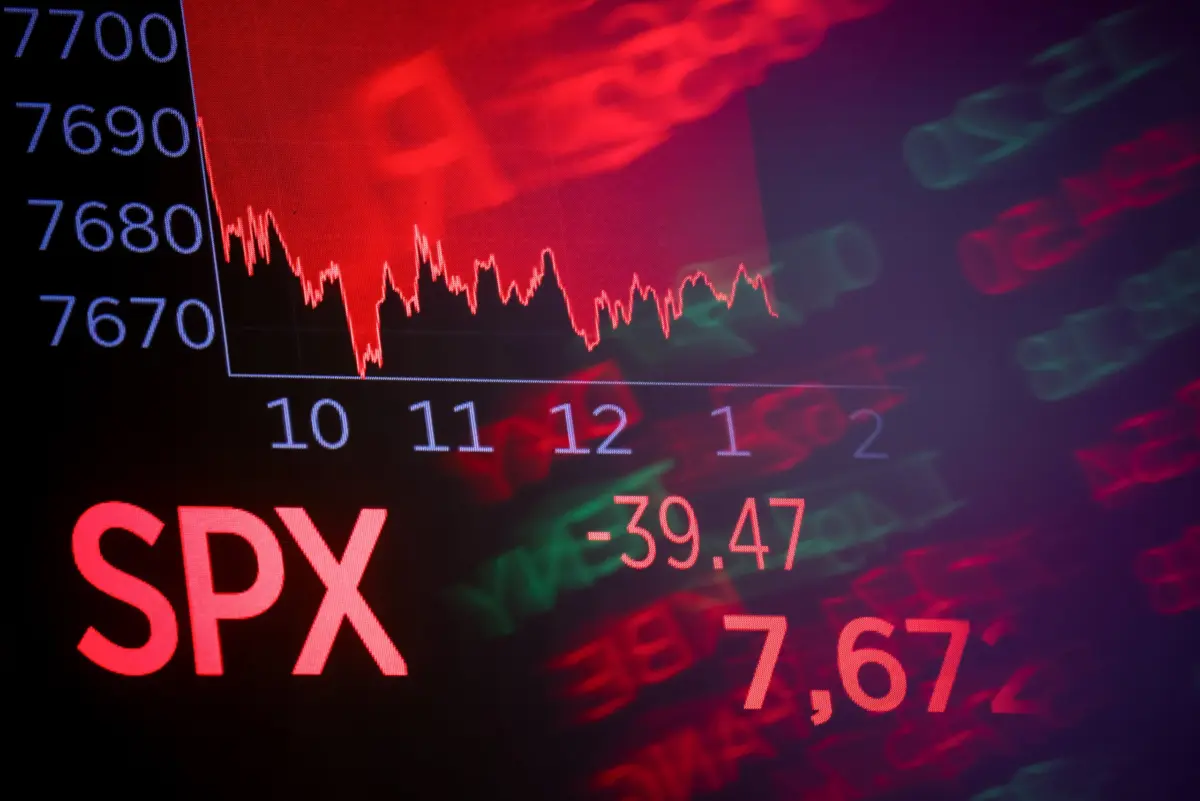
LONDON — As global equities continue to ride a wave of record-shattering valuations driven by an insatiable appetite for artificial intelligence, a prominent voice in the London financial sector is breaking ranks to sound a catastrophic alarm. Joachim Klement, head of market strategy at investment bank Panmure Liberum, has warned that the staggering capital expenditure supporting the current AI boom is hurtling toward a brick wall.
According to Klement, the unraveling of the AI trade could occur as early as 2027, potentially triggering the most severe market crash the global economy has witnessed since the 2008 global financial crisis.
This dramatic pivot from one of Europe’s most respected market minds highlights a growing tension on Wall Street and in European trading halls: a stark disconnect between soaring corporate earnings projections and rapidly deteriorating macroeconomic realities. While major indexes continue to scale unprecedented heights, institutional dissent is mounting over whether debt-fueled data center investments are creating an unmanageable financial bubble.
Main Facts: The Anatomy of an Impending Crisis
The core thesis presented by Panmure Liberum centers on the unsustainable financial mechanics currently powering the technology sector. Driven by optimism over generative AI capabilities, global equities have repeatedly broken historical records this year. However, Klement argues that this momentum is built on a brittle foundation of hyper-expansion that is rapidly depleting corporate liquidity.
- The Timeline: Klement’s base case projects that the AI bubble will burst between 2027 and 2028.
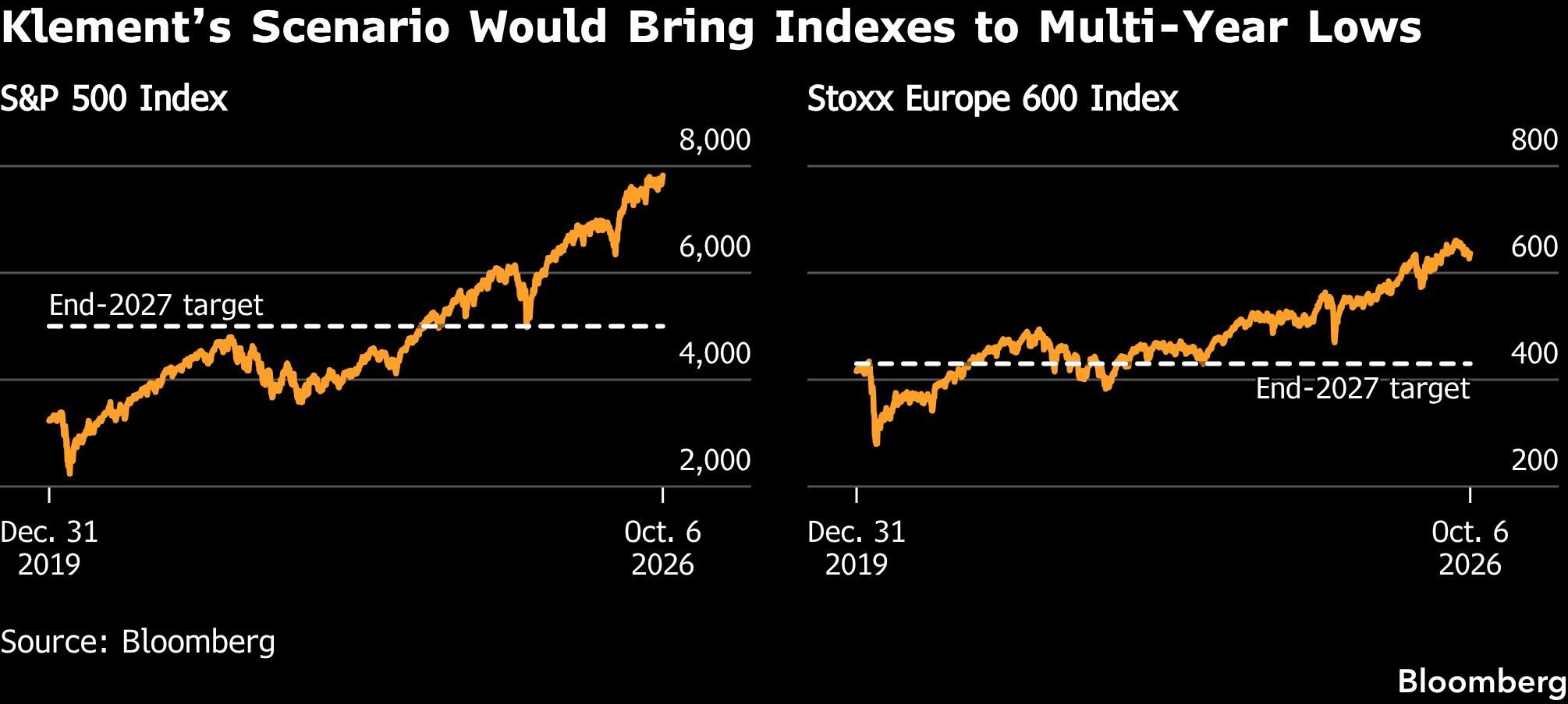
- The Price Targets: His year-end 2027 target for the S&P 500 stands at 5,000 points—implying a staggering 36% downside from current trading levels. Meanwhile, he forecasts Europe’s Stoxx 600 index to plunge to 430 points, representing a decline of more than 30%.
- The Catalysts: The predicted collapse is expected to be triggered by the rapid depletion of free cash flows among major technology firms (hyperscalers), compounded by skyrocketing borrowing costs that make ongoing infrastructure debt unsustainable.
- The Outlier Status: Among seven major market strategists tracked by Bloomberg, Klement’s forecast is by far the most aggressively bearish, contrasting sharply with a consensus average that still projects 14% upside.
Chronology: From Unabashed Optimism to Imminent Alarm
To understand the weight of Klement’s current warning, one must examine his recent evolutionary shift in market perspective. His trajectory over the past year reflects a rapid recalculation of risk in the face of persistent global headwinds.
2023–2024: The Bullish Stance
Having successfully navigated and capitalized on a bullish position regarding European equities through the previous year, Klement established a reputation for accurately reading regional market resilience. His analysis was largely aligned with the broader market consensus: technology would lead, and macroeconomic frictions would eventually soothe.
Mid-September 2025: Peak Optimism
As recently as mid-September, Klement’s internal modeling and institutional outlook remained exceptionally robust. His baseline assumption at the time was that the relentless momentum of the technology sector would propel the S&P 500 to a landmark 8,300 points by the conclusion of the following year.
October 2026: The Paradigm Shift
Within weeks, however, incoming economic data regarding sticky inflation and stubborn central bank interest rate trajectories forced a comprehensive reassessment. Klement realized that the cost of capital was rising far too quickly for tech giants to maintain their multi-billion-dollar infrastructure buildouts without incurring crippling debt service burdens.
Reflecting on this abrupt pivot, Klement noted the psychological challenge of his position: "I’m starting to worry people today for something that I think might happen in six to nine months." Rather than advocating an immediate panic sell-off, he has shifted his messaging toward proactive preparation and defensive contingency planning.
Supporting Data: The Trillion-Dollar AI Infrastructure Machine
The scale of capital pouring into the artificial intelligence ecosystem is unprecedented in corporate history, serving as both the engine of the current bull market and the primary vector of systemic risk.
According to comprehensive data compiled by Bloomberg Intelligence, capital expenditures dedicated to data centers by major hyperscalers are projected to more than double in 2026 compared to the previous year, surging to an eye-watering $713 billion. While spending is expected to continue climbing into subsequent years, the rate of growth is anticipated to decelerate—a crucial inflection point for markets that rely on exponential expansion to justify soaring stock valuations.
[2025 Data Center CapEx] ──(More than Doubles)──> [2026 Projections: $713 Billion]
                                                            │
                                                            ▼
                                                 [Slower Growth Pace in 2027]
                                                            │
                                                            ▼
                                               [Depleted Free Cash Flow Risk]
This massive deployment of capital has fundamentally altered how Wall Street evaluates tech earnings. Klement asserts that market participants have developed a form of tunnel vision:
"It is a situation where people are just focusing on one thing and one thing only, and that is earnings and in particular tech earnings. And they excuse every macro, credit or whatever headwind that you can come up with with that story."
Despite these warnings, counter-narratives persist across the financial sector. Earlier this week, strategists at Citigroup Inc. released notes maintaining that solid corporate earnings through 2027 will possess enough resilience to support further gains in global equities, brushing off the immediate threat of elevated interest rates and ongoing geopolitical volatility.
Official Responses and Institutional Alignment
Klement is not standing entirely alone in his apprehension. A chorus of institutional voices is beginning to echo concerns over the intersection of AI spending, inflation, and credit markets.
Earlier this week, Rohit Sipahimalani, Chief Investment Officer at Singapore-based state-owned investment firm Temasek International, publicly identified the reversal of the AI trade and persistent inflation as the two most critical structural risks facing global financial markets heading toward 2027. Sipahimalani’s warnings corroborate Klement’s observations regarding the vulnerability of global portfolios to a sudden sentiment shift in the tech sector.
Conversely, mainstream sell-side analysts remain largely committed to the growth narrative. The consensus among major banking strategists tracked by Bloomberg assumes continued corporate margin expansion, robust enterprise software adoption, and hardware monetization that will eventually validate the hundreds of billions of dollars being sunk into silicon chips, server racks, and liquid-cooled data facilities.
Implications: How Investors Can Prepare for the Precipice
Klement is careful to emphasize that his bearish scenario is a forward-looking contingency rather than a call to immediately dump all equity holdings. He acknowledges that markets can remain irrational longer than structural models can remain solvent, and his own near-term outlook for European markets still anticipates modest gains of roughly 10% through the end of 2026.
However, for investors looking down the barrel of a potential post-2008 style crisis, the strategist offers a clear, technical playbook for self-preservation:
- Monitor the Moving Averages: Klement’s primary technical indicator for disaster is the S&P 500 crossing below its 200-day moving average—a classic trend-following benchmark that smooths out daily volatility to reveal long-term market health. The index last breached this critical threshold during the market stresses of March.
- Shift to Defensive Posture: The moment the benchmark index drops below its 200-day moving average, Klement recommends going "full defensive."
- Sector Rotation: Investors are advised to aggressively pivot capital away from high-growth technology and consumer discretionary sectors, rotating instead into ultra-defensive safe havens such as consumer staples (food, household goods), tobacco, and pharmaceutical stocks.
"What I tell people is now is the time to prepare," Klement concluded. "Now is the time to make contingency plans for when the market goes into a bear market."
As global markets march deeper into the second half of the decade, the debate between tech-fueled euphoria and macroeconomic reality will undoubtedly intensify. Whether Klement’s 2027 doomsday scenario materializes or proves to be a premature caution, the message to investors is clear: complacency is currently the most expensive risk on the trading floor.
