

By Anthony Capkun
Published: October 1, 2026
Main Facts
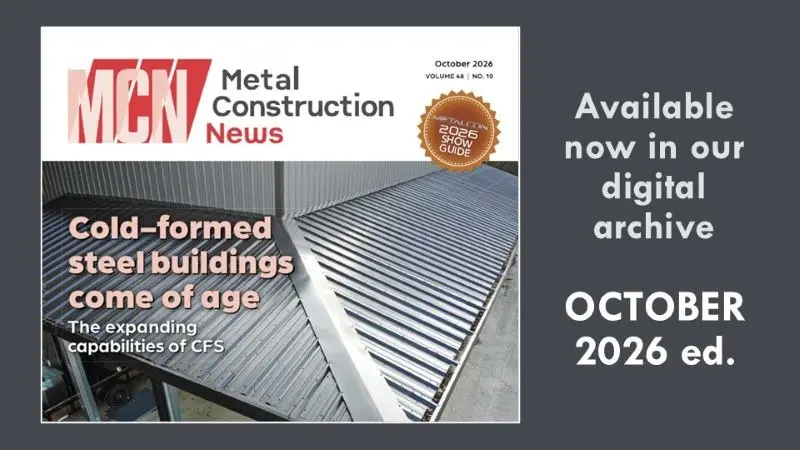
The industrial and metal construction sectors are experiencing a period of rapid technological maturation and operational shifting. Addressing these transformations, Metal Construction News (MCN) has officially released its highly anticipated October 2026 edition. Available now in both print and digital formats, this month’s publication targets the intersection of advanced engineering, building envelope science, and job-site logistics.
Headlining the October issue is a comprehensive analysis of the evolution of Cold-Formed Steel (CFS) structures, which are breaking traditional design boundaries due to breakthroughs in engineering software and fabrication methods. Furthermore, the edition features the comprehensive METALCON 2026 Show Guide, serving as the definitive roadmap for industry professionals attending the year’s premier metal construction event.
Beyond core structural engineering, the October issue addresses acute operational vulnerabilities faced by contractors and facility managers. Key focus areas include a forensic look at ice damming as a thermal failure rather than a mere weather leak in large distribution centers, strategies for mitigating the financial bleeding caused by multisite labor tracking inefficiencies, a critical review of modern safety gear standards versus baseline OSHA compliance, and the architectural imperative of specifying AMCA 550-certified louvers for structures in hurricane-prone zones along the Atlantic and Gulf coasts.
Chronology of Industry Shifts Leading to the October 2026 Focus
To fully understand the weight of the topics covered in the October 2026 edition of MCN, it is vital to trace the technological and economic trajectory that brought the metal construction industry to its current juncture.
- Late 2023 – 2024: Driven by post-pandemic supply chain recalibrations and surging labor costs, general contractors began demanding greater predictability from structural materials. Prefabrication and modular construction methods gained widespread traction, placing a premium on lightweight, high-strength materials like cold-formed steel.
- Throughout 2025: As commercial real estate experienced shifts toward massive e-commerce fulfillment centers, engineers grappled with unprecedented building envelope failures. Facility owners reported chronic moisture issues, hidden thermal bridging, and structural stress on low-slope metal roofs during heavy winter storms. Simultaneously, the proliferation of multisite projects exposed deep flaws in legacy time-tracking software, costing contractors millions in unbilled hours and inaccurate estimating data.
- Early 2026: Regulatory pressures intensified regarding windborne debris mitigation, particularly following severe storm seasons along the Gulf and Atlantic coasts. Architects faced stricter code enforcements regarding exterior wall penetrations, turning product certifications—such as AMCA standards for louvers—into make-or-break compliance issues. Concurrently, personal protective equipment (PPE) manufacturers introduced smart-safety textiles, widening the gap between legacy OSHA compliance and cutting-edge job-site protection.
- October 2026: MCN consolidates these pivotal industry developments into its flagship autumn edition, timing its release directly with the industry-wide convergence at METALCON 2026.
Supporting Data and Deep Dive into Feature Topics
The October 2026 issue of Metal Construction News is built upon rigorous field research, engineering case studies, and expert commentary. Below is a detailed exploration of the core themes featured in this month’s edition.
1. Cold-Formed Steel (CFS) Buildings Come of Age
For decades, cold-formed steel was largely relegated to interior framing, secondary structural supports, or low-rise commercial applications. However, advanced computer-aided engineering (CAE), building information modeling (BIM), and automated roll-forming technologies have fundamentally altered the landscape.
Today’s CFS systems boast higher strength-to-weight ratios, precise factory tolerances, and accelerated erection times. Engineers are now utilizing advanced CFS framing to design mid-rise commercial structures, hybrid industrial facilities, and complex architectural facades that were previously thought too ambitious for light-gauge steel. The October issue explores how these engineering advancements are expanding the geographic and structural footprint of CFS systems.
2. METALCON 2026 Show Guide
As the premier annual gathering for the metal construction industry, METALCON demands meticulous navigation. MCN’s exclusive Show Guide provides attendees with an exhaustive roadmap, including:
- Complete interactive floor plans and detailed exhibitor directories.
- Schedules for special networking events, keynote presentations, and live product demonstrations.
- Curated lists of workshops and masterclasses designed to upskill engineering and installation professionals.
- Comprehensive guides to educational tracks, detailing sessions and presenters focused on sustainability, digital transformation, and workforce development.
3. Ice Damming: A Thermal Failure, Not Just a Leak
Maintenance teams at large-scale distribution centers and logistics hubs frequently treat winter roof leaks as localized waterproofing failures. MCN’s engineering analysis flips this traditional perspective on its head, arguing that ice damming is fundamentally a manifestation of thermal envelope failure.
When heat escapes from the interior of a massive warehouse due to inadequate insulation or poor thermal break detailing, it melts the underside of snow accumulated on the metal roof. This meltwater runs down to the colder eaves, refreezes, and creates a dam that forces subsequent water beneath the roof panels. The October issue highlights how facility managers must shift from reactive patching to holistic thermal imaging and insulation upgrades to protect multimillion-dollar distribution assets.
4. Multisite Work and the Labor Tracking Crisis
In an era where contractors frequently manage multiple geographically dispersed job sites simultaneously, accurate labor tracking has become a logistical nightmare. Traditional methods—such as manual timesheets or generic GPS tracking—often fail to account for complex variables like travel time between sites, material staging delays, and unallocated project hours.
MCN explores how these micro-inefficiencies compound over the life of a project, distorting true job costs, skewing profit margins, and ultimately leading to uncompetitive or unprofitable future bids. The article emphasizes the urgent need for integrated, industry-specific digital labor-tracking ecosystems.
5. The Safety Gear Gap: Beyond Basic OSHA Compliance
There is a widening chasm in the 2026 construction market between equipment that meets the minimum legal threshold of OSHA compliance and equipment that integrates state-of-the-art safety engineering. From breathable, high-visibility ergonomic harnesses to wearable IoT devices that monitor worker fatigue and core body temperature in extreme weather, modern safety gear has evolved dramatically. MCN evaluates how forward-thinking contractors are reevaluating their procurement standards to prioritize worker longevity and risk reduction well above baseline regulatory minimums.
6. Certified Louvers for Hurricane-Prone Regions
Architects designing commercial and industrial properties along the Atlantic and Gulf coasts face unrelenting environmental stressors, chief among them being wind-driven rain and hurricane-force winds. Standard architectural louvers often fail under these extreme cyclic pressures, allowing water infiltration that can catastrophically damage interior mechanical systems.
The October issue provides a vital primer on AMCA 550-certified louvers (specifically designed for high-velocity wind-driven rain) and explains why specifying certified products is no longer just best practice, but a critical design requirement for coastal building resilience.
Official Responses and Industry Perspectives
Industry leaders, association heads, and technical experts have responded enthusiastically to the insights published in the October 2026 edition.
Dr. Aris Thorne, Lead Structural Engineer at the Cold-Formed Steel Research Institute, noted regarding the cover story:
"We are witnessing a paradigm shift in how structural designers view cold-formed steel. By shedding the limitations of legacy fabrication, CFS is stepping into the spotlight as a primary structural medium. MCN’s deep dive captures this technological tipping point precisely as the industry is scaling adoption."
Elena Vance, Facilities Asset Manager for a national logistics conglomerate, weighed in on the thermal analysis of ice damming:
"For years, operators have treated winter roof leaks as localized roofing defects. MCN’s framing of ice damming as a systemic thermal failure is a wake-up call. Until we address continuous insulation and thermal bridging at a macro level, we will continue to lose millions in inventory and structural remediation."
Marcus Sterling, Principal Architect at Coastal Resilience Design Group, emphasized the importance of the louver standards coverage:
"With climate volatility increasing along our southern and eastern seaboards, specifying AMCA 550-certified louvers is non-negotiable. Having an accessible, authoritative breakdown of these certifications in MCN helps bridge the knowledge gap between regulatory bodies and practicing architects."
Implications for the Metal Construction Sector
The release of the October 2026 edition of Metal Construction News arrives at a crucial moment for the industry. The implications of the highlighted trends are far-reaching:
- Technological Integration: The acceleration of CFS adoption and the demand for sophisticated labor-tracking software indicate that the construction sector is permanently shedding analog workflows in favor of data-driven, precision engineering.
- Risk Mitigation and Compliance: By reframing issues like ice damming as thermal failures and emphasizing advanced safety gear and hurricane-rated louvers, MCN pushes the industry toward a culture of proactive risk management rather than reactive compliance.
- Economic Competitiveness: Contractors who successfully master multisite labor tracking and embrace modern structural efficiencies will hold a distinct bidding advantage in an increasingly competitive commercial construction market.
Industry professionals can access the complete October 2026 edition, along with a searchable archive of past issues, through the official MCN Digital Edition Archive.
Metal Construction News extends its sincere gratitude to all industry contributors, engineering partners, and advertisers who made the October 2026 publication possible.
