

By Global News Desk
Published: September 18, 2026
Main Facts
The geopolitical landscape of the Middle East has suffered a severe destabilizing shock as military hostilities between Saudi Arabia and Yemen’s Iran-backed Houthi movement intensified significantly. The conflict, which broadened rapidly following earlier military engagements involving the United States, Israel, and Iran, has now transformed into a multi-theater crisis threatening regional stability and critical global energy corridors.
Cross-border strikes between the Royal Saudi Air Force and Houthi forces escalated dramatically, resulting in the first confirmed fatality on Saudi soil from Houthi projectile attacks since hostilities flared anew. Meanwhile, the maritime chokepoints of the Middle East—specifically the Strait of Hormuz and the Bab el-Mandeb strait—have become active zones of military confrontation. An oil tanker flying the flag of Togo was struck and disabled in the Strait of Hormuz during what Iranian state media termed an "illegal passage," heightening fears of a total shutdown of Gulf petroleum exports.
The humanitarian toll of the expanding war has become increasingly visible along the shores of the Red Sea. Thousands of Yemeni civilians, fleeing lightning advances by Houthi forces along the country’s coastline, have embarked on perilous sea crossings to Djibouti and neighboring territories. According to the International Organization for Migration (IOM), over 100,000 Yemenis have been internally and externally displaced within the span of a single week.
Concurrently, global energy markets are absorbing unprecedented pressure. With traditional maritime routes through both the Persian Gulf and the Red Sea severely compromised, crude oil prices remain stubbornly above $100 a barrel, while retail fuel costs in major Western economies surge to historic highs, casting a long shadow over upcoming political cycles in the United States.
Chronology of Escalation
The current phase of the regional conflict is the culmination of months of deteriorating security and broken diplomatic frameworks. The timeline below details the sequence of events leading to the current crisis:
- February 2026: The military conflict expands dramatically as the United States and Israel launch coordinated air operations against Iranian military infrastructure, triggering retaliatory postures across the Persian Gulf and Levant.
- June 2026: An interim diplomatic agreement brokered to de-escalate tensions between the United States and Iran completely collapses within weeks of its signing, leaving bilateral communication channels effectively frozen.
- Early September 2026: Houthi forces execute a lightning offensive, seizing control of virtually the entire Yemeni coastline along the Red Sea, including strategic ports and transit routes. The Saudi military responds with an intensified campaign of hundreds of airstrikes targeting Houthi-held positions in Hajjah and Taiz.
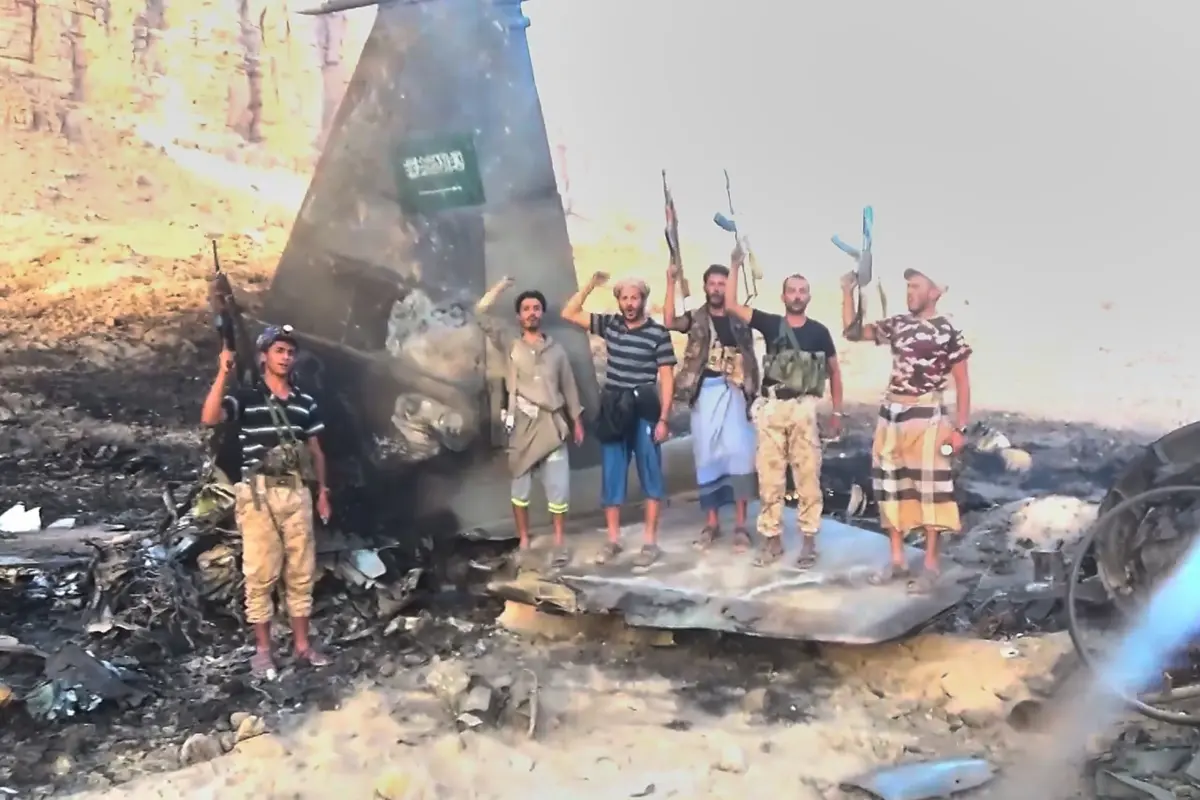
- Mid-September 2026 (Wednesday): Houthi military spokesmen claim the successful downing of a Saudi F-15 fighter jet over Marib province, releasing propaganda footage featuring fighters posing atop the purported wreckage.
- Mid-September 2026 (Thursday):
- Saudi civil defense authorities report the first fatality from intercepted Houthi drone debris over the western city of Taif, alongside dozens of previously injured civilians.
- Iran’s Revolutionary Guards Navy reports that a Togo-flagged oil tanker caught fire following a strike in the Strait of Hormuz.
- Displaced Yemeni civilians complete dangerous maritime evacuations across the Bab el-Mandeb strait, arriving on the shores of Djibouti under severe duress.
- Upcoming (Next Week): The multidimensional crisis is slated to take center stage at the United Nations General Assembly in New York, where an official Iranian delegation is expected to participate.
Supporting Data and Market Impact
The intersection of military conflict and vital shipping lanes has produced immediate, tangible consequences for the global economy and humanitarian agencies:
Energy and Commodity Markets
- Crude Oil Benchmarks: Global crude prices, though easing marginally on Thursday, remain firmly entrenched well above the $100-per-barrel threshold—marking their highest sustained levels since May.
- Refined Products: In the United States, average retail diesel prices touched an all-time record high on Thursday, hovering just shy of $6.40 per gallon.
- Strait of Hormuz Traffic: Prior to the outbreak of hostilities, approximately one-fifth of the world’s petroleum and liquefied natural gas (LNG) traversed the narrow outlet to the Gulf. Current naval blockades and military actions have reduced this throughput to a trickle, severely constraining Gulf exports.
Humanitarian Metrics
- Displacement Figures: The IOM estimates that more than 100,000 individuals have been uprooted by the recent surge in fighting across Yemen.
- Maritime Exodus: Hundreds of refugees continue to utilize small, ill-equipped watercraft to traverse the Bab el-Mandeb—appropriately translated from Arabic as the "Gate of Tears"—escaping active combat zones in coastal villages such as Dhubab.
Official Responses and Diplomatic Posture
As the security architecture of the region frays, statements from key capitals and political leaders underscore the difficulty of achieving a near-term diplomatic breakthrough.
United States Administration and Domestic Pressures
U.S. President Donald Trump faces a complex matrix of geopolitical and domestic political challenges. Despite direct appeals from Riyadh for renewed military backing against the Houthi movement—following a previous two-month U.S. bombing campaign and subsequent ceasefire last year—the White House has thus far rebuffed calls for direct offensive intervention.
Speaking in an interview with Axios on Thursday, President Trump addressed the possibility of resuming large-scale military action against Iran:
"I have a big decision coming up. Do I want to go in and annihilate them or do I not? It’s a big decision. Anything could happen with me," Trump stated, though foreign policy analysts note that past threats of major offensives by the administration have frequently failed to materialize.
The administration’s hesitation is compounded by domestic political vulnerabilities. With the November midterm congressional elections fast approaching, Republican candidates face potential voter backlash driven by soaring energy costs directly linked to the conflict with Iran.
Houthi Leadership
In a televised address characterized by defiant rhetoric, Houthi leader Abdul Malik al-Houthi outlined the movement’s core demands while seated with a traditional tribal dagger at his side:
"We want the Saudis to cease their blockade and occupation of our country, and to stop their aggression against us. This is our demand!"
The broadcast, carried by Houthi-controlled media outlets, featured standard movement slogans displayed on the surrounding walls: "Death to America, death to Israel, a curse upon the Jews, victory for Islam."
Iranian Position
Tehran maintains that the Strait of Hormuz remains officially closed to international shipping and will not reopen until the United States lifts its ongoing naval blockade of Iranian ports. Furthermore, Iranian authorities have floated proposals to negotiate directly with neighboring Gulf monarchies to establish a toll system, allowing passage through the strait only upon the payment of transit fees to Tehran.
Implications for Regional Security and Global Trade
The unfolding crisis carries profound implications that extend far beyond the immediate geography of the Arabian Peninsula.
Geopolitical Realignment
The inability of regional powers and Western allies to secure vital waterways highlights the vulnerability of global supply chains to asymmetric warfare. The Houthi deployment of drones, ballistic missiles, and anti-access capabilities demonstrates that non-state actors backed by major regional patrons can effectively paralyze multi-billion-dollar maritime trade routes.
Humanitarian Concerns
Aid organizations are increasingly stretched thin as the influx of refugees into the Horn of Africa strains local infrastructure. Testimonies from survivors, such as 50-year-old Wahida Omer—who arrived in Djibouti on a small boat after fleeing Dhubab without her husband or belongings—illustrate the human cost of the renewed violence. As Omer recounted to International Organization for Migration documentarians, "The sea was frightening, difficult… we were crying the whole way, and we arrived still crying."
Outlook for Diplomacy
With direct U.S.-Iran negotiations at a complete standstill following the collapse of the June interim agreement, international attention pivots toward multilateral forums. The upcoming United Nations General Assembly provides a critical, albeit narrow, window for back-channel diplomacy. Whether the presence of an Iranian delegation in New York can jump-start meaningful talks—or whether military escalations will continue unchecked—remains the central question facing global policymakers as the autumn diplomatic season begins.
