

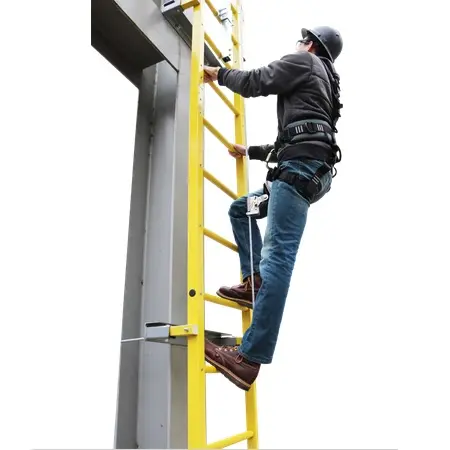
For decades, the physical journey of a commercial roofer or facility maintenance technician began with a familiar, rhythmic climb. Whether ascending an internal hatch ladder to reach a mechanical room or scaling an external vertical ladder on a brick facade, the primary safety feature flanking these climbers was almost always a steel cage. To the untrained eye, these curved metal enclosures offered a reassuring sense of security. To safety engineers and regulatory bodies, however, they represented a dangerous illusion of safety.
That illusion was dismantled when the Occupational Safety and Health Administration (OSHA) updated its Walking-Working Surfaces standards. The regulatory landscape governing fixed ladders underwent a seismic shift that continues to reverberate across the construction, roofing, and property management industries. With a multi-decade rollout plan currently underway, building owners and roofing contractors must navigate a complex transition away from traditional cages and toward active, cable- and rail-based fall arrest technologies.
Understanding these changes is not merely a matter of regulatory compliance; it is a vital component of risk management, worker safety, and long-term capital expenditure planning.
1. Main Facts: The New Reality of Fixed Ladder Compliance
The core of the regulatory shift lies in a fundamental reassessment of what constitutes effective fall protection. Under the revised standard OSHA 1910.28(b)(9), traditional ladder cages and wells are no longer recognized as compliant fall protection systems on fixed ladders that extend more than 24 feet above a lower level.
Instead, OSHA has mandated a transition to active systems designed to arrest a fall before injury occurs. The primary facts governing this regulatory shift include:
- The 24-Foot Threshold: Any fixed ladder—whether an internal roof hatch access ladder or an external roof access ladder—with a climb height exceeding 24 feet falls under the strict purview of these updated regulations.
- The Rejection of Cages: Cages do not stop a falling worker; rather, they merely contain the fall, often causing the worker to strike the metal hoops and rungs on the way down. Consequently, cages are being phased out as a sole means of fall protection.
- Mandated Alternatives: To comply with modern standards, affected fixed ladders must be equipped with either a Ladder Safety System or a Personal Fall Arrest System (PFAS).
- The Harness Neck-Injury Hazard: A critical, often overlooked detail in the regulation relates to body harnesses. Under OSHA 1910.140(d)(1)(iv), personal fall arrest systems must sustain a falling employee without the chest or shoulder straps making contact with the worker’s neck or chin area during a fall. Traditional dorsal (back-mounted) D-ring harnesses often fail this requirement when used on vertical ladders, necessitating the adoption of specialized harnesses with front- or waist-mounted D-rings.
2. Chronology: The Multi-Decade Regulatory Roadmap
The transition away from legacy safety systems was designed by OSHA to be gradual, allowing building owners and contractors ample time to audit their facilities, budget for upgrades, and execute retrofits. However, the timeline contains strict triggers that demand immediate action when certain conditions are met.
[Pre-Nov 19, 2018]      [Nov 19, 2018]             [Current Era]             [Nov 18, 2036]
-----------------------------------------------------------------------------------------
Legacy installations     New/replacement ladders    Repairs & modifications   Absolute deadline:
permitted to use cages   must feature active        trigger mandatory         All fixed ladders
as sole protection.      fall arrest systems.       system upgrades.          must be retrofitted.
Phase 1: The Legacy Era (Pre-November 19, 2018)
Prior to November 19, 2018, building codes and OSHA standards permitted the installation of cages or wells as the primary means of safety on fixed ladders taller than 20 or 24 feet (depending on the specific jurisdiction and older code versions). Hundreds of thousands of commercial buildings across the United States were constructed under these guidelines, leaving a massive footprint of legacy caged ladders.
Phase 2: The Line in the Sand (November 19, 2018)
On November 19, 2018, the amendment to OSHA 1910.28(b)(9) officially took effect. From this date forward, the rules of the game changed permanently:
- New Installations: Any fixed ladder installed after November 19, 2018, that extends more than 24 feet above a lower level must be equipped with a ladder safety system or a personal fall arrest system from day one. Cages are no longer permitted as the sole source of fall protection on new builds.
- Existing Installations: Ladders installed prior to this date were temporarily grandfathered in, allowing them to continue utilizing cages or wells, provided no modifications were made to the structure.
Phase 3: The Maintenance and Replacement Trigger (The Present Era)
We are currently in a critical transitional phase. Under 1910.28(b)(9)(i)(B), if any portion of an existing grandfathered fixed ladder, cage, or well is replaced, repaired, or modified, the entire ladder must immediately be brought up to modern standards. This means that minor repairs to a damaged cage can trigger a mandatory requirement to install a fully compliant ladder safety system.
Phase 4: The Final Horizon (November 18, 2036)
The ultimate deadline is absolute. Under 1910.28(b)(9)(i)(D), on and after November 18, 2036, all fixed ladders extending more than 24 feet above a lower level, regardless of their original installation date, must be equipped with a personal fall arrest system or a ladder safety system. On this date, grandfathering ends entirely, and legacy caged systems that lack active fall arrest components will become officially non-compliant.
3. Supporting Data: The Physics of Falls and System Engineering
To appreciate why OSHA initiated this regulatory overhaul, it is necessary to examine the physics of vertical falls and the engineering differences between legacy and modern safety systems.
The Failure of the Cage: What the Data Shows
For decades, safety experts assumed that cages would protect workers by allowing them to lean back against the enclosure to rest, or by catching them if they slipped. However, accident reconstruction data compiled by safety researchers and the Bureau of Labor Statistics (BLS) revealed a grimmer reality:
- Deflection and Impact: When a worker slips inside a ladder cage, they do not slide down smoothly. Instead, gravity pulls them vertically while the cage forces them laterally. The result is a violent, ricocheting fall where the worker strikes the steel rungs, side rails, and cage hoops.
- Entrapment Risks: Cages frequently trap falling workers, making it incredibly difficult for emergency personnel to perform high-angle rescues.
- No Deceleration: Cages provide no deceleration mechanism. A worker falling 20 feet inside a cage will strike the ground or a lower platform with virtually the same force as if they fell in open space, often compounded by blunt-force trauma from hitting the cage itself.
Anatomy of a Compliant Ladder Safety System
In contrast to a passive cage, a modern Ladder Safety System is an active engineering control designed to arrest a fall within inches. OSHA defines these systems as integrated assemblies that eliminate or reduce the possibility of a worker falling off a ladder. They typically consist of:
+-------------------------------------------------------------+
|               LADDER SAFETY SYSTEM COMPONENTS               |
+-------------------------------------------------------------+
|  1. THE CARRIER:                                            |
|     A rigid rail or flexible cable running the full length  |
|     of the ladder.                                          |
+-------------------------------------------------------------+
                           |
                           v
+-------------------------------------------------------------+
|  2. THE SAFETY SLEEVE (TROLLEY):                            |
|     A mechanical device that glides freely during ascent/   |
|     descent but locks instantly during a sudden drop.       |
+-------------------------------------------------------------+
                           |
                           v
+-------------------------------------------------------------+
|  3. THE CONNECTORS & LANYARD:                               |
|     Short, heavy-duty links connecting the sleeve to the   |
|     worker's harness.                                       |
+-------------------------------------------------------------+
                           |
                           v
+-------------------------------------------------------------+
|  4. THE BODY HARNESS:                                       |
|     A specialized full-body harness, specifically featuring |
|     a sternal (chest) or waist-mounted D-ring.              |
+-------------------------------------------------------------+
The Sternal D-Ring Requirement: Addressing the Harness Paradox
A major point of confusion for contractors and building owners is the type of harness required for fixed ladder climbing. Most standard construction harnesses feature a single dorsal D-ring located between the shoulder blades. While ideal for horizontal roof work and general fall arrest, dorsal connections present a severe hazard on vertical ladders:
- The Throat-Choke Hazard: If a climber falls while connected to a vertical cable via a dorsal D-ring, the pulling force is directed from behind and above. This pulls the harness upward, forcing the chest and shoulder straps directly into the climber’s neck and chin.
- OSHA Standard 1910.140(d)(1)(iv): This standard specifically dictates that personal fall arrest systems must sustain the employee within the harness strap configuration without making contact with the employee’s neck and chin area.
- The Solution: To comply, climbers must use harnesses equipped with a sternal (chest) D-ring or a specialized front-waist connection. These front-mounted attachment points keep the climber upright and distribute forces across the torso and thighs, completely avoiding the neck area during a fall arrest event.
4. Official Responses and Industry Perspectives
The transition away from cages has met with mixed reactions across the construction and property management sectors, prompting clarification from regulatory bodies and safety consultants alike.
OSHA’s Stance: Prioritizing Active Intervention
OSHA’s primary objective in revising the Walking-Working Surfaces rule was to align general industry standards with construction standards, creating a unified approach to fall protection. Regulatory impact analyses conducted by OSHA estimated that the updated rules would prevent approximately 29 fatalities and nearly 6,000 lost-workday injuries annually across all affected industries.
In public memos and letters of interpretation, OSHA officials have repeatedly emphasized that while cages do not need to be physically removed from existing ladders (they can remain in place alongside a new cable or rail system), they cannot be counted as a safety device.
The Building Owner’s Dilemma: Capital Allocation
For commercial property managers and building owners, the regulations represent a logistical and financial challenge. Retrofitting a single external access ladder with a cable-based safety system can cost several thousand dollars, depending on height, structural integrity, and structural attachments. Across a large corporate campus or a portfolio of industrial properties, these costs escalate quickly.
Property management associations have advised members to conduct comprehensive facility audits immediately. By identifying which ladders are currently grandfathered and which are nearing repair thresholds, owners can integrate retrofit costs into their multi-year capital expenditure (CapEx) budgets well ahead of the 2036 deadline.
The Roofing Contractor’s Perspective: A Dual Role
Roofing contractors find themselves on the front lines of this regulatory transition. They are both users of these systems and consultants to the building owners.
When a roofing crew arrives at a job site, they must assess the safety of the access points. If an external ladder exceeds 24 feet and lacks a ladder safety system, the contractor faces immediate liability and safety concerns for their crew. Consequently, forward-thinking contractors are increasingly acting as safety advisors, helping building owners identify non-compliant ladders and proposing retrofit packages as part of their roofing service contracts.
5. Strategic Implications for Building Owners and Contractors
The ramifications of OSHA’s fixed ladder standards stretch far beyond simple equipment installations. They influence liability, insurance premiums, workforce training, and procurement strategies.
Liability and Risk Management
In the event of a fall-related injury or fatality on a commercial property, the absence of compliant fall protection is an open-and-shut case for regulatory citations and civil litigation.
- For Owners: Allowing third-party contractors or internal maintenance staff to climb a non-compliant ladder (>24 feet installed post-2018 without a safety system) carries immense legal risk.
- For Contractors: Sending employees up a non-compliant ladder violates the employer’s duty to provide a safe workplace under OSHA’s General Duty Clause.
The Importance of Partnering with Experienced Specialists
Navigating the technical nuances of these regulations requires specialized expertise. Upgrading a ladder system is not as simple as clamping a steel cable to the rungs. Structural engineering calculations must be performed to ensure the existing ladder and the building facade can withstand the dynamic impact forces of a arrested fall.
Furthermore, procurement teams must ensure that the components selected—such as the cable system, the safety sleeve, and the harnesses—are fully compatible. This is where partnering with established industry veterans becomes invaluable.
With over 70 years of experience and five strategically located facilities across the country, companies like Roofmaster play a vital role in this transition. By providing contractors with the precise technical guidance, high-quality fall arrest systems, and compliant front-D-ring harnesses needed to meet modern standards, Roofmaster continues to serve as a cornerstone for those building and maintaining America’s commercial infrastructure.
Conclusion: Actionable Steps for the Industry
To ensure compliance and protect human lives, building owners and roofing contractors should adopt a proactive three-step strategy:
| Step | Action Item | Target Audience |
|---|---|---|
| 1 | Conduct a Fixed Ladder Audit: Document the height, installation date, and current safety mechanisms of every internal and external fixed ladder on your properties. | Building Owners & Facility Managers |
| 2 | Upgrade During Routine Maintenance: Do not wait for the 2036 deadline. If a ladder or roof hatch requires repair, use that opportunity to install a modern cable- or rail-based ladder safety system. | Contractors & Property Managers |
| 3 | Standardize Compliant PPE: Equip all climbing crews with specialized harnesses featuring sternal or waist D-rings, and mandate comprehensive training on how to inspect and use safety sleeves. | Roofing Contractors & Safety Directors |
By moving away from the outdated security of the ladder cage and embracing engineered fall arrest systems, the commercial roofing and construction industries can ensure that every climb begins with compliance and ends with a safe return to the ground.
