

The commercial roofing industry is undergoing a profound transformation. As building owners and facility managers seek sustainable, cost-effective, and long-term solutions to extend the lifespan of existing roof substrates, liquid-applied membranes have emerged as a dominant force. Among these, silicone has rapidly ascended to become one of the fastest-growing and most technically demanding roof coating applications in the modern market.
However, the transition from traditional roofing systems to high-performance silicone applications is not without its hurdles. For contractors, entering this lucrative market requires a deep understanding of application technology, material science, and safety protocols. The capital investment required to equip a crew can range from a modest $1,000 for manual, roll-applied setups to upwards of $30,000 for state-of-the-art, high-pressure hydraulic spray systems. Choosing the wrong equipment can lead to catastrophic application failures, ruined machinery, and severe financial losses.
Main Facts: The Technical and Financial Realities of Silicone Application
Silicone roof coatings provide an seamless, impermeable barrier that exhibits exceptional resistance to ultraviolet (UV) radiation, extreme temperature fluctuations, and—most importantly—ponding water. Unlike acrylic coatings, which tend to degrade and wash away under standing water, silicone maintains its chemical integrity, making it the premier choice for flat or low-slope commercial roofs.
Despite these benefits, silicone is a highly viscous, moisture-curing material. This unique chemistry presents distinct application challenges:
- Viscosity and Curing: Silicone coatings have a high solids content (often exceeding 90%). This makes the material incredibly thick and difficult to pump. Furthermore, because silicone cures by reacting with moisture in the air, any equipment used must be airtight to prevent the material from curing inside the pumps, hoses, and guns.
- The Cost Spectrum: Contractors looking to enter the market face a wide financial spectrum. Basic roll-applied systems can be put together for approximately $1,000, while professional-grade, high-volume spray rigs cost between $15,000 and $30,000.
- Application Methods: The two primary methods of application are roll-applied and spray-applied. The choice between them depends on job size, crew experience, capital availability, and environmental conditions such as wind speed.
Chronology: The Evolution of Commercial Roofing and Liquid-Applied Membranes
To understand the current prominence of silicone coatings, it is necessary to examine how commercial roofing technology has evolved over the past several decades.
[1970s-1980s] Built-Up Roofing (BUR) & Coal Tar Pitch Dominance
      │
      ▼
[1990s] Rise of Single-Ply Membranes (TPO, EPDM) & Early Acrylic Coatings
      │
      ▼
[2000s] Introduction of Early-Generation Silicones (High VOCs, fast degradation)
      │
      ▼
[2010s] Breakthrough in High-Solids, Low-VOC Silicone Formulations
      │
      ▼
[Present] Widespread Adoption of Advanced Hydraulic Spray and Power Roller Systems
The Era of Traditional Roofing (1970s–1980s)
For much of the 20th century, commercial roofing relied heavily on Built-Up Roofing (BUR) systems, coal tar pitch, and asphalt. These systems were labor-intensive, hazardous to install, and environmentally unfriendly. They required melting asphalt in large kettles, creating significant safety risks and air pollution.
The Rise of Single-Ply and Early Coatings (1990s)
The introduction of single-ply membranes like thermoplastic polyolefin (TPO) and ethylene propylene diene monomer (EPDM) revolutionized the industry in the 1990s. During this period, early elastomeric coatings—primarily acrylic-based—gained traction. While effective at reflecting sunlight and lowering energy costs, these early coatings struggled with ponding water and required frequent reapplication.
The Silicone Breakthrough (2000s–2010s)
In the early 2000s, silicone coatings emerged as a premium alternative. Early formulations were difficult to work with and contained high levels of volatile organic compounds (VOCs). However, chemical advancements in the 2010s led to the development of high-solids, solvent-free silicone coatings. These modern formulations complied with strict environmental regulations while offering unprecedented durability and water resistance.
As chemical formulations advanced, so too did application technology. Contractors transitioned from using standard paint sprayers—which frequently clogged and broke down under the stress of high-solids silicone—to specialized, heavy-duty hydraulic equipment designed specifically to handle highly viscous materials.
Supporting Data: Technical Specifications and Cost-Benefit Analysis
Choosing between roll-applied and spray-applied systems requires a careful analysis of technical specifications, labor productivity, and capital costs.
| Feature / Metric | Roll-Applied Systems | Spray-Applied Systems (Mid-Range) | Spray-Applied Systems (High-End) |
|---|---|---|---|
| Capital Cost | $1,000 – $3,000 | $15,000 – $22,000 | $22,000 – $30,000+ |
| Production Rate | Slow to Moderate (1,500 – 3,000 sq. ft./day) | Fast (10,000 – 15,000 sq. ft./day) | Extremely Fast (20,000+ sq. ft./day) |
| Crew Size Required | 2–4 workers | 3–5 workers | 4–6 workers |
| Wind Sensitivity | Low (Minimal risk of overspray) | High (Overspray risks limit use) | High (Overspray risks limit use) |
| Key Components | 14”–40” rollers (6” dia.), wheeled frame, gravity vat | Pneumatic/Hydraulic pump, 150-250ft hose, spray gun | Heavy-duty hydraulic pump, 250ft+ hose, drum elevator, mixers |
| Target Project Size | Small to Medium (<10,000 sq. ft.) | Medium to Large (10,000 – 50,000 sq. ft.) | Large to Industrial (>50,000 sq. ft.) |
Roll-Applied Systems: The Low-Cost, High-Control Option
For contractors testing the waters of silicone application, or those operating in dense urban environments where wind drift is a constant liability, roll-applied equipment is the most practical choice.
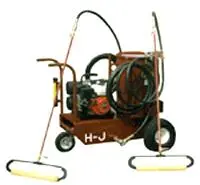
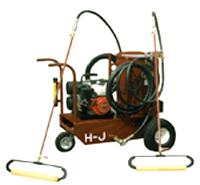
Commercial-grade power rollers differ significantly from residential paint rollers. These heavy-duty systems feature rollers ranging from 14 inches to 40 inches in width, with a robust 6-inch diameter to hold a substantial volume of material. The roller is mounted on a sturdy metal frame equipped with wheels to reduce operator fatigue.
Crucially, these systems include an attached vat or manifold system. This vat features precisely engineered flow-control holes that feed the silicone directly onto the roof surface ahead of the roller. This configuration ensures an even, consistent mil thickness without the risk of airborne overspray.
Spray-Applied Systems: The High-Production Powerhouses
When dealing with large commercial and industrial roofs, manual rolling becomes economically unfeasible due to labor costs. In these scenarios, spray application is the industry standard. However, silicone cannot be sprayed using standard architectural paint sprayers.
The high viscosity of silicone requires heavy-duty hydraulic or pneumatic piston pumps. These units typically operate at pressures between 3,000 and 4,000 PSI and must deliver a flow rate of at least 3 to 4 gallons per minute (GPM) to support the large spray tips (typically .029 to .039 inches) required for high-solids silicone.
The price disparity between a $15,000 unit and a $30,000 unit is driven by several key engineering features:
- Hose Length and Diameter: High-solids silicone experiences significant pressure drop over long distances. High-end systems feature heavy-duty, moisture-resistant hoses (often 3/4-inch diameter transitioning to 1/2-inch whip hoses) that can extend up to 250 feet or more without losing pressure.
- Hydraulic Elevators and Auxiliaries: Premium spray rigs feature integrated hydraulic lifts that raise and lower the heavy pump fluid section directly out of 55-gallon drums. This eliminates manual lifting and speeds up drum changeovers.
- Active Agitation Systems: High-end units often include hydraulic auxiliary connections to power drum mixers, ensuring the silicone remains homogeneous throughout the application process.
Expert Insights and Official Responses
Industry experts emphasize that successfully applying silicone roof coatings requires comprehensive training and a thorough understanding of the equipment. Pat Amicucci, an industry specialist at Roofmaster®, highlights the complexity of these investments:
"Silicone has become one of the fastest growing roof coating applications today and one of the more technical. Crews need to be familiar with the operations and dangers associated with the equipment… Fitting your company with the right options is not all black and white."
Safety Considerations and Equipment Risks
Safety trainers from the Roof Coatings Manufacturers Association (RCMA) point out that the high pressures involved in spray application introduce unique workplace hazards. Skin injection injuries—where high-pressure fluid penetrates the skin—are a severe risk when operating hydraulic sprayers. These injuries require immediate, specialized surgical intervention to prevent amputation.
Furthermore, respiratory protection is non-negotiable when spraying silicone. Unlike roller applications, which produce virtually no airborne particles, spraying atomizes the silicone, creating a mist that can cause severe respiratory irritation and long-term lung damage if inhaled. Workers must be equipped with supplied-air respirators (SAR) or full-face air-purifying respirators (APR) with organic vapor/P100 cartridges.
The Overspray Liability
Experienced contractors frequently warn about the financial dangers of overspray. When spraying silicone in wind speeds exceeding 10 to 15 miles per hour, the atomized particles can drift significant distances, landing on parked cars, neighboring buildings, and landscaping.
Because silicone is designed to bond tenaciously to surfaces, removing overspray from automotive paint and glass can cost thousands of dollars per vehicle. This risk highlights the value of having commercial power rollers on hand, allowing larger contractors to keep their crews working even when wind conditions prohibit spraying.
Implications: The Future of Commercial Roofing
The rapid adoption of silicone coatings carries significant implications for the broader commercial construction and property management industries.
┌────────────────────────────────────────────────────────┐
│               Environmental Benefits                   │
│  • Diverts tons of roofing waste from landfills        │
│  • Lowers urban heat island effect via reflectivity    │
└───────────────────────────┬────────────────────────────┘
                            │
                            ▼
┌────────────────────────────────────────────────────────┐
│                 Economic Advantages                    │
│  • Costs up to 50% less than a complete roof tear-off  │
│  • Classed as maintenance (immediate tax write-off)    │
└───────────────────────────┬────────────────────────────┘
                            │
                            ▼
┌────────────────────────────────────────────────────────┐
│             Contractor Competitiveness                 │
│  • Requires specialized training & high-end machinery  │
│  • Barrier to entry protects professional contractors  │
└────────────────────────────────────────────────────────┘
Landfill Diversion and Sustainability
Traditionally, when a commercial roof reached the end of its service life, the only option was a complete tear-off and replacement. This practice contributes millions of tons of waste to landfills annually.
Silicone coatings offer a sustainable alternative. By restoring and sealing an existing roof membrane, contractors can extend its life by 10, 15, or even 20 years. When that coating eventually wears down, the roof can simply be cleaned and recoated, creating a virtually infinite cycle of preservation that aligns with modern environmental mandates.
Economic Advantages for Building Owners
From a financial perspective, a silicone restoration project can cost up to 50% less than a complete roof replacement. Additionally, because a coating is classified as maintenance rather than a capital improvement, building owners can often write off the entire cost of the project in the first year, providing significant tax advantages.
The Barrier to Entry for Contractors
For roofing contractors, the technical complexity of silicone application acts as a natural barrier to entry. While low-end, amateur outfits can easily install shingle roofs or basic single-ply membranes, they lack the technical expertise and capital equipment required to execute high-volume silicone applications.
Contractors who invest in high-quality equipment—and partner with experienced suppliers like Roofmaster®, which brings 70 years of industry knowledge to the table—are well-positioned to capture a highly profitable segment of the commercial roofing market. Ultimately, the transition to silicone is not merely a trend; it represents a permanent shift toward smarter, more sustainable, and highly engineered building maintenance solutions.
