

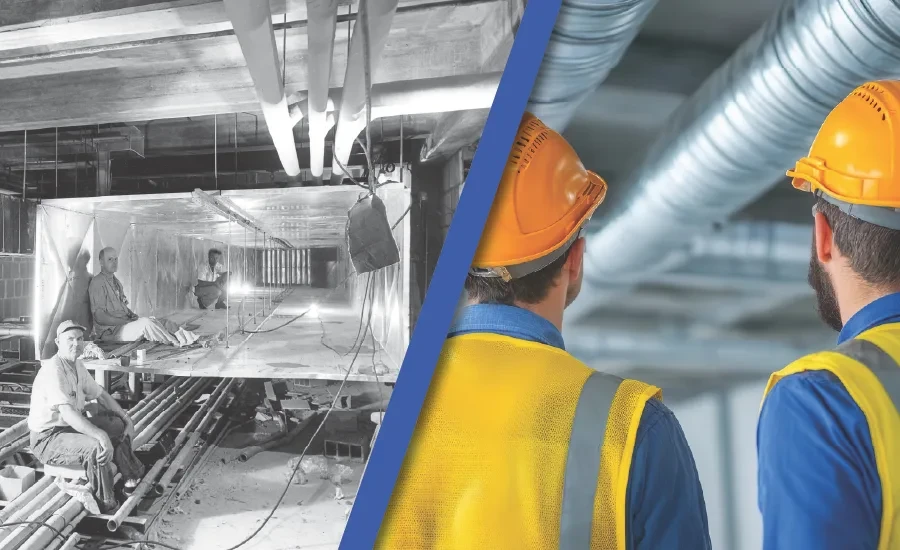
By Industry News Desk
For anyone operating within the modern heating, ventilation, and air conditioning (HVAC) sector, the overarching narrative of the past decade remains stubbornly consistent: finding and retaining qualified, skilled labor is the single greatest operational hurdle facing contractors today.
As demand for advanced indoor climate control systems surges across commercial, industrial, and residential markets, the workforce pipeline is failing to keep pace. Contractors are routinely forced to turn down lucrative bids, stretch existing crews to their absolute limits, and rethink every facet of their daily operations just to stay competitive. In response to this compounding crisis, a quiet revolution is taking place on jobsites across North America. Driven by necessity, forward-thinking contractors are looking past traditional installation methods and embracing material innovations—most notably, architectural cable suspension systems—to work smarter, cut installation times in half, and maximize the output of their limited labor forces.
The Core Crisis: Understanding the HVAC and Sheet Metal Labor Shortage
To understand why operational efficiency has become paramount, one must first examine the stark statistical reality of the North American skilled labor market. The numbers paint a sobering picture of an industry grappling with an aging workforce and a widening generational gap.
According to data compiled by the U.S. Bureau of Labor Statistics (BLS), the crisis shows no signs of abating anytime soon. The agency projects approximately 40,100 job openings for HVAC mechanics and installers every single year through 2034. This baseline figure accounts not only for newly created positions driven by commercial and residential growth but also for the massive wave of retirements washing over the trade.
When looking specifically at the sheet metal industry—the backbone of commercial HVAC ductwork installation—the data becomes even more alarming. According to reports from the Sheet Metal and Air Conditioning Contractors’ National Association (SMACNA):
- Approximately 35,000 sheet metal workers are projected to retire in the near future.
- More than half of the current active sheet metal workforce is currently over the age of 45.
- For every five experienced workers leaving the trade, only two new workers are entering to replace them.
- An overwhelming 90% of SMACNA contractor members report facing persistent, damaging labor shortages.
These statistics represent more than just numbers on a spreadsheet; they translate directly to delayed project timelines, squeezed profit margins, and immense physical and mental strain on the remaining workforce.
The Contractor’s Dilemma: Two Paths Forward
Faced with this compounding labor deficit, HVAC contractors essentially have two distinct strategic paths they can pursue to maintain profitability and meet project deadlines.
The first option is aggressive recruitment and hiring. Contractors can invest heavily in signing bonuses, competitive wages, apprenticeship sponsorships, and recruiting campaigns to lure talent away from competitors or attract fresh blood to the trades. While essential for the long-term health of the industry, this approach is notoriously difficult, expensive, and slow to yield results in the short term. The talent pool is simply too shallow.
The second option—and the one yielding the most immediate, tangible relief—is operational optimization. Contractors are increasingly turning their analytical gaze inward, auditing every phase of a project lifecycle to find ways for their existing technicians to work smarter, not harder. This means eliminating redundancies, reducing physical fatigue, and maximizing billable, productive time while the employee is on the clock.
One of the most accessible and high-impact operational changes a contractor can make is transitioning away from traditional, labor-intensive hanging methods—such as threaded rod and unistrut—and moving toward advanced wire cable suspension systems.
A Paradigm Shift in Hanging Systems: Cable Versus Threaded Rod
For decades, the standard method for suspending commercial ductwork, air handlers, and piping has been the traditional threaded rod and strut assembly. While reliable, this method is inherently labor-intensive, requiring extensive measuring, cutting, deburring, and fastening on the jobsite.
The modern alternative utilizes high-tensile wire rope paired with precision-engineered locking mechanisms. This cable-based approach radically alters the physics and logistics of overhead installations, resulting in faster setups, drastically reduced material transport weights, and infinitely easier height adjustments.
"The shift from traditional threaded rod toward cable-based systems has really been driven by labor and installation efficiency," explains Brian Pimental, HVAC Sales Manager for Griplock Systems. "Think about all the time spent on the ground cutting rod and strut, deburring it, handling nuts and bolts, and moving materials around the jobsite. Cable eliminates many of those steps."
The operational advantages become clear when evaluating the physical workflow of a technician on a jobsite. With traditional methods, workers must constantly shuttle up and down from scissor lifts to fetch components, use power tools to cut steel rods, grind sharp edges, and manage tangles of heavy electrical cords for cutting wheels.
Cable suspension systems consolidate these touch points. A technician can take a compact box of cable components up onto a scissor lift and remain elevated for extended periods, executing multiple drops without ever touching the ground for supplies.
Furthermore, the logistical footprint of the materials themselves cannot be overstated. Traditional threaded rod and heavy strut arrive on flatbed trucks and demand substantial staging areas on crowded urban jobsites. Conversely, a pallet of boxed cable suspension systems can perform the exact same structural holding job while occupying a tiny fraction of that footprint.
"Jobsite logistics are a big part of it, too," notes Larry Dalton, HVAC Sales Manager for Griplock Systems. "Rod and strut can come in on a flatbed and require a significant amount of space to store. With cable, a pallet of boxes can do the same job with a much smaller footprint. On a tight jobsite, that makes a real difference."
Real-World Case Study: Quantifying the Labor Savings
Theory and manufacturer claims are validated out in the field, where contractors are beginning to track exact metrics on labor hours saved.
Consider the experience of a commercial HVAC contractor based in Greenville, South Carolina. The firm recently decided to break away from traditional strut and all-thread methods, pivoting instead to Griplock Systems cable suspension for a major ductwork installation.
The project required the installation of approximately 150 linear feet of large-scale spiral ductwork. Under normal operating conditions using their legacy hanging methods, the contractor’s project management team estimated that the installation would require a full two days of dedicated crew time.
However, by utilizing a modern cable suspension system, the installation crew completed the entire run in a fraction of the time—saving more than a full day of labor. The contractor calculated this jump in efficiency amounted to a staggering 60% reduction in total labor costs for that phase of the project.
These savings were not realized through rushing or cutting safety corners, but rather through the fundamental elimination of redundant steps. Where workers previously had to measure and cut heavy steel strut, attach it securely to overhead building structures, and meticulously thread nuts onto long rods, the cable system streamlined the entire sequence.
"I’ve always said that 60% is a good average for the installation time savings you can see with cable," Dalton emphasizes. "Some applications will save more, but 60% is a comfortable number across the board."
The feedback from the field was overwhelmingly positive. The project manager overseeing the Greenville installation praised the robust quality of the suspension hardware and highlighted the responsive technical support from the manufacturer, stating without hesitation that he would specify and recommend the system for all future HVAC suspension applications.
Expanding Applications: Beyond Standard Ductwork
While straight runs of spiral and rectangular ductwork remain the primary use case for wire cable suspension—largely because ductwork is present on virtually every commercial HVAC project—the technology’s footprint is rapidly expanding.
Contractors are discovering that cable systems are equally effective for suspending a wide array of auxiliary mechanical equipment, including:
- Variable Air Volume (VAV) boxes
- Variable Refrigerant Flow (VRF) systems
- Residential and commercial furnaces
- Air handling units (AHUs)
- Cable trays and electrical conduit racks
At the same time, the technology is making significant inroads into the residential sector. Custom-built luxury homes featuring complex architectural designs, soaring vaulted ceilings, and exposed structural elements often present unique installation challenges. In these spaces, finding a clean, structurally sound surface to mount heavy equipment can be exceptionally difficult. Suspending mechanical systems with discreet, high-strength cable offers residential contractors a streamlined, highly aesthetic, and practical solution that satisfies both structural engineers and interior designers.
Technological Evolution: Engineering Safety and Ease of Use
Like any maturing product category, cable suspension systems have undergone significant engineering advancements since their introduction to the construction market.
Early-generation cable hangers often required external tools—such as wrenches, release keys, or specialized pins—to unlock the mechanism if a height adjustment needed to be made. If a technician made a mistake in calculation, correcting the drop length could be a frustrating exercise.
Modern systems, by contrast, feature intuitive push-button or integral release designs. These allow technicians to make micro-adjustments in seconds with zero tools required.
Furthermore, the internal mechanics of premium systems have evolved to protect the structural integrity of the wire rope itself. For instance, Griplock’s engineered system utilizes an internal three-ball-bearing mechanism. This design is specifically crafted to grip the cable securely without digging into or fraying the individual wire strands, ensuring maximum load-bearing capacity while allowing for buttery-smooth vertical adjustments.
Dispelling Industry Misconceptions
As with any disruptive technology entering a traditional, risk-averse industry like construction, cable suspension systems have occasionally been met with skepticism and persistent myths from veteran installers.
Misconception 1: Cable Sways More Than Threaded Rod
A common concern voiced by old-school mechanics is that wire rope will allow suspended ductwork to sway excessively compared to rigid steel rods. Industry experts are quick to point out the physics flaws in this argument.
While a cable is flexible, any long, slender structural element is susceptible to movement under lateral force. If an installer walks up to a 20-foot drop of traditional threaded rod and pushes against it, that rod is going to sway significantly. Properly engineered cable suspension systems, when installed with correct sway bracing or angled drops where necessary, offer rock-solid stability that easily complies with seismic and wind-load codes.
Misconception 2: All Cable Systems Are Interchangeable
Another dangerous assumption is that all wire suspension products on the market are functionally identical. Because many systems look similar from the outside, some contractors assume price is the only differentiator.
"I think another misconception is that all cable suspension systems are the same," warns Larry Dalton. "Contractors may see similar-looking products and assume they all perform the same way. The differences are in the design, the locking mechanism, the materials, and how the system connects to the cable. Quality matters immensely when you are hanging thousands of pounds of overhead metal."
The Horizon: Multi-Trade Integration and the Future of MEP
As the construction industry looks toward the future, the integration of cable suspension technologies is poised to move past single-trade applications and into holistic mechanical, electrical, and plumbing (MEP) coordination.
Manufacturers are already designing advanced multi-utility suspension frameworks that allow HVAC, electrical, and plumbing contractors to share a unified hanging infrastructure. This collaborative approach dramatically reduces ceiling clutter, speeds up scheduling, and minimizes coordination conflicts on complex, high-density jobsites like data centers, hospitals, and high-rise commercial towers.
"That’s where we see a lot of opportunity with our MEP system, ModuGrip," says Brian Pimental, looking toward the horizon of the industry. "The future is not just about hanging ductwork; it’s about providing suspension solutions that help coordinate multiple trades, particularly on complex projects such as data centers."
Implications for Contractors
The labor shortage in the HVAC and sheet metal trades is not a temporary blip; it is a structural demographic shift that will define the construction landscape for the next decade and beyond. Contractors who cling rigidly to legacy installation methods risk falling behind nimble competitors who embrace operational efficiency.
By auditing jobsite workflows, eliminating unnecessary physical touch points, and adopting advanced materials like engineered cable suspension systems, HVAC contractors can effectively bridge the labor gap. They can do more with fewer hands, protect their skilled workforce from unnecessary physical fatigue, slash installation times by over half, and ultimately protect their profit margins in an increasingly challenging economic environment.
In the battle against the labor shortage, working harder is no longer a viable strategy—working smarter with the right tools is the only path forward.
