

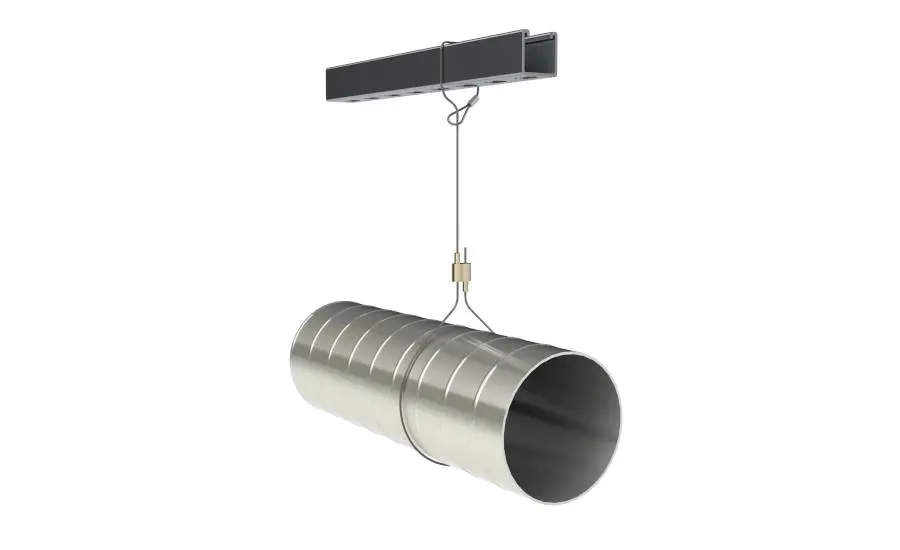
INDUSTRY REPORT — In the fast-paced world of commercial construction and mechanical contracting, labor efficiency and material optimization dictate the difference between a profitable project and a budget overrun. For decades, the standard method for suspending overhead mechanical assets—specifically spiral ductwork—has relied heavily on traditional threaded-rod systems. While proven, threaded rod installations are notoriously labor-intensive, requiring precise measurements, field-cutting, extensive hardware assemblies, and constant manual leveling.
Enter Griplock® Systems, a prominent innovator in cable suspension technology. The company has engineered a game-changing solution tailored specifically for the heating, ventilation, and air conditioning (HVAC) sector: the SMACNA TRI-verified Looping Gripper. Designed to streamline the installation of spiral ductwork, this engineered cable suspension solution offers contractors a faster, safer, and remarkably versatile alternative to conventional hanging methods. By combining rapid-adjustment capabilities with rigorous engineering standards, Griplock Systems is helping mechanical contractors slash installation times, mitigate labor shortages, and optimize job-site efficiency.
Main Facts: The Anatomy of Modern Duct Suspension
At its core, the Griplock HVAC Cable Suspension System is built around the innovative Looping Gripper, a specialized mechanical fastener designed to create a secure, high-strength loop around spiral ductwork. Rather than threading nuts, washers, and stabilization brackets onto rigid steel rods, installers utilize flexible, high-tensile wire rope paired with the self-locking gripper device.
Key Product Specifications and Features:
- The Three-Ball Locking Mechanism: At the heart of the Looping Gripper is Griplock’s proprietary three-ball locking mechanism. As tension is applied to the cable, three precision-engineered stainless-steel balls wedge the wire rope tightly against a tapered internal wedge. The greater the load, the tighter the grip, ensuring exceptional holding power.
- Durable Construction: Fabricated from premium nickel-plated brass, the gripper components offer robust corrosion resistance and long-term mechanical reliability, even in demanding ceiling plenums and semi-exposed industrial environments.
- Tool-Free Adjustability: Unlike threaded rods that require wrenches and manual unfastening to alter heights, the Griplock system features an accessible release plunger. Installers simply depress the locking mechanism to instantly release the wedge grip, allowing the cable to slide freely for height adjustments. Releasing the plunger instantly locks the cable back into place.
- SMACNA TRI Verification: The system carries verification from the Sheet Metal and Air Conditioning Contractors’ National Association (SMACNA) Testing and Research Institute (TRI). This independent validation confirms that the suspension hardware meets rigorous industry performance, safety, and load-bearing standards.
- Load Customization: Available in multiple configurations designed to accommodate various cable diameters and safe working loads (SWLs), the system can be precisely matched to the specific weight and dimensions of any spiral duct run.
Chronology: The Evolution of Ductwork Suspension
To understand the significance of Griplock’s innovation, it is helpful to examine the historical timeline of how mechanical contractors have supported overhead infrastructure over the past century.
Era 1: The Rigid-Rod Standard (Early to Mid-20th Century)
For generations, threaded steel rods—commonly paired with split-ring hangers, trapeze angles, or clevis hangers—served as the undisputed default for suspended HVAC systems. While structurally rigid, this method required meticulous pre-planning. Installers had to cut rods to exact lengths on-site using portable bandsaws or thread-cutters, attach them to structural anchors overhead, and manually thread leveling nuts into place for every single hanger point.
Era 2: The Push for Prefabrication and Modular Construction (Late 20th Century)
As labor costs escalated and construction schedules compressed, mechanical contractors began seeking ways to pre-assemble components off-site. Modular trapeze units and pre-cut hanger assemblies became common. However, the inherent rigidity of threaded rod remained a bottleneck. If a duct run interfered with an unforeseen structural beam or electrical tray, adjustments required unbolting assemblies, re-cutting rods, and leveling the entire run from scratch.
Era 3: The Rise of Wire Rope Suspension (Early 2000s)
The introduction of high-tensile wire rope and mechanical cable grips into the construction market marked a major paradigm shift. Initially adopted in the architectural lighting and signage industries, wire rope systems quickly caught the attention of mechanical engineers. Contractors realized that flexible cable could be draped over structural purlins or wrapped around bar joists in a fraction of the time it took to install rigid anchors.
Era 4: SMACNA Verification and Modern Engineering (Present Day)
The modern era of HVAC suspension is defined by rigorous standardization and regulatory compliance. Recognizing the need for engineered alternatives to traditional methods, industry bodies like SMACNA established stringent testing protocols. Griplock Systems’ development and subsequent SMACNA TRI verification of the Looping Gripper represent the culmination of this evolution—offering a fully compliant, high-efficiency engineered product that bridges the gap between rapid installation and absolute structural security.
Supporting Data: Efficiency, Labor Savings, and Material Logistics
In modern construction, time truly is money. Labor shortages across the trades have forced mechanical contractors to do more with fewer personnel, making productivity-enhancing tools essential. Field studies and contractor feedback regarding cable suspension systems like Griplock highlight stark operational contrasts when compared to legacy methods.
1. Installation Speed and Labor Reduction
According to mechanical contracting field metrics, switching from traditional threaded-rod systems to a cable-based gripping solution can reduce hanger installation time by up to 50% to 70%.
- Fewer Operations: A threaded rod installation requires measuring, cutting, threading, hoisting, and securing multiple hardware components. A looping cable system requires simply passing the cable around the duct, feeding it through the gripper, and tensioning.
- One-Man Operations: Traditional rigid-rod installations often demand a two-person crew—one to hold the ductwork in place and one to fasten and level the hardware. The intuitive tool-free adjustment of the Griplock system allows a single technician to position, level, and fine-tune spiral duct runs safely and efficiently.
2. Logistics and Job-Site Freight Optimization
The physical weight and geometry of construction materials significantly impact job-site logistics.
- Weight Reduction: A standard bundle of threaded steel rods is heavy, awkward to transport, and difficult to maneuver up stairwells or inside service elevators. In contrast, spools of high-tensile wire rope and compact boxes of Griplock loop grippers take up a fraction of the storage footprint.
- Reduced Waste: Field-cutting threaded rods inevitably generates scrap metal and sharp burrs that require clean-up. Cable systems generate virtually zero material waste, as cables are easily trimmed to exact lengths on-site with specialized cable cutters without leaving dangerous sharp edges protruding below the ductwork.
3. Seismic and Dynamic Load Performance
Spiral ductwork systems are frequently subjected to thermal expansion, mechanical vibration from air handling units, and dynamic air pressure fluctuations. The three-ball locking mechanism in Griplock’s design inherently dampens vibration-induced loosening, maintaining uniform tension over the lifecycle of the mechanical system.
Official Responses and Industry Perspectives
The adoption of advanced cable suspension systems is driven by voices from across the mechanical construction ecosystem—from product developers and independent testing bodies to field contractors and project managers.
The Manufacturer’s Perspective
Product engineering teams at Griplock Systems emphasize that the design philosophy behind the Looping Gripper was centered entirely on solving real-world job-site frustrations.
"Contractors today are operating in an environment defined by tight profit margins, aggressive project timelines, and persistent labor constraints," notes a senior technical representative for Griplock Systems. "Our goal with the SMACNA TRI-verified Looping Gripper was not just to offer another hanging device, but to engineer a comprehensive suspension ecosystem. By eliminating the need for rigid rods, specialized hand tools, and endless multi-part assemblies, we give mechanical contractors the ability to redirect valuable labor hours toward core ductwork assembly and system commissioning."
The Engineering and Compliance Standpoint
Independent validation remains vital for any product introduced into commercial HVAC infrastructure. Structural engineers point out that obtaining SMACNA TRI verification provides building owners, general contractors, and municipal inspectors with absolute peace of mind.
"When you introduce an alternative material into structural mechanical support, safety and compliance are non-negotiable," explains a commercial mechanical engineering consultant. "Having formal SMACNA verification means the Griplock system has undergone rigorous laboratory testing under extreme load conditions. It bridges the gap between innovative labor-saving design and strict structural engineering compliance."
Field Contractor Feedback
Out in the field, mechanical foremen and lead installers have been among the most vocal advocates for cable suspension technology.
"Once your crew gets used to the workflow of a looping gripper, going back to threaded rod feels like stepping back in time," shares a veteran HVAC project superintendent managing a multi-story healthcare facility build-out. "We recently utilized cable suspension on a massive commercial spiral duct run. Not only did it cut our hanging time in half, but being able to walk down the line and make micro-adjustments to the duct level simply by depressing a plunger saved us countless hours of rework. It’s a cleaner, faster, and much smarter way to work."
Implications: The Future of Mechanical Contracting
The broader adoption of SMACNA-verified cable suspension solutions like Griplock Systems’ Looping Gripper signals a fundamental shift in how mechanical contractors approach overhead installations. As the construction industry continues to embrace lean building principles, modular prefabrication, and advanced safety protocols, traditional installation methods are facing inevitable obsolescence.
1. Elevating Job-Site Safety
Safety is paramount on every modern commercial construction site. Traditional overhead installations involving overhead grinding, metal cutting, and heavy steel rod handling present inherent ergonomic and safety risks. Lightweight cable systems reduce overhead strain, minimize heavy tool usage, and significantly decrease the risk of repetitive motion injuries and material-handling accidents.
2. Streamlining Project Management and Scheduling
In an era where supply chain fluctuations and labor shortages routinely threaten project schedules, gaining efficiencies at the installation phase provides a crucial buffer. By cutting the time required for duct hanging by more than half, mechanical contractors can absorb minor delays elsewhere in the project lifecycle and deliver finished, operational HVAC systems to building owners ahead of schedule.
3. Setting a New Standard for Sustainability
Beyond labor savings, modern mechanical systems are increasingly evaluated through an environmental lens. Compact packaging, reduced shipping weight, minimal material waste, and the recyclability of brass and steel hardware align seamlessly with green building certifications such as LEED (Leadership in Energy and Environmental Design).
Conclusion
Griplock Systems has successfully addressed one of the most persistent bottlenecks in commercial mechanical construction. By fusing advanced engineering—exemplified by their proprietary three-ball locking mechanism and nickel-plated brass construction—with practical, user-centric design, the SMACNA TRI-verified Looping Gripper stands out as an indispensable asset for modern HVAC contractors.
As mechanical systems grow more complex and project timelines tighten, solutions that combine unyielding structural integrity with radical installation efficiency will define the market leaders of tomorrow. For HVAC contractors looking to protect their profit margins, optimize job-site labor, and maintain the highest standards of safety and compliance, transitioning to engineered cable suspension systems is no longer just an alternative—it is the clear path forward.
