

Main Facts
Three years after its high-profile inauguration, the Danfoss Smart Store in Nordborg, Denmark, has established a new global benchmark for energy efficiency and sustainability in commercial retail. Operating at the intersection of private enterprise and advanced engineering, the facility showcases what is possible when proven technologies—ranging from carbon dioxide ($textCO_2$) refrigeration and heat recovery systems to electronic controls, sensors, cloud-based monitoring, and localized renewable energy—are fully integrated under demanding real-world operational conditions.
According to the latest performance metrics released by Danfoss, the Smart Store achieves a remarkable 60% lower net energy use compared to traditional modern supermarket benchmarks.
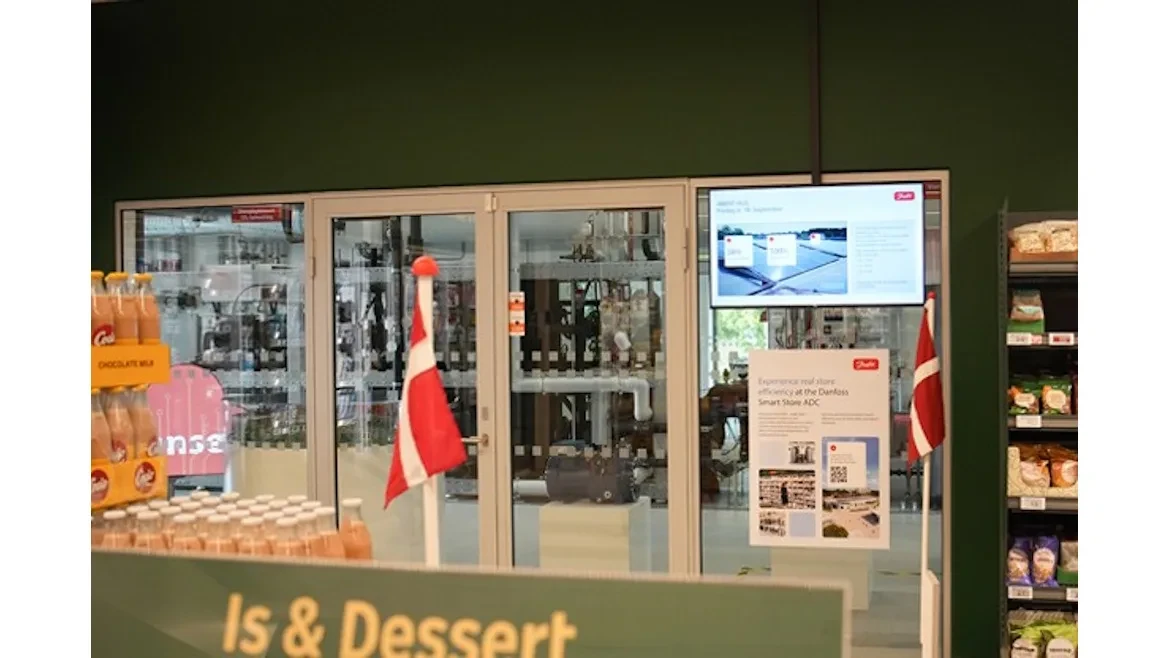
The site operates as a dual-purpose innovation hub. It houses a fully functional, high-traffic Coop 365 supermarket managed by BALS—Denmark’s largest independent retail cooperative operating 12 stores across the Sønderborg Municipality—directly alongside the Danfoss Application Development Center (ADC). This living laboratory allows Danfoss engineers, industry partners, and global retailers to test, integrate, and optimize cutting-edge thermal and energy management technologies in a live commercial environment.
The facility’s architecture proves that reducing a supermarket’s carbon footprint does not require speculative, unproven inventions. Instead, it demonstrates that maximum efficiency is achieved through the systemic integration of existing commercial HVACR (Heating, Ventilation, Air Conditioning, and Refrigeration) technologies, intelligent orchestration, and data-driven cloud platforms.
Chronology: The Evolution of the Smart Store
To understand how the Danfoss Smart Store achieved its current status as a global retail blueprint, it is helpful to trace its operational timeline and developmental milestones over the past decade.
Pre-2023: Conceptualization and Design
Long before breaking ground, Danfoss and its local stakeholders recognized a systemic inefficiency in grocery retail: refrigeration and heating systems traditionally operate in silos. Supermarkets reject massive amounts of waste heat from their refrigeration racks into the atmosphere, while simultaneously burning fossil fuels or drawing heavily on the electrical grid for space and water heating. The conceptual framework for the Smart Store was built around holistic energy loops—capturing, routing, and utilizing every kilowatt-hour of thermal energy generated within the facility.
2023: Grand Opening and Inception
The Danfoss Smart Store officially opened its doors in Nordborg, Denmark. From day one, the facility was designed to function simultaneously as a neighborhood grocery store and an advanced testing ground (ADC). The integration of an operational Coop 365 supermarket meant that engineers could study how foot traffic, opening and closing of display cases, outdoor weather fluctuations, and inventory loads directly impacted thermal and electrical loads.
2023–2025: Operational Optimization and Knowledge Sharing
During its first three years of continuous operation, the facility hosted more than 4,500 industry stakeholders, including international retail executives, HVACR contractors, policymakers, and engineering students. These visitors used the ADC to observe real-time data analytics powered by cloud-based monitoring tools. Over this 36-month window, engineers fine-tuned the algorithms governing the electronic expansion valves, variable-speed compressor drives, and heat-exchanger loops, squeezing incremental efficiency gains out of an already streamlined system.
2025–Present: Validated Milestones and Global Expansion
By late 2025, cumulative operational data provided conclusive, long-term proof of concept. With a full year of solar generation data, district heating export records, and verified lifecycle emissions studies finalized, the Smart Store transitioned from an innovative pilot project to an indisputable commercial blueprint for green retail infrastructure.
Supporting Data and Technical Performance
The success of the Danfoss Smart Store is anchored in rigorous, verifiable data rather than theoretical projections. The site’s technical ecosystem relies on several interconnected pillars:
1. $textCO_2$ Refrigeration and Advanced Heat Recovery
At the heart of the store’s thermal architecture is a transcritical $textCO_2$ refrigeration system. Unlike traditional hydrofluorocarbon (HFC) systems—which possess high global warming potentials (GWP)—$textCO_2$ (R-744) is a natural, environmentally benign refrigerant with a GWP of one and an ozone depletion potential of zero.
More importantly, the refrigeration system acts as the primary thermal engine for the entire building. Instead of venting condenser heat outside, the system captures it and routes it through specialized heat exchangers.
- Internal Space Heating: Since opening, the store has utilized 130,000 kWh of recovered heat to maintain comfortable indoor temperatures and supply domestic hot water.
- District Heating Integration: Excess thermal energy that the store cannot consume locally is exported to the municipal district heating network, supplying an additional 50,000 kWh to neighboring homes and businesses.
- Economic Viability: The entire heat-recovery infrastructure boasts an exceptionally fast average financial payback time of just three years, proving that sustainability and profitability are not mutually exclusive in commercial real estate.
2. On-Site Solar Generation and Smart Grid Interaction
The facility features an extensive rooftop photovoltaic (solar) array designed to offset electrical consumption.
- In 2025 alone, the solar panels generated 100,000 kWh of electricity, effectively covering 38% of the store’s total electricity demand.
- True to its "Smart Store" moniker, the facility does not simply consume or store this energy; it interacts dynamically with the local power grid. Of the solar power generated, 25,000 kWh of surplus electricity was fed back into the local grid, helping stabilize regional energy supplies during peak demand periods.
3. Lifecycle Emissions Analysis
An independent, verified case study conducted by Danfoss utilized projected Danish grid emission factors to model the environmental impact of the store over a standard 15-year system lifecycle. The results starkly contrast modern energy management with legacy retail standards:
- The Smart Store achieves 39% lower emissions than a modern, standard $textCO_2$-based reference supermarket.
- Compared to a legacy supermarket running on traditional HFC refrigerants, the Smart Store achieves a staggering 68% reduction in lifetime greenhouse gas emissions.
Official Responses and Industry Perspectives
The collaborative nature of the project has drawn praise from executive leadership across the corporate and cooperative retail sectors, emphasizing that practical, scalable sustainability must anchor future commercial strategies.
Lars G. Andersen, CEO of BALS, underscored the practical philosophy driving the partnership:
"For us, energy efficiency is very practical. If we can reduce energy consumption, we reduce costs and emissions at the same time. We have worked that way for years, and the Smart Store gives us a real supermarket where we can test new solutions, measure their impact, and see how the learnings can be applied in our other stores."
Andersen’s comments highlight the commercial reality facing independent retailers worldwide: energy costs represent one of the single largest operating expenditures for grocery stores. By partnering with Danfoss, BALS has de-risked the deployment of advanced decarbonization technologies, translating complex engineering concepts into bottom-line operational savings.
Kristian Strand, President of Danfoss Climate Solutions, emphasized the broader systemic implications of the Nordborg facility for the global HVACR industry:
"The Smart Store demonstrates that the technologies needed to significantly reduce supermarket energy use and emissions already exist. By bringing refrigeration, heating, controls, and energy management together in one system, retailers can improve efficiency, lower operating costs, and strengthen competitiveness."
Strand also pointed toward future opportunities for large-scale commercial deployments:
"The potential is even greater in larger stores and more carbon-intensive energy systems, where closer grid integration can further improve how energy is used."
Implications for the Future of Retail and HVACR
The three-year performance record of the Danfoss Smart Store carries profound implications for the global supermarket industry, commercial real estate developers, and HVACR engineering professionals.
1. The Death of the "Siloed" Building System
Historically, commercial buildings have been engineered in functional silos. Refrigeration contractors designed the cooling racks, HVAC engineers handled space heating and ventilation, and facility managers monitored electrical loads independently. The Smart Store proves that this fragmented approach is obsolete. Future-proof supermarkets require holistic energy management systems where thermal and electrical networks communicate in real-time via cloud platforms. Waste heat from refrigeration must be treated as a valuable commodity rather than a nuisance byproduct.
2. Regulatory Compliance and ESG Pressures
As global governments tighten environmental regulations—such as the phasedown of HFCs under the Kigali Amendment to the Montreal Protocol and increasingly stringent municipal building energy performance standards—retailers face mounting pressure to decarbonize their portfolios. The Smart Store provides a de-risked, turnkey model for meeting and exceeding environmental, social, and governance (ESG) targets without sacrificing operational reliability or food safety.
3. Scaling Up: From Neighborhood Cooperatives to Hypermarkets
While the Nordborg site is modeled around a standard neighborhood supermarket footprint (Coop 365), the engineering principles scaled within its walls hold exponential potential for larger commercial formats. Hypermarkets, distribution centers, and massive fulfillment hubs generate exponentially higher thermal loads. Applying the integrated heat recovery and intelligent control strategies validated at the Smart Store to these larger facilities could yield unprecedented carbon reductions on a global scale.
4. Education and Workforce Development
Beyond its engineering and commercial functions, the Smart Store’s role as an Application Development Center (ADC) addresses a critical industry bottleneck: workforce training. As complex natural refrigerant systems ($textCO_2$, propane, ammonia) and advanced digital controls replace legacy HFC technologies, technicians, contractors, and engineers require hands-on training environments. By welcoming thousands of students, policymakers, and technicians over the past three years, the Smart Store has actively contributed to bridging the technical skills gap necessary to sustain the green transition in building services.
Ultimately, the Danfoss Smart Store stands as more than just a successful grocery store in Southern Denmark. It is a living proof-of-concept that the technologies required to achieve near-zero-emission commercial retail are fully realized, commercially viable, and ready for global deployment today.
